Cheating surged once exams moved online. Consequently, institutions now rely on remote proctoring software to preserve credibility. The technology combines webcam feeds, screen capture, AI analytics, and trained reviewers. Moreover, vendors promise rapid threat response as new cheating tools appear.
This article explores recent evidence, privacy trade-offs, and procurement guidance for universities, certification bodies, and enterprise L&D leaders.
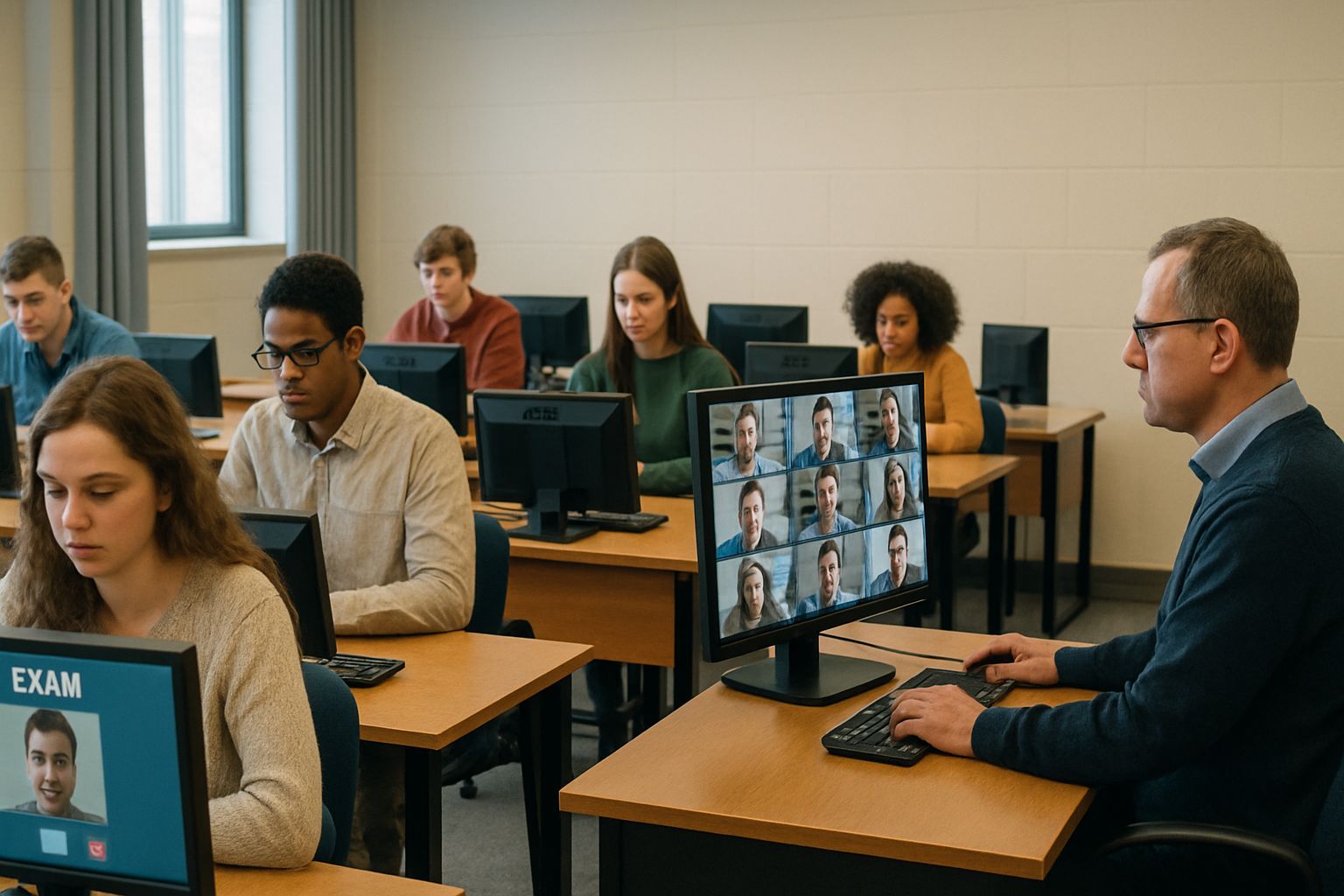
Cheating Threats Rapidly Escalate
Organized cheating markets advertise real-time answer services. Furthermore, LSAC will halt the remote LSAT in mainland China after October 2025 because rings compromised earlier sittings. A systematic review found pandemic-era self-reported cheating reached 54.7%, compared with 29.9% pre-COVID.
Meanwhile, AI chatbots offer on-demand essay generation. Screen-sharing apps let outsiders sit hidden behind monitors. Therefore, attackers now outpace classic controls like timed multiple-choice banks.
Key Takeaway: Online threats multiply quickly; static controls fail. Transitioning, stronger surveillance becomes essential.
Remote Proctoring Software Impact
Randomized experiments show webcam monitoring lowers average scores, suggesting deterrence. Vendors blend facial matching, gaze tracking, and browser lockdowns, creating layers. Additionally, multi-modal analytics flag suspicious audio spikes and extra device usage.
Major providers—Proctorio, Honorlock, Examity—report double-digit client growth. Market studies place global revenue between $650 million and $1.2 billion in 2025, with teens-level CAGR projected. Consequently, investment fuels faster innovation cycles.
Key Takeaway: Evidence confirms meaningful cheating reduction, yet efficacy varies. Transitioning, decision-makers must evaluate context.
Evidence Backing Cheating Deterrence
Researchers compared 800 students across webcam-monitored and unmonitored groups. Scores dropped significantly when oversight existed, implying many unmonitored students cheated. Moreover, comparative studies report 20-40% fewer plagiarism incidents under AI review.
However, systematic reviews still label the dataset limited. Many papers use self-report surveys or narrow course samples, making broad generalization risky.
- 44.7% overall online cheating prevalence (Newton & Essex, 2023).
- Statistically significant score drops under live surveillance (Alguacil et al., 2023).
- 40-55% student discomfort with invasive webcams.
Key Takeaway: Quantitative studies favor proctoring, though more rigorous trials remain necessary. Transitioning, institutions should combine data with internal pilots.
Balancing Key Privacy Concerns
Cleveland State’s 2022 ruling deemed mandatory room scans unconstitutional. Similarly, European regulators investigated algorithmic bias after darker-skinned candidates failed identity checks. Consequently, privacy groups urge data minimization and optionality.
Institutions can lower risk through shorter retention periods, encrypted storage, and clear student consent flows. Furthermore, transparent appeal pathways alleviate stress when AI flags innocent behavior.
Key Takeaway: Privacy protections build trust and reduce litigation. Transitioning, include legal counsel early.
Choosing Optimal Proctoring Models
Decision-makers can combine several tactics:
- Live online proctoring: Human observers intervene instantly; best for critical licensing exams.
- Recorded review: Sessions store video, later sampled by auditors; suitable when budgets limit live staffing.
- Automated AI: Scalable and low-cost for large cohorts; human escalation handles edge cases.
- Assessment redesign: Open-book formats plus secure online exam software reduce reliance on surveillance.
Blended approaches often yield superior equity and cost profiles. Moreover, integrating lockdown browsers with randomized questions further deters collaboration.
Key Takeaway: No single model fits every exam. Transitioning, align risk, stakes, and learner needs.
Procurement Best Practice Steps
Stakeholders must probe vendor claims. Firstly, request independent false-positive metrics and demographic breakdowns. Secondly, demand plain-language privacy policies describing biometric template handling. Additionally, schedule user-experience tests under low-bandwidth conditions.
Checklist for evaluation of Exam Proctoring Software, Online exam proctoring software, and Secure remote assessments:
- Transparency reports detailing algorithm accuracy.
- Compliance with regional data-protection laws.
- Integration ease with LMS and HR systems.
- 24/7 multilingual support for live online proctoring.
Key Takeaway: Thorough due diligence prevents costly surprises. Transitioning, codify requirements before RFP release.
Future Proctoring Trends Forecast
Vendors now train models to detect ChatGPT access, phone vibrations, and abnormal keystroke pauses. Moreover, blockchain certificates may soon embed identity-verified results, reducing forgery. Research also explores privacy-preserving gaze estimators that avoid full video streams.
Meanwhile, some educators pivot toward authentic project-based tasks that minimize cheating incentives. Nonetheless, online proctoring for certification exams will stay crucial where psychometric comparability matters.
Key Takeaway: Expect an arms race between cheaters and defenders. Transitioning, budget for continual upgrades.
Conclusion
Online testing remains vital for scale, flexibility, and access. Evidence shows remote proctoring software meaningfully deters dishonest conduct when implemented thoughtfully. Yet privacy, equity, and accuracy require vigilant management.
Why Proctor365? The platform pairs AI-powered proctoring, advanced identity verification, and scalable monitoring into one secure solution. Trusted by global exam bodies, Proctor365 delivers secure online exam software that supports secure remote assessments across all formats. Experience seamless live online proctoring and robust analytics today. Visit Proctor365 to elevate exam integrity with industry-leading remote proctoring software.
Frequently Asked Questions
- How does remote proctoring software deter online cheating?
Remote proctoring uses AI analysis, facial recognition, browser lockdowns, and human observation to deter cheating. It detects suspicious activity and verifies identity, ensuring exam integrity with features aligned to Proctor365’s advanced fraud prevention and identity verification capabilities. - What measures does Proctor365 offer to balance privacy and security?
Proctor365 ensures secure online assessments by combining AI-powered proctoring with encrypted data practices and clear consent processes. It balances privacy and accuracy while implementing effective fraud prevention and identity verification strategies. - Why is AI-powered proctoring essential for modern exams?
AI-powered proctoring quickly identifies unusual behaviors using advanced analytics and facial matching, ensuring real-time fraud prevention. This technology, as employed by Proctor365, supports efficient identity verification and secure online testing environments. - What procurement best practices should institutions consider?
Institutions must request transparency reports, validate false-positive metrics, and ensure compliance with data-protection laws. Evaluating vendors with comprehensive user experience tests safeguards exam integrity, matching Proctor365’s standards in advanced proctoring solutions.