Generative AI has turbocharged academic dishonesty. Consequently, institutions scramble to update defenses. Remote proctoring software now sits at the center of this battle. Colleges once relied on basic exam proctoring software, yet fraud tactics evolved. Moreover, advanced exam monitoring software alone cannot outpace contract cheaters.
However, the cheating crisis extends beyond simple answer sharing. Reuters exposed organized LSAT fraud networks crossing borders. Meanwhile, the 2025 HEPI survey showed 88% of students using generative AI for coursework. Therefore, leaders need layered, evidence-based countermeasures. AI alerts during exams must integrate with authentic assessment, clear policy, and human judgment.
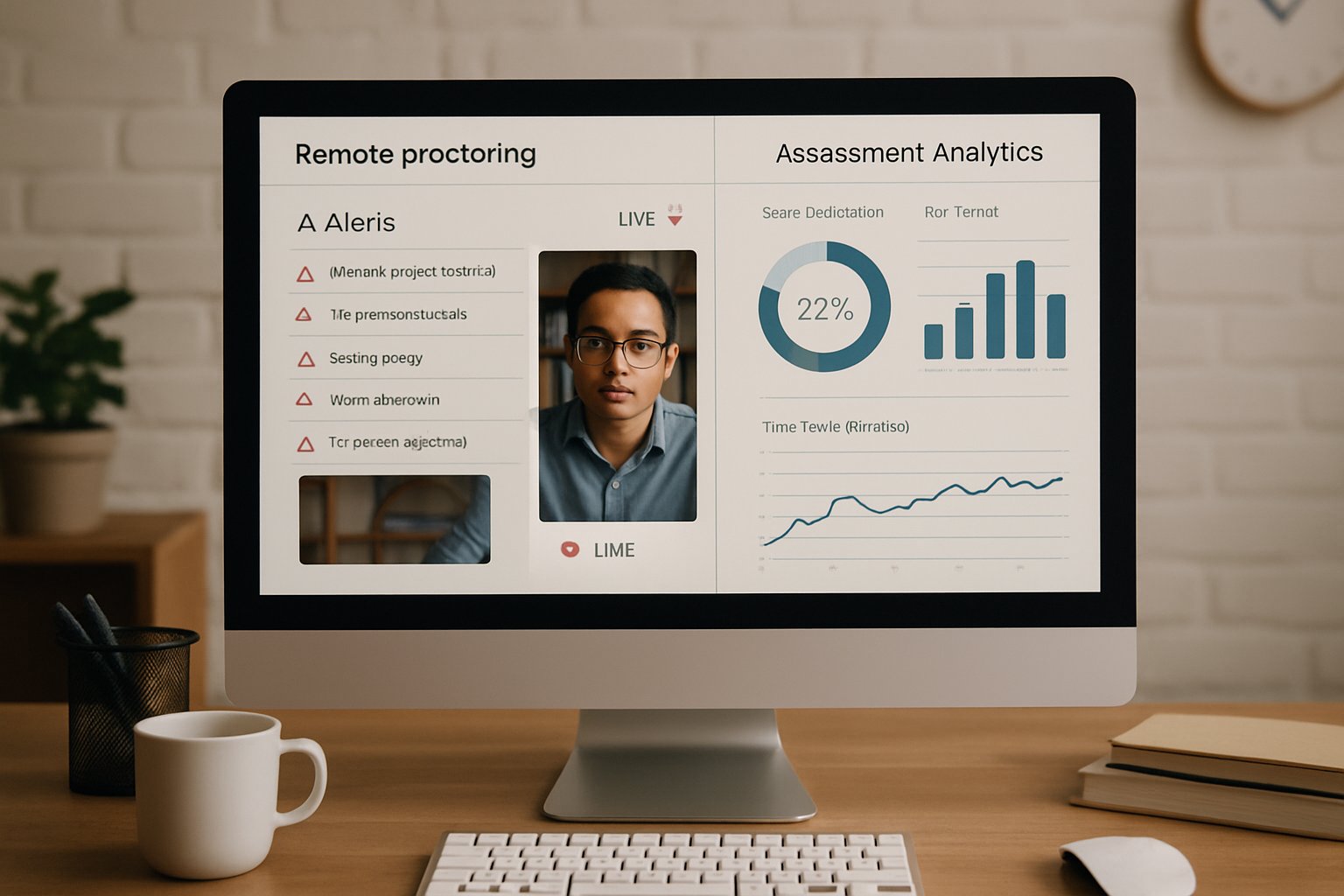
Consequently, this guide maps proven strategies against the modern cheating arsenal. Each section pairs data with actionable steps for universities, ed-tech platforms, certification providers, training institutes, and corporate L&D teams.
Ultimately, restoring trust demands both cultural change and smart technology. This article delivers the blueprint.
Cheating Landscape Today
First, understand how cheating evolved. Contract-cheating marketplaces advertise same-day answers. Additionally, browser-spoofing plug-ins claim to neutralize remote proctoring software. Generative AI now drafts essays instantly. Consequently, the integrity gap widens.
Some key facts illustrate the scale:
- HEPI 2025: 92% students use AI; 18% submit AI text.
- Turnitin 2024: 11% papers contain ≥20% AI writing.
- Market size: $2.1B online proctoring projected for 2025.
- Ogletree ruling called room scans unconstitutional.
These statistics confirm a fast-moving arms race. Therefore, institutions must respond with agility. Next, we examine assessment design fixes.
Assessment Design Fixes
Assessment redesign delivers the highest impact with minimal surveillance. Instead of secret questions, educators can assign applied projects requiring personal reflection. Moreover, staged submissions make outsourcing difficult. Students present interim drafts, receive feedback, then refine.
Authentic tasks also reduce dependence on exam proctoring software. Oral defenses, recorded demos, and group projects let instructors verify individual effort. Consequently, contract-cheating loses value. Meanwhile, webcam exam proctoring remains optional for low-stakes quizzes.
However, assessment shifts require policy support. Institutions should publish clear AI usage rules. Furthermore, AI alerts during exams become secondary checks rather than sole evidence.
Thoughtful design discourages cheating before it starts. Meanwhile, technology still plays a vital role. Now, we unpack those controls.
Technical Controls Explained
Technical solutions act as layered deterrents. Automated online proctoring scans video, audio, and screen feeds for anomalies. Additionally, exam monitoring software can lock browsers and track keystrokes. When algorithms flag issues, human reviewers decide.
However, no tool functions perfectly. Gaze tracking may misread cultural differences. Similarly, webcam exam proctoring struggles with low light or shared living spaces. Therefore, institutions should adopt hybrid exam proctoring, blending AI speed with human judgment.
Remote proctoring software integrates these modules into one platform. Moreover, AI alerts during exams surface only the riskiest sessions for review. Consequently, staff time drops while integrity rises.
Smart control combos deter casual cheating yet respect student privacy. Next, we discuss supporting governance.
Policy And Governance
Policies translate technology into fair practice. Institutions must define acceptable AI usage, privacy expectations, and sanction paths. Furthermore, exam monitoring software governance should mandate human review before any accusation.
Ogletree v. Cleveland State shows legal pitfalls. Mandatory room scans violated the Fourth Amendment. Consequently, remote proctoring software policies should minimize biometric data and offer alternatives. State laws also regulate automated online proctoring biometric data.
Moreover, hybrid exam proctoring workflows must let students contest flags transparently. Clear appeal windows build trust. Meanwhile, staff training reduces false positives.
Robust governance protects students and institutions alike. Implementation details follow in the roadmap section.
Implementation Quick Roadmap
Leaders often ask where to start. The following phased checklist guides deployment.
- First month: inventory assessments, publish AI policy, audit exam proctoring software licenses.
- Three months: stress-test tasks, pilot automated online proctoring with clear opt-outs.
- Six months: train staff, refine AI alerts during exams thresholds, document appeals.
- Twelve months: scale hybrid exam proctoring, integrate webcam exam proctoring analytics, review vendor contracts.
These steps balance speed, cost, and compliance. Consequently, remote proctoring software adoption becomes manageable. Finally, choose the right platform.
Remote Proctoring Software
Selecting a vendor requires more than feature checklists. Pricing, privacy posture, and support quality matter. Legacy exam proctoring software often lacks open APIs for data exchange.
During demos, insist on seeing how remote proctoring software handles low bandwidth, diverse accents, and accessibility needs.
Additionally, compare automated online proctoring accuracy claims with independent studies. Ask for false-positive rates across demographics. Meanwhile, verify webcam exam proctoring data retention meets regional privacy laws.
A disciplined evaluation prevents future headaches. Consequently, your final choice reinforces academic integrity.
Conclusion
In summary, modern exam integrity demands layered defense. Authentic tasks cut outsourcing incentives, while AI alerts during exams spotlight anomalies. Secure browsers, exam monitoring software, and hybrid exam proctoring create scalable safeguards. However, governance and fair policies remain essential.
Why Proctor365? Our remote proctoring software delivers AI-powered monitoring, advanced identity verification, and real-time AI alerts during exams. Moreover, global exam bodies trust the platform to secure high-stakes tests. Improve integrity today by visiting Proctor365.
Frequently Asked Questions
- What is remote proctoring software and how does it work?
Remote proctoring software monitors exams using AI-powered analytics and secure browser features. It improves exam integrity by detecting suspicious activities and ensuring identity verification with a blend of automated checks and human oversight. - How can AI proctoring reduce academic dishonesty?
AI proctoring detects anomalous behavior and cheating through real-time AI alerts during exams. This technology enhances fraud prevention with advanced identity verification, ensuring exam authenticity and improved security for remote assessments. - What are the benefits of hybrid exam proctoring?
Hybrid exam proctoring combines automated AI alerts with human judgment for enhanced exam monitoring. This approach leverages advanced identity verification and webcam exam proctoring, reducing false positives and improving overall exam integrity. - How does Proctor365 ensure exam integrity?
Proctor365 delivers AI-powered monitoring, real-time alerts, and robust identity verification. Our platform integrates automated screening with human oversight, ensuring secure, compliant, and fair exam environments through advanced fraud prevention technologies.