Pressure on firms to prove training integrity has never been higher. Consequently, many leaders now adopt remote test proctoring for mandated programs. They hope technology reduces cheating in corporate compliance testing without delaying launch schedules.
However, employees complain about cumbersome remote proctoring software and potential privacy intrusion. This article explores practical, balanced strategies that satisfy regulators, respect users, and keep budgets realistic. By the end, you will know how to deploy solutions that withstand audits and user scrutiny.
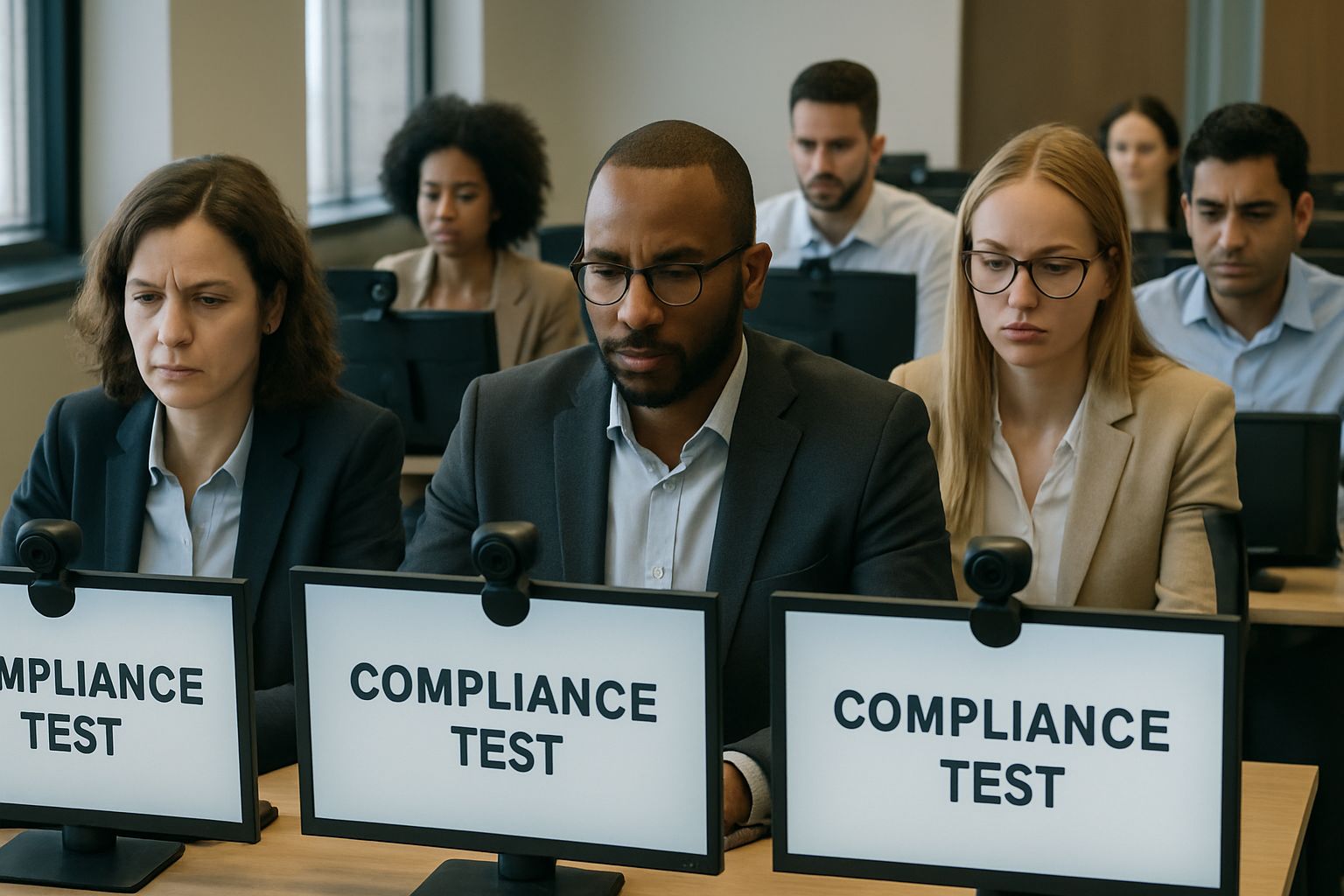
Compliance Risk Drivers Explained
First, regulators expect objective proof that every learner completed corporate compliance testing unaided. Moreover, hybrid workforces make in-person invigilation impossible at scale.
Remote online proctoring fills that gap, yet decision makers must weigh risk tiers. High-stakes exams demand secure remote proctoring with layered controls, while simple surveys may not.
Identity fraud, content leakage, and reputational fallout create tangible financial exposure. Therefore, remote test proctoring sits near the top of most audit checklists.
Rigorous risk analysis drives tool selection and policy depth. Next, we examine trend data that shapes those selections.
Remote Test Proctoring Trends
MarketResearchFuture values the segment above two billion dollars for 2024. Furthermore, double-digit growth remains likely through 2030 across industries.
Vendors now package remote exam proctoring software with edge processing that keeps raw video local. Simultaneously, online proctoring software offers blockchain logging for immutable audits. Live remote proctoring still attracts high-stakes clients who want immediate human judgment.
However, the California Bar lawsuit shows infrastructure failures can cripple remote test proctoring deployments overnight. Consequently, buyers scrutinize uptime statistics and incident histories before signing contracts.
Trend data highlights innovation yet exposes reliability gaps. Our next section tackles privacy and fairness questions that overshadow technology claims.
Privacy And Fairness Concerns
Privacy groups attack remote proctoring software for capturing room images, keystrokes, and biometrics. Moreover, researchers document algorithmic bias that misflags darker skin tones.
Secure remote proctoring must therefore minimize data and guarantee transparent appeal paths. Live remote proctoring also risks inconsistent human judgments, yet offers empathy for accommodations.
Employees disciplined after false positives may litigate under discrimination statutes. Additionally, corporate compliance testing violations can trigger costly regulatory penalties.
Hence, remote test proctoring programs need privacy-by-design and fairness audits before launch. Addressing bias early prevents reputational damage and workforce distrust. Next, we outline a concise implementation checklist.
Best Practice Implementation Checklist
Begin with a pilot covering diverse roles and device types. Subsequently, measure false-positive rates and learner sentiment.
- Classify assessments by risk and match secure remote proctoring level accordingly.
- Demand SOC 2, ISO 27001, and clear DPAs from remote exam proctoring software vendors.
- Enable edge processing within online proctoring software to reduce data transfer.
- Provide accessibility workflows and human review in live remote proctoring environments.
- Rotate item pools and proctor exam online with locked browsers for layered security.
Moreover, maintain recordings only for legally mandated retention periods. Therefore, remote test proctoring remains defensible during audits and disputes.
Following this checklist curbs risk without crushing budgets. We now review legal expectations across regions.
Legal Landscape Across Jurisdictions
In the United States, no single law targets remote online proctoring. However, CCPA, ADA, and biometric statutes still apply.
European GDPR treats facial identity matching as sensitive, requiring explicit purpose limitation. Consequently, firms must proctor exam online only with clear legal bases and documented consent.
Data transfers to non-EU servers invite regulatory scrutiny and possible fines. Therefore, remote test proctoring contracts must specify residency options and deletion timelines.
Aligning policies with law protects organizations and learners alike. Next, we explore evaluating technology partners.
Vendor Selection Due Diligence
Not all remote proctoring software offers equal uptime or transparency. Thus, request breach histories and SLA metrics during procurement.
Compare remote exam proctoring software based on false-positive rates and demographic audit results. Additionally, benchmark online proctoring software for latency, bandwidth use, and device compatibility.
High-stakes clients still favor live remote proctoring with human escalation buttons. Finally, ensure remote test proctoring vendors allow your team direct access to raw evidence files.
Robust due diligence prevents costly contract disputes later. Let us conclude with the industry outlook.
Future Outlook And Recommendations
AI models will improve anomaly detection while privacy engineering hardens edge workflows. Meanwhile, secure remote proctoring will integrate differential privacy to mask non-essential background pixels.
Expect better user analytics as vendors proctor exam online using federated learning patterns. However, regulators will demand proof that automated flags receive fair human review.
Therefore, remote test proctoring roadmaps must fund continuous fairness audits and disaster recovery drills. Leaders who plan now will deliver resilient, trusted assessment programs.
We wrap up with practical next steps.
Conclusion
Remote test proctoring secures corporate compliance testing when risk analysis, privacy design, and strict vendor checks align. Trend data shows rising remote online proctoring adoption, yet legal scrutiny and bias concerns persist.
Consequently, leaders must pair secure remote proctoring with layered item security and clear appeals. Proctor365 delivers AI-powered monitoring, advanced identity verification, and elastic cloud scale trusted by global exam bodies.
Moreover, our platform lets you proctor exam online with configurable privacy controls and real-time analytics. Explore how remote test proctoring through Proctor365 can strengthen your next assessment cycle today.
Visit Proctor365.ai and schedule a live remote proctoring demo now.
Frequently Asked Questions
- How does remote test proctoring enhance exam integrity?
Remote test proctoring deters cheating by using layered security measures. Proctor365 leverages AI-powered monitoring, identity verification, and real-time analytics to ensure secure, trusted exam environments. - What strategies minimize privacy intrusion during remote proctoring?
Proctor365 prioritizes privacy with edge processing and configurable data controls. Our solution minimizes data capture while ensuring compliance with regulations to maintain transparent, secure proctoring. - How does Proctor365 support exam compliance and fraud prevention?
Proctor365 enables exam compliance and fraud prevention through robust identity checks, blockchain logging, and AI-driven monitoring. These features work together to meet regulatory standards and reduce fraudulent activities. - What should organizations consider when selecting a remote proctoring solution?
Organizations should assess uptime, false-positive rates, privacy controls, and scalability. Proctor365 offers reliability, advanced security features, and transparent audit trails to support secure remote proctoring.