Cheating scandals hurt institutional credibility. Consequently, leaders now demand fair, secure digital assessments. A proctored online test meets that demand by blending AI surveillance with human oversight. However, many stakeholders still ask how virtual proctors watch remote candidates. This article demystifies the process and explores modern online exam proctoring approaches. Meanwhile, global universities, ed-tech platforms, certification bodies, and corporate L&D teams will learn how to safeguard assessment integrity at scale. We reference current research, privacy rulings, and market statistics to deliver an expert, balanced view. Moreover, you will grasp the exact signals a virtual proctor tracks and decide which model fits your program. Finally, see why Proctor365’s advanced identity verification and AI analytics set a higher standard for remote exams.
Proctored Online Test Basics
At its core, a proctored online test uses software plus human review to replicate a secure test center. Live proctoring, record-and-review, and fully automated AI modes each offer different oversight levels. Moreover, secure browsers, ID checks, and room scans build layered defenses.
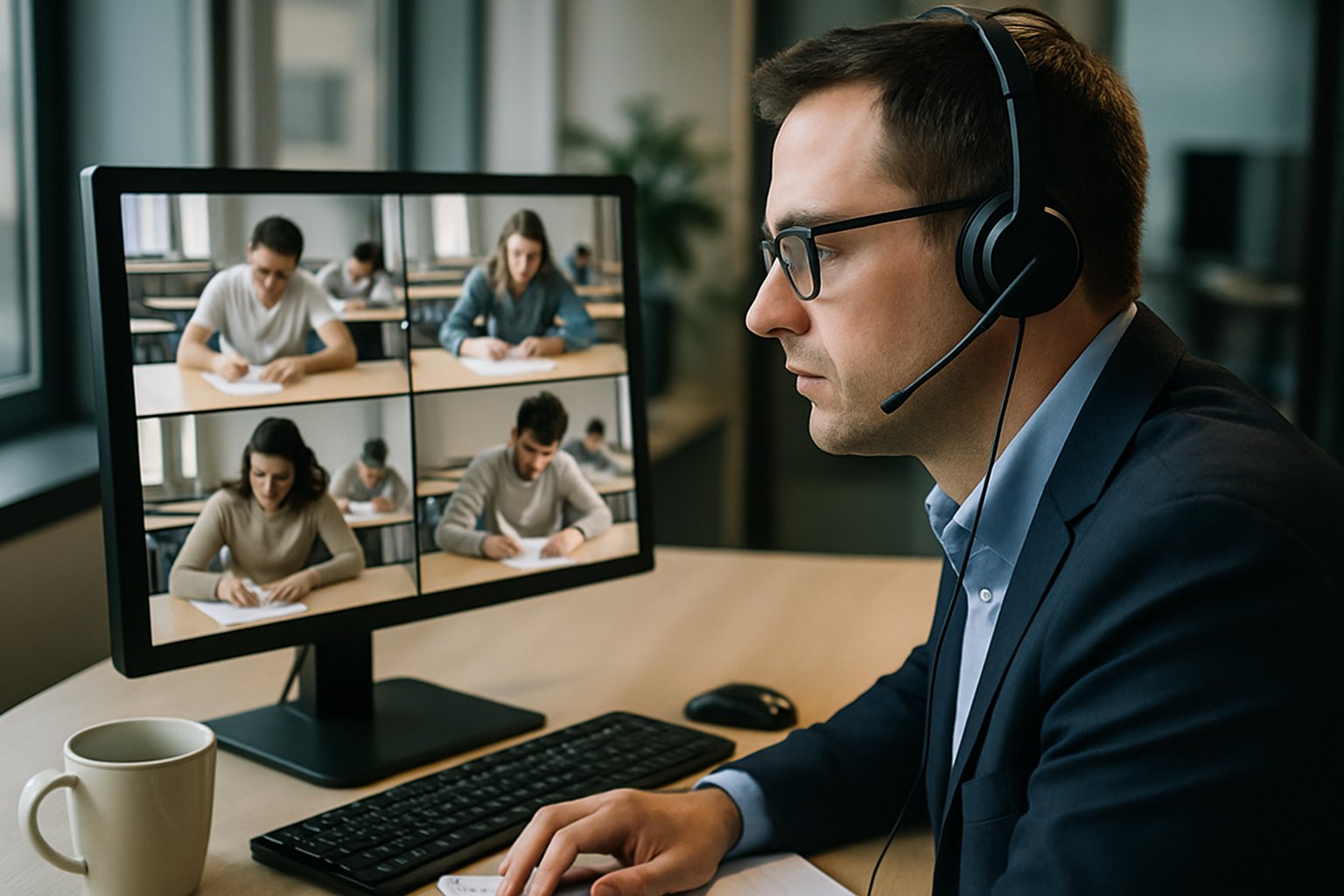
These elements create visibility comparable to in-person supervision.
Integrity rises when every layer works together.
Next, we detail the specific signals proctors monitor.
Monitoring Signals Explained Simply
Virtual proctors watch five core data streams: webcam video, microphone audio, screen share, browser events, and device telemetry. Furthermore, AI models look for gaze shifts, multiple faces, phone shapes, unusual voices, or tab switching. Screen recording also captures copy-paste events and virtualization attempts. As a result, online exam proctoring teams gain time-stamped evidence for any anomaly.
Automated flags highlight sections needing human review.
Reviewers then assess context before reporting misconduct.
With monitoring understood, benefits and drawbacks deserve equal attention.
Benefits And Core Drawbacks
Institutions mention three headline gains. Firstly, scale and convenience open testing to global candidates without travel.
Secondly, continuous video plus logs deter wrongdoing and support fair appeals. Moreover, many programs report cost savings versus physical test centers.
- Frontiers study: darkest-skin students flagged 7.64% time versus 1.56% for lighter peers.
- EFF review: 97% of students could not opt out of remote surveillance.
- Market forecasts: remote proctoring expected to top $2 B by 2029.
- A proctored online test cuts venue costs by eliminating travel and room hire.
Convenience and deterrence drive adoption for many programs.
Yet privacy, bias, and accessibility require careful mitigation.
The next section reviews those ongoing debates and developments.
Emerging Trends And Debates
Vendors now chase ISO/IEC 42001 certifications that govern responsible AI. Consequently, automated decision logs are becoming clearer for auditors.
Meanwhile, courts have limited compulsory room scans, citing constitutional privacy concerns. In contrast, some certification boards migrated fully to online exam proctoring to increase reach.
Researchers also expose algorithmic bias, urging transparent audits before deployment. Moreover, student groups lobby for true opt-out choices.
Legal and social pressure will shape future feature sets.
Institutions cannot ignore fairness and privacy expectations.
Therefore, implementation strategies need robust governance.
Implementation Best Practice Guide
Successful programs start with risk assessments and pilot runs. Additionally, teams demand vendor SOC, ISO, and accessibility evidence.
Provide clear consent notices, minimize data retention, and ensure human review of AI flags. Furthermore, offer in-person alternatives for those rejecting surveillance. Effective online exam proctoring also requires accessibility audits before launch.
Continuous training keeps staff prepared for false positives or technical failures. Consequently, trust grows among learners and regulators.
Documented workflows prove that every proctored online test follows the same fair process.
Governance, transparency, and choice reduce institutional risk.
Such foundations protect both students and reputation.
Next, let us examine partner selection.
Choosing The Right Partner
Alignment between platform features and exam stakes is critical. Moreover, request false positive rates, demographic bias reports, and uptime metrics.
Look for scalable, cloud-native architecture plus 24/7 support. In addition, ensure mobile compatibility for candidates without laptops.
A trustworthy vendor will treat every proctored online test recording as sensitive evidence, retaining it only as policy allows.
Robust due diligence prevents unpleasant surprises later.
Financial, technical, and ethical checks must align.
Finally, we conclude with key insights and solutions.
Conclusion And Next Steps
Virtual proctors now blend AI analytics, human insight, and secure browsers to safeguard every proctored online test. Consequently, institutions can scale assessment delivery while maintaining fairness, provided they tackle privacy, bias, and accessibility head-on. Clear policies, pilot studies, and transparent vendor metrics remain essential.
Why Proctor365? The platform delivers AI-powered monitoring, advanced identity verification, and global scalability for each proctored online test. Trusted by universities, certification bodies, and enterprises worldwide, Proctor365 raises integrity while easing logistics. Discover how its secure workflows protect your exams by visiting Proctor365.ai today.
Frequently Asked Questions
- What is online exam proctoring?
Online exam proctoring secures digital assessments by combining advanced AI analytics and human oversight. It uses secure browsers, identity verification, and continuous monitoring to deter cheating and maintain exam integrity. - How does AI-powered proctoring enhance exam security?
AI-powered proctoring employs sophisticated algorithms to monitor webcam feeds, audio, and screen activity. It detects suspicious behavior and potential fraud, bolstering exam security with real-time alerts and advanced identity verification. - What measures should institutions take to ensure assessment integrity?
Institutions should conduct risk assessments, pilot testing, and accessibility audits. Implement secure browsers, live proctoring, and human review alongside Proctor365’s AI proctoring, fraud prevention, and identity verification to maintain exam integrity. - How does Proctor365 set a higher standard for remote exams?
Proctor365 delivers advanced identity verification, AI analytics, and scalable remote proctoring. Its secure workflows prevent fraud and ensure exam fairness, making it the preferred choice for global institutions and certification bodies.