Busy teams need credentials without borders. Consequently, professional bodies are replacing legacy test centers with ai proctor exam models. Candidates launch webcams, verify identity, and earn certificates from any device. However, privacy advocates, regulators, and lawyers have sharpened their scrutiny.
This article unpacks market growth, technology, benefits, risks, and proven roll-out tactics. Furthermore, we highlight new legal expectations and investor pressure for algorithmic fairness. Readers will leave with a concise compliance checklist and forward-looking insights.
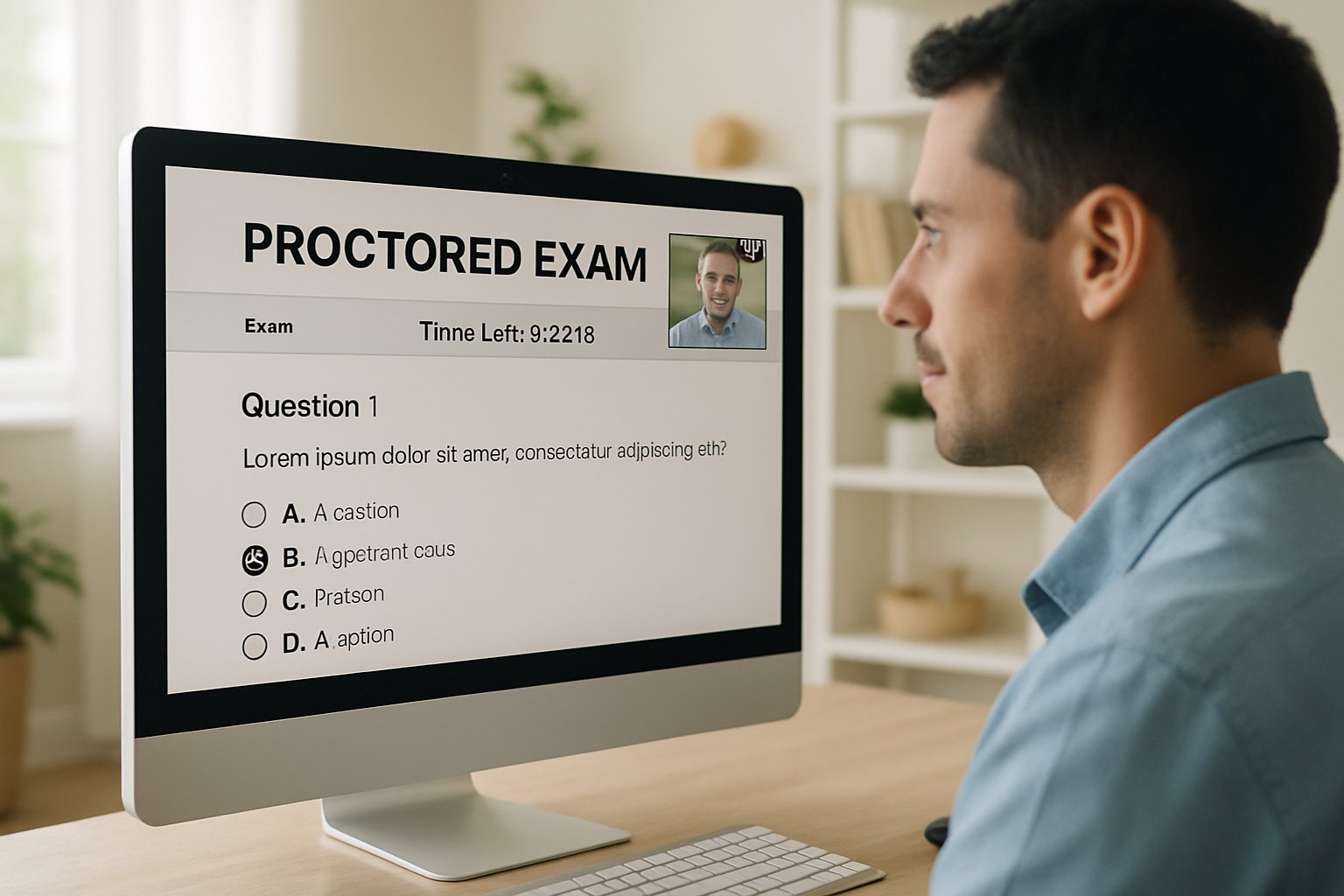
Global remote proctoring revenue sits between USD 1 and 9 billion, depending on analyst cuts. Moreover, CompTIA and other marquee certifiers now offer permanent online options through Pearson OnVUE. Yet student coalitions and the Electronic Privacy Information Center demand stronger audits and opt-outs.
Consequently, decision makers must weigh speed and scalability against legal, ethical, and user-experience pressure. This guide targets universities, ed-tech platforms, certifiers, and corporate L&D teams navigating that balance. Read on to benchmark your roadmap against industry evidence.
Market Momentum Snapshot Now
Market analysts place 2025 remote proctoring revenue anywhere from USD 1 to 9.6 billion. Disparities arise because some reports bundle assessment services with monitoring tools. Nevertheless, adoption indicators stay strong.
Surveys suggest up to 70% of major certification programs now trust remote delivery. Meanwhile, enterprise compliance teams schedule thousands of quarterly retakes through automated dashboards. Market watchers predict accelerated ai proctor exam demand as hybrid work solidifies.
In short, remote testing has moved from experimental to expected. Next, we explore the technology powering that shift.
Core Technology Stack Explained
Modern platforms blend AI computer vision, audio analytics, and secure browser controls. Additionally, identity verification starts each session with government ID matching and biometric face checks. Once launched, algorithms flag gaze shifts, second faces, or forbidden devices in real time.
Proctor365 and peers now tout hybrid human review for every AI alert. Consequently, false positives drop and audit trails improve. For bandwidth-constrained sites, recorded sessions synchronize once networks stabilize.
Choosing proctoring software for online exam delivery therefore hinges on modular APIs and latency controls. Vendors that embed ai proctor exam logic at the SDK level integrate faster with LMS platforms. To summarize, the stack combines computer vision, secure browsers, and human QA.
With features mapped, we can assess concrete benefits and limits.
AI Proctor Exam Benefits
Key advantages include:
- Global candidate reach without travel constraints.
- Elastic scheduling that handles sudden enrollment spikes.
- Rich video and log evidence for audits.
- Performance data that guides question improvements.
Selecting proctoring software for online exam platforms also simplifies scheduling integrations. However, every upside carries offsetting tradeoffs around privacy, bias, and reliability. Consequently, leaders must balance benefits with robust controls.
The next section outlines the regulatory stakes behind those controls.
Emerging Legal Landscape Updates
Regulators now treat algorithmic test monitoring as a consequential employment selection procedure. The FTC’s 2024 Rite Aid order sets disclosure, bias testing, and data-retention baselines. Meanwhile, EEOC guidance obligates employers to prove job-related validity if adverse impact appears. Privacy activists continue filing complaints against opaque room scans.
Therefore, any ai proctor exam policy should reference EEOC, GDPR, and FTC principles. Failing to document fairness testing can trigger costly class actions. Importantly, settlements rarely absolve clients; employers remain accountable.
Legal momentum favors transparency, audits, and documented accommodation processes. Accordingly, the following checklist converts these expectations into practice.
Implementation Success Checklist Guide
Use this streamlined plan to de-risk deployment.
- Assess whether high-stakes security truly requires monitoring.
- Run pilot tests capturing false-positive rates across demographics.
- Demand vendor bias reports and data retention limits.
- Integrate human review and publish appeals workflows.
- Offer accessible alternatives for candidates needing accommodations.
- Document adverse-impact analyses and corrective actions every quarter.
Choosing proctoring software for online exam projects without an ai proctor exam framework invites headaches. Moreover, a mature checklist reassures internal counsel and investors.
With controls in place, leaders can watch future innovations confidently.
Future Directions Preview Ahead
Vendors are prioritizing transparent model cards that publish demographic accuracy splits. Furthermore, edge computing will allow offline proctoring with later synchronization, reducing bandwidth pain. Some LMS providers experiment with embeddable trust widgets showing live risk scores.
Analysts also expect more open standards, spurred by academic pressure. Consequently, future ai proctor exam deployments should become more interoperable and auditable. Expect proctoring software for online exam ecosystems to integrate real-time explainability dashboards.
Innovation appears inevitable, yet accountability will remain non-negotiable. Finally, we close with actionable takeaways and vendor selection guidance.
Conclusion And Next Steps
Remote certification has shifted from novelty to necessity. Yet success demands transparent technology, strong governance, and ongoing bias audits. Follow the checklist, consult counsel, and choose vendors committed to fairness.
When selecting an ai proctor exam partner, evaluate evidence, not hype. Why Proctor365? Our platform delivers AI-powered proctoring, advanced identity verification, and scalable monitoring trusted by global exam bodies. Therefore, secure your assessments and elevate integrity by visiting https://www.proctor365.ai/ today. Request a demo to experience frictionless setup and real-time analytics.
Frequently Asked Questions
- How does Proctor365’s AI proctor exam model maintain exam integrity?
Proctor365 employs advanced AI proctoring that combines computer vision, biometric identity verification, and real-time monitoring to minimize unauthorized actions, ensuring exam integrity and compliance with security guidelines. - What are the benefits of remote proctoring for global candidates?
Remote proctoring offers global reach, elastic scheduling, and secure exam delivery. It empowers candidates to take assessments on any device while providing detailed audit trails and instant fraud detection. - How does Proctor365 handle identity verification and fraud prevention?
Proctor365 integrates biometric face checks, government ID matching, and secure browser controls to verify identities reliably. Our system swiftly detects irregular behavior, ensuring robust fraud prevention and exam integrity. - What measures support legal compliance and bias prevention in AI proctoring?
Proctor365 adheres to EEOC, GDPR, and FTC guidelines by conducting regular bias audits, utilizing transparent model cards, and offering dispute resolutions, ensuring legal compliance and fair exam monitoring.