University leaders now face a new challenge: protecting digital assessments from sophisticated cheating.
Budgets tighten while misconduct tools flood social channels.
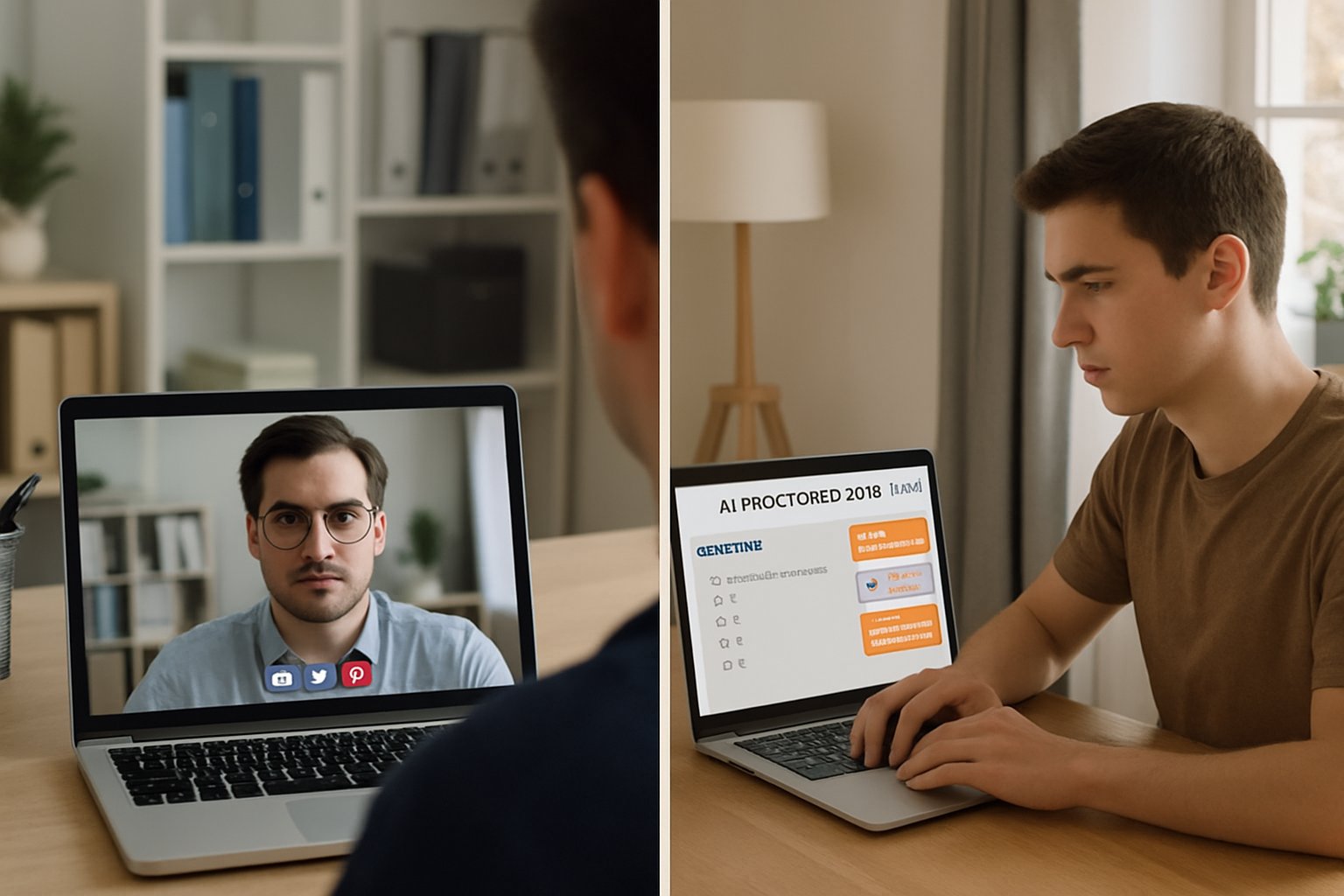
Consequently, many teams debate whether an ai proctored exam or live monitoring best serves learners.
Meanwhile, lawsuits and student protests add urgency to that decision.
The February 2025 California bar exam outage highlighted what is at stake.
Moreover, privacy advocates question biometric scans embedded in several platforms.
Vendors reply that advanced analytics deter misconduct at unprecedented scale.
In contrast, faculty groups highlight equity gaps revealed by recent research.
For ed-tech leaders, choosing a remotely proctored exam solution now carries financial and reputational risk.
Therefore, this article compares automated, live, and hybrid proctoring models.
Readers will gain market context, legal lessons, and practical evaluation tips.
Let’s begin by defining each method clearly.
Defining An AI Proctored Exam
An ai proctored exam relies on algorithms rather than humans.
Computer vision locks browsers, scans faces, and tags suspicious movements.
Furthermore, backend models assign confidence scores to every recorded event.
Institutions receive searchable dashboards within minutes.
Advantages appear clear.
Scalability supports thousands of candidates simultaneously, and scheduling friction disappears.
However, researchers documented false positives and demographic bias, especially for darker skin tones.
Regulatory scrutiny therefore continues across multiple jurisdictions.
In summary, software offers speed and reach.
Next, we examine live proctoring.
Live Proctoring Explained Clearly
Live remote proctoring assigns trained staff to watch candidate feeds in real time.
Consequently, proctors can ask clarifying questions and stop misconduct immediately.
This human layer improves context recognition where gestures appear ambiguous.
Nevertheless, costs rise because each proctor monitors limited screens.
When institutions switch from an ai proctored exam to live proctoring, they accept higher staffing needs.
A 2022 Frontiers study found human oversight reduced disproportionate flagging.
Yet operational errors still occur, as shown by the 2025 bar exam crash.
To sum up, humans add nuance but raise cost.
Now consider reliability data.
Operational Reliability Lessons Learned
The February 2025 California bar exam became a cautionary tale.
Meazure Learning’s hybrid service froze, causing submission failures for thousands.
Subsequently, the State Bar filed a fraud complaint citing unmet uptime guarantees.
Candidate careers paused, and public trust dipped quickly.
- 4,500 examinees affected according to court filings.
- Hours-long delays reported by 83% of surveyed candidates.
- Potential class damages exceed USD 50 million.
The case showed that even an ai proctored exam can fail spectacularly without stress testing.
Market watchers therefore stress rigorous load testing before any remotely proctored exam rollout.
Reliability shapes both reputation and legal exposure.
Fairness issues deserve equal focus.
Fairness And Bias Concerns
Peer-reviewed evidence shows algorithmic bias in flagging rates.
The 2022 Frontiers paper recorded higher false alerts for women of color.
Moreover, privacy lawsuits under Illinois BIPA challenge biometric data retention.
Learners describe stressful room scans and constant surveillance.
Affected students flagged by an ai proctored exam often struggle to appeal vague algorithmic scores.
Policy committees therefore recommend transparent audits and alternative assessments when possible.
Policy And Transparency Steps
Institutions should demand third-party bias audits before procurement.
Additionally, publish clear flag appeal processes to protect students.
Addressing bias improves legitimacy.
Cost factors now enter the debate.
Cost Scalability Trade Offs
Market.us values the remote proctoring sector near USD 900 million in 2024.
Growth forecasts reach multi-billion levels by 2030, although estimates vary widely.
Automated models drive lower unit costs, while live services remain labor intensive.
Consequently, hybrids try balancing expense and accuracy.
- AI-only: as low as USD 3 per seat.
- Live: often USD 15-25 per seat.
- Hybrid: median around USD 8 per seat.
Budget committees compare the price of each ai proctored exam against academic misconduct risk.
Nevertheless, hidden costs surface when false positives demand manual reviews or legal defense.
Hybrid Models In Practice
Honorlock and Examity combine AI alerts with on-demand pop-ins.
Therefore, institutions pay for human minutes only when needed, improving margins.
Selecting the right mix saves money and morale.
Next comes a practical checklist.
Decision Checklist For Institutions
Leaders should create a structured rubric before signing any contract.
Key questions include:
- What documented false positive rate exists across demographics?
- How will data be stored and deleted?
- Is a service-level agreement enforceable with penalties?
- Can paperless accommodations be provided quickly?
Furthermore, pilot every remotely proctored exam workflow with diverse volunteers.
Capture accessibility feedback early.
A disciplined process reduces surprises.
We now close with final thoughts.
Automated systems scale yet risk bias.
Live monitoring adds judgment yet strains budgets.
Hybrid models promise balance, but only careful vetting protects test integrity.
Why Proctor365? Our platform delivers AI-powered proctoring backed by live experts when needed.
Advanced identity verification confirms candidates within seconds.
Scalable exam monitoring supports universities, certification boards, and corporate L&D teams worldwide.
Consequently, institutions achieve fairness without sacrificing security.
Ready to launch your next ai proctored exam with confidence?
Visit Proctor365 and discover how our trusted solution safeguards every remotely proctored exam journey.
Frequently Asked Questions
- What is AI proctoring and how does it work?
AI proctoring uses advanced algorithms to monitor candidate activity through browser lockdowns and facial scanning while generating confidence scores, ensuring secure, scalable exam environments with strong fraud prevention. - How does live proctoring improve exam integrity?
Live proctoring assigns trained experts to watch candidate feeds in real time, enabling immediate intervention for suspicious behavior and reducing false positives, thus enhancing exam reliability and fairness. - What advantages does a hybrid proctoring model offer?
Hybrid models blend automated monitoring with on-demand live reviews, balancing cost efficiency and accuracy while addressing potential biases and ensuring robust exam security. - How does Proctor365 ensure fairness and security during exams?
Proctor365 integrates AI proctoring with live expert oversight and advanced identity verification, safeguarding exam integrity and offering transparent fraud prevention while addressing demographic bias concerns.