Exams are moving online at record speed. Institutions now face a critical challenge: hold secure, fair assessments without physical rooms. For many, preventing cheating in online exams drives policy and procurement. An ai based remote proctoring system delivers that virtual invigilation, yet the technology sparks debate.
Many vendors market ai based remote proctoring as a turnkey fix. This guide unpacks current data, regulations, benefits, and risks so decision-makers can act with confidence. Furthermore, the market for these tools could top USD 1 billion in 2025, according to multiple reports. Meanwhile, new laws in Europe and California impose strict privacy and bias safeguards.
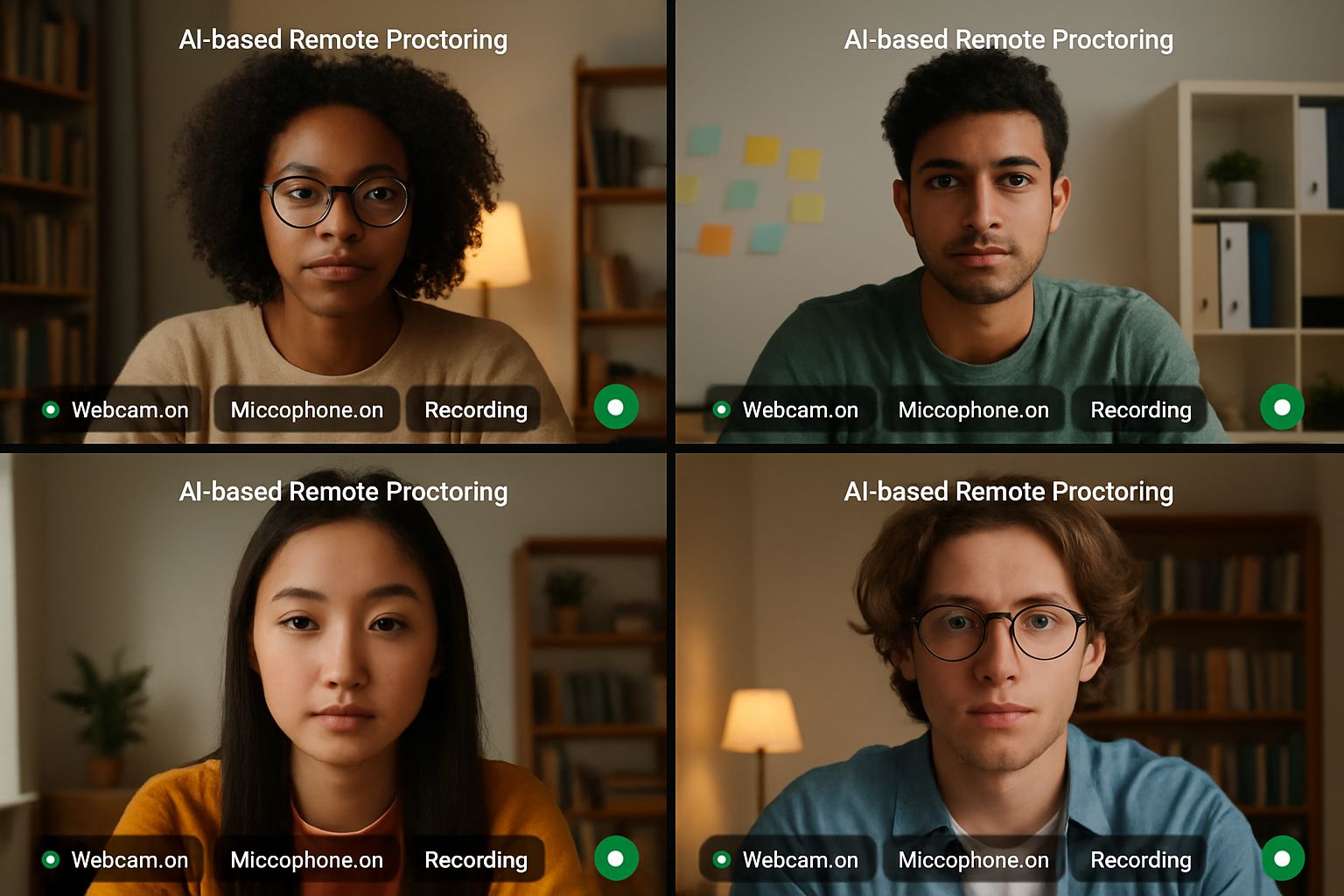
Consequently, vendors scramble to update algorithms, add human review, and publish audit results. Read on for a concise, evidence-based briefing tailored to universities, ed-tech leaders, and corporate L&D teams.
AI Based Remote Proctoring System
First, understand the workflow. Every ai based remote proctoring system begins with identity checks and environment requirements. Machine models then watch webcam, microphone, and on-screen actions for rule violations. Finally, human reviewers confirm or dismiss any AI alerts.
Automated tools promise scale, yet live proctoring still matters for nuanced judgment. Most vendors therefore offer hybrid options blending ai based remote proctoring and trained staff oversight. Additionally, behavioral biometrics like keystroke rhythm supplement webcam analytics.
In short, the system ties multiple data streams to keep exams honest. Proper calibration determines success.
Key takeaway: The ai based remote proctoring system relies on AI triage plus optional human review. Effective deployment starts with clear identity, environment, and data policies.
Next, let’s explore market momentum.
Global Market Momentum Today
Global demand keeps rising. Market Growth Reports values online proctoring between USD 648 million and USD 1.2 billion in 2024. Moreover, compound annual growth rates hover near 15% through the decade. Around 70% of surveyed solutions now embed AI modules, confirming widespread adoption.
Adoption of ai based remote proctoring remains uneven across disciplines, yet momentum increases in credentialing and corporate upskilling programs. Analysts agree an ai based remote proctoring system now sits at the heart of digital assessment strategies.
Universities chase flexibility; certification bodies want global access; corporate L&D teams seek cost savings. Consequently, platform vendors sign multi-year deals and add capacity fast.
Major players include Proctorio, Honorlock, Respondus, Examity, PSI, and Pearson VUE’s OnVUE. Each markets hybrid workflows and privacy dashboards.
Key takeaway: Strong growth and vendor competition signal maturity, yet differentiation rests on trust and compliance. Market sizing still varies, so cite ranges not absolutes.
Those compliance pressures are our next focus.
Evolving Global Compliance Pressures
Regulators now shape product design. The EU AI Act bans emotion recognition in education and treats proctoring as high-risk from 2025 onward. Therefore, vendors must provide risk assessments, human oversight, and detailed logs. Meanwhile, California’s Student Test Taker Privacy Protection Act limits data retention and room scans.
Additional bills, like SB 930 introduced January 2026, would mandate end-to-end encryption for contracts. Consequently, legal teams now evaluate jurisdictional differences before signing.
Institutions also craft internal policies that require opt-outs, accessibility accommodations, and transparent audits. Failure to comply risks reputational harm.
Choosing an ai based remote proctoring system that meets Annex III is now mandatory for EU universities. Policies increasingly require that ai based remote proctoring solutions undergo impact assessments.
Key takeaway: Compliance demands drive product features and contract language. Staying ahead reduces legal and ethical exposure.
Next, we weigh concrete benefits.
Benefits Institutions Value Most
Despite challenges, decision-makers still invest because the tools solve real problems. Below are standout advantages:
- Scalability: thousands of concurrent sessions without hiring extra invigilators.
- Convenience: 24/7 testing supports working learners worldwide.
- Integrity signals: hybrid AI flags deterring and preventing cheating in online exams.
- Cost efficiency: travel and site fees disappear for many programs.
Moreover, early studies show reduced cheating incident rates when ai based remote proctoring is paired with strict honor codes. Training institutes also appreciate quick result turnaround. Ultimately, selecting the right ai based remote proctoring system also supports accreditation renewal.
Key takeaway: Institutions cite scale, convenience, and deterrence as primary gains. These gains must, however, balance student trust.
Therefore, we must examine persistent risks.
Persistent Risks And Gaps
Technical audits reveal bias in facial recognition accuracy across skin tones and lighting. Additionally, connectivity drops can trigger false flags, frustrating test takers.
Privacy groups label some room-scan practices intrusive, while accessibility experts note incompatibility with assistive tech. Consequently, several universities now restrict or ban mandatory webcam scans.
Determined cheaters also evolve. Services offering deepfake overlays or hidden gadgets sell workarounds online. Thus, layered defenses and rapid incident response stay vital.
Key takeaway: Bias, privacy, and evasion risks persist. Continuous auditing and policy refinement remain necessary.
Finally, consider how to select trusted partners.
Practical Vendor Selection Checklist
Teams should press vendors on the following checkpoints:
- Independent bias audits with public summaries.
- Data hosting region and retention limits.
- Human review protocols and escalation time.
- Accessibility conformance to WCAG 2.2 AA.
- Encryption compliance with EU and state laws.
Furthermore, request historical false-positive rates and demographic breakdowns. Institutions can pilot the platform to verify usability and bandwidth tolerance. Ask how the tool balances preventing cheating in online exams with accessibility obligations.
Key takeaway: A rigorous checklist reduces surprises post-launch. Clear metrics and trials build stakeholder trust.
We now close with overarching guidance and a proven partner.
Conclusion
Remote proctoring now stands at a crossroads. Adoption grows, regulations tighten, and research highlights both promise and peril. Institutions that weigh evidence, follow our checklist, and require transparency will protect learners while maintaining credibility.
Why Proctor365? Proctor365’s ai based remote proctoring system combines advanced computer vision with live human oversight. The platform offers lightning-fast identity verification, scalable cloud monitoring, and analytics trusted by global exam bodies. Moreover, its architecture aligns with EU AI Act and California privacy rules. Consequently, organizations focused on preventing cheating in online exams achieve results without sacrificing equity.
Schedule a personalized demo today and see how Proctor365 elevates exam integrity from day one.
Frequently Asked Questions
- What is AI-based remote proctoring?
AI-based remote proctoring uses computer vision, identity verification, and human oversight to monitor exams. Proctor365 leverages these techniques to ensure secure, fair, and compliant online assessments. - How does Proctor365 support exam integrity?
Proctor365 integrates rapid identity checks with scalable AI analytics and live human review, deterring cheating and enhancing exam integrity while meeting global privacy and compliance standards. - How do proctoring systems address privacy and compliance?
Proctor365 and similar systems adhere to regulations like the EU AI Act and California laws by implementing robust data encryption, risk assessments, and transparent identity protocols for secure online tests. - What are the benefits of AI-based remote proctoring for institutions?
Institutions enjoy 24/7 exam access, scalability, cost savings, and quick result turnarounds. Proctor365’s approach enhances fraud prevention and supports accreditation through reliable, compliant proctoring.