Universities now face a new integrity puzzle. Remote learners expect fair, secure assessments wherever they log in. Consequently, institutions are turning to the ai based proctoring exam model to scale trust without physical rooms. Market reports place global spend near one billion USD and project strong double-digit growth. Vendors promise AI that detects cheating faster than humans. However, sceptics cite privacy lawsuits and algorithmic bias. Decision makers therefore need balanced information before they sign the next contract.
Over the next pages we explore core technologies, market drivers, and regulatory shifts shaping remote assessment. Additionally, we reveal practical steps that help programs adopt ai based remote proctoring while respecting student rights. Each section ends with concise actions you can share with boards and accreditation teams. By the end, you will answer what is ai based proctoring in exams and learn how to pilot responsibly.
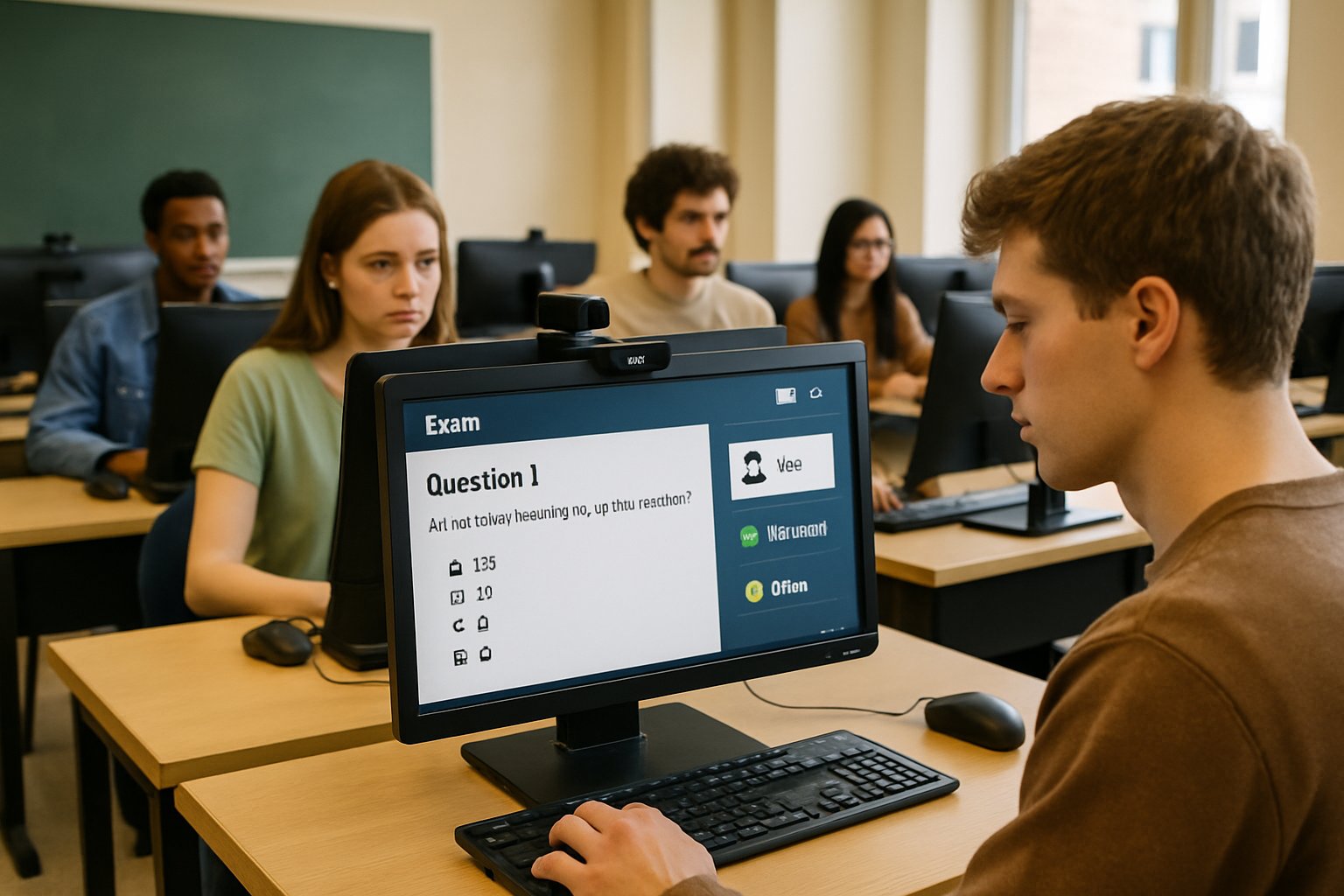
AI Based Proctoring Exam Growth
Pandemic disruptions normalised remote tests across continents. Consequently, adoption rates soared from under 20% to almost 60% of surveyed institutions by 2025.
Analysts at ResearchAndMarkets valued the market between USD 0.8 and 1.5 billion in mid-2020s. Moreover, forecasts suggest revenue could triple by 2031, implying mid-teens CAGR.
- Massive shift to hybrid learning models requiring ai based remote proctoring at scale.
- Need to deter AI-assisted cheating tools like Cluely.
- Cost pressure pushing automation over live invigilation.
Adoption momentum shows no sign of slowing. Institutions therefore need a strategy that scales responsibly.
Next, we dissect the technology powering that growth.
Core Proctoring Tech Components
An ai based proctoring exam stack usually combines five building blocks. These include a secure browser, identity checks, liveness detection, behavioural analytics, and human review.
Machine learning models flag anomalies like gaze wandering or suspicious audio. However, trained human auditors still make final misconduct decisions in most systems.
These modular parts work together to protect exam integrity. Understanding each part means you finally grasp what is ai based proctoring in exams.
With the mechanics clear, let us explore tangible value for stakeholders.
Benefits For Test Owners
Automated workflows cut scheduling effort by up to 80%, according to vendor case studies. Consequently, staff can support more candidates without extra payroll.
An effective ai based proctoring exam deters casual cheating and reassures stakeholders.
- Scalable 24/7 testing across time zones.
- Instant identity verification reduces impersonation.
- Rich audit trails simplify appeals.
Corporate certifiers also leverage ai based remote proctoring to reach global employees who cannot travel. Moreover, faster result release improves learner satisfaction and program revenue.
Greater scale, faster insights, and higher candidate trust define the business case. Those gains, however, arrive with notable trade-offs.
We now address the most pressing risks and criticisms.
Major Risks And Controversies
When an ai based proctoring exam misfires, innocent students bear stress. False positives remain a top fear.
Equity researchers found lighting, skin tone, and disability factors influence accuracy. Consequently, institutions must calibrate models and offer alternative assessments.
Legal exposure also looms. Illinois BIPA lawsuits against Respondus show real monetary risk for biometric processing.
Meanwhile, the EU AI Act will classify many systems as high-risk by 2026. Therefore, non-compliant features like emotion analysis could soon be banned.
Privacy, bias, and regulation pose concrete threats to projects. Addressing them early prevents costly surprises and clarifies what is ai based proctoring in exams.
The following section outlines practical safeguards.
Best Practice Implementation Steps
First, run a limited pilot with diverse volunteers. Collect metrics on false positives, user sentiment, and technical downtime.
Second, minimise data collection and retention. Therefore, store recordings only as long as policy or law demands.
Third, integrate human review for every algorithmic flag. Additionally, publish clear appeal procedures for candidates.
Pilot data will reveal whether your ai based proctoring exam meets accuracy targets.
Following these steps anchors integrity in process, not promises. Prepared teams move forward confidently.
Regulatory awareness complements sound process, so we map the landscape next.
Regulation And Legal Landscape
In the United States, state privacy laws create a patchwork. BIPA treats each biometric capture as a separate violation.
FERPA also governs student records, requiring clear consents for data sharing. Consequently, universities must align proctoring workflows with registrar policies.
Across the Atlantic, the EU AI Act introduces mandatory risk assessments and registry disclosures. Moreover, certain emotion or undisclosed biometric features face outright bans.
Each ai based proctoring exam must document biometric handling to satisfy regulators.
Legal stakes vary by region but penalties grow sharper each year. Early compliance planning protects institutional reputations.
We now wrap with key insights and an action plan.
Conclusion And Next Steps
You now hold the knowledge needed to deploy secure, respectful testing. Growth is rapid but regulation tightens. Clear processes, human review, and minimal data collection reduce risk. Ongoing pilots confirm accuracy and equity. Implementation varies by context. However, tested frameworks speed adoption. Stakeholders who still wonder what is ai based proctoring in exams should begin with a small pilot. Stakeholders should revisit metrics quarterly to ensure continuous improvement.
An ai based proctoring exam, when executed well, preserves trust while scaling programs. Why Proctor365? The platform blends real-time AI monitoring, advanced identity verification, and elastic cloud infrastructure trusted by global exam bodies. Consequently, your organisation safeguards integrity without harming learner experience. Explore the benefits at Proctor365.ai today.
Frequently Asked Questions
- What is AI based proctoring in exams?
AI based proctoring uses advanced algorithms, biometric identity verification, and human oversight to monitor remote exams. This secure system prevents cheating and ensures fairness while meeting compliance and regulatory requirements. - How does Proctor365 enhance exam integrity?
Proctor365 enhances exam integrity through real-time AI monitoring, elastic cloud infrastructure, and automated identity checks. These features work together to detect fraud quickly, reduce false positives, and maintain secure exam conditions. - What benefits does AI based remote proctoring offer institutions?
AI based remote proctoring streamlines scheduling, enables instant fraud detection, and reduces manual workloads. Proctor365’s solution improves candidate trust, scales assessments globally, and complies with privacy laws for secure testing. - How does Proctor365 address privacy and bias concerns?
Proctor365 minimizes data retention, employs human review to counter algorithmic bias, and adheres to regional privacy regulations. This balanced approach protects sensitive biometric data while ensuring fair and secure exam monitoring.