Candidates now sit major certifications at home, not in distant test centers.
That dramatic shift began once the ai proctored exam proved it could scale securely.
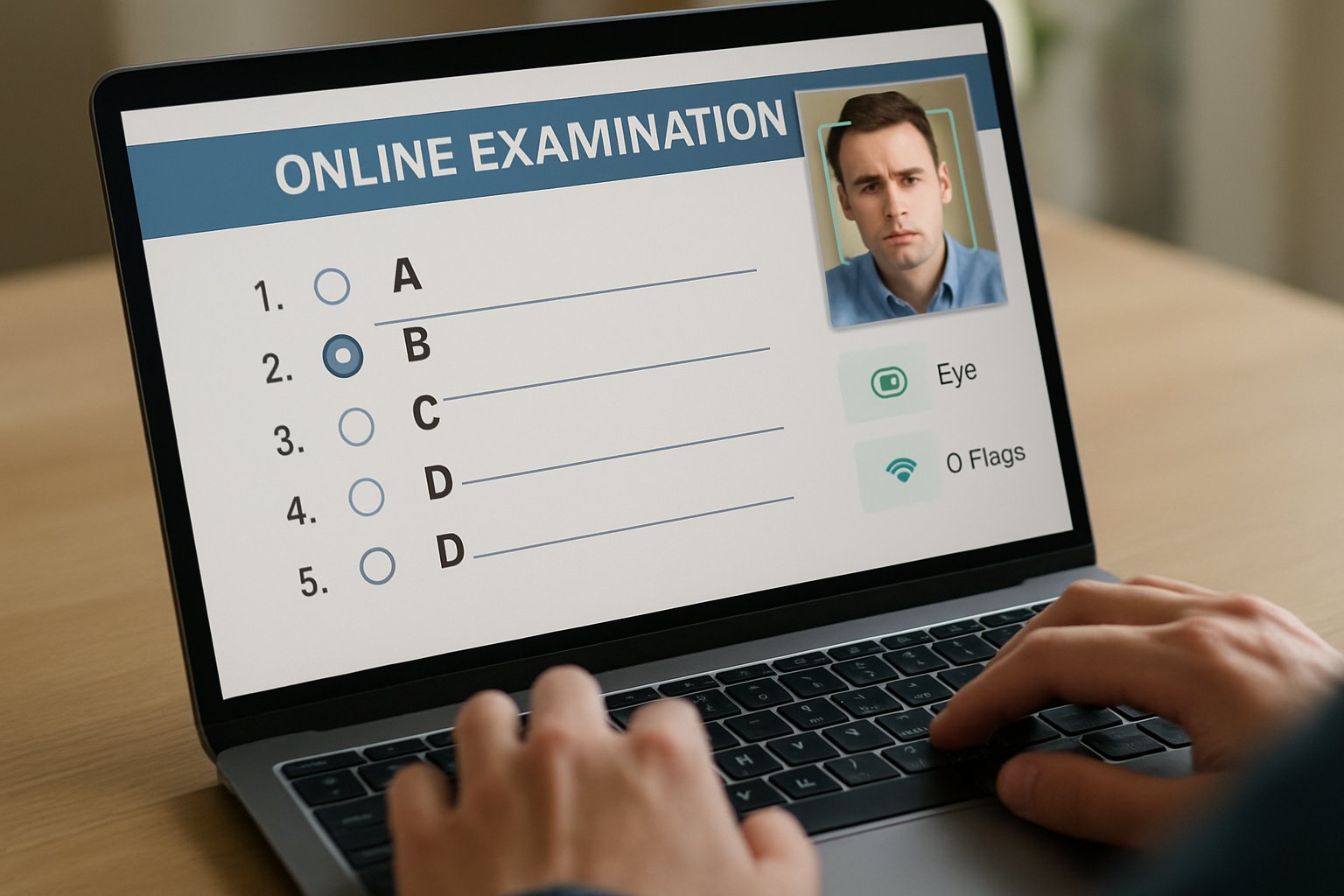
Universities, vendors, and employers quickly noticed the cost and access gains.
Today, an ai proctored exam can launch anywhere, anytime, serving thousands in multiple time zones.
However, adoption still raises critical questions about privacy, bias, and reliability.
Consequently, decision-makers must balance integrity gains with candidate welfare.
This article reviews market data, technology features, risks, and next steps for assessment leaders.
Practical tips follow each section to support evidence-based planning.
Let us dive in.
AI Proctored Exam Shift
Pearson’s 2025 deal to deliver Salesforce certifications online signaled a definitive market turn.
Similar moves by Prometric and PSI extended reach to dozens of professional programs.
Certification teams cite three drivers.
- Global reach without test centers.
- Lower logistics and venue costs.
- Unified audit trails for every session.
Together, these factors reshape expectations for each upcoming ai proctored exam.
Market momentum now favors digital delivery across certification ecosystems.
Next, we quantify that surge.
Growth Market Numbers Surge
IndustryResearch.co projects online proctoring revenue to hit USD 825.2 million in 2026.
Meanwhile, ResearchAndMarkets recorded US$836.4 million for 2023 and forecasts rapid expansion.
- Market value of each ai proctored exam averages US$15-25, depending on scope.
- Remote delivery reports annual growth of 14-18% worldwide.
- Over 78% of UK universities still run online assessments after 2025.
Importantly, many forecasts exclude corporate compliance testing, so real totals could be higher.
The money involved ensures sustained vendor investment and competition.
Understanding the technology stack is the next priority.
Technology Behind Exam Surveillance
AI engines monitor webcam, screen, and audio feeds in real time.
They flag anomalies like second faces, background voices, or banned websites.
Identity verification starts with facial matching and secure ID capture.
Additionally, secure browsers lock down tabs and shortcuts.
Any ai proctored exam also records timestamped events for audit teams.
For a high-stakes remotely proctored exam, vendors add human proctors who intervene instantly.
These layered controls create an evidence trail for appeals.
Still, benefits matter only if they outweigh risks.
Key Benefits Drive Adoption
Cost remains the loudest advantage.
Vendors report savings of up to 50% compared with test-center delivery.
Moreover, candidate convenience boosts registration totals, especially in underserved regions.
- Schedule flexibility attracts working professionals.
- Rapid results speed hiring decisions.
- Rolling windows reduce exam anxiety.
Consequently, every remotely proctored exam can support rolling cohorts without seat shortages.
Institutions also value the searchable session archive when investigating misconduct.
The ai proctored exam therefore protects credential reputation at scale.
Benefits appear persuasive yet cannot ignore legitimate critiques.
The next section reviews those concerns.
Privacy Concerns And Safeguards
Advocacy group EPIC warns that proctoring collects excessive biometric data from private spaces.
Accessibility researchers add that facial recognition may misread darker skin tones and disabilities.
Vendors respond with ISO 42001 audits, data-retention limits, and opt-out policies.
Furthermore, many platforms now employ human review to validate AI flags.
During any remotely proctored exam, clear policies and appeal pathways remain essential.
Without transparency, an ai proctored exam could expose institutions to legal action.
Taken together, safeguards are evolving but still require diligent oversight.
Strategic planning closes the discussion.
Preparing Your Proctoring Strategy
Start with a risk matrix that aligns proctoring intensity with exam stakes.
Next, vet vendors for ISO audits, bias testing, and LTI integration.
Pilot each remotely proctored exam with diverse candidates to surface technical barriers early.
Moreover, publish privacy notices and accommodation guides before rollout.
Finally, schedule regular audits of ai proctored exam recordings to refine policies.
Proactive governance builds candidate trust and regulatory resilience.
The conclusion below recaps core lessons and introduces a proven partner.
Hybrid Delivery Model Options
Many programs now blend test centers, live remote proctors, and AI recordings.
This hybrid approach balances security, cost, and candidate experience.
Such flexibility eases transitions during regional disruptions.
Consequently, institutions remain resilient while expanding reach.
Hybrid success depends on the same rigorous planning outlined above.
Your team can adapt the framework to evolving risks.
That adaptability pays dividends during policy reviews.
The final section explains how to move forward confidently.
AI-backed monitoring now dominates global certification delivery, driven by cost savings, reach, and audit power.
However, privacy, bias, and reliability deserve continuous oversight.
Teams that pair robust policies with transparent technology unlock the full promise of the ai proctored exam.
Proctor365 meets that promise today.
Our platform combines advanced identity verification, adaptive analytics, and scalable exam monitoring trusted by leading exam bodies.
Furthermore, our cloud architecture supports every remotely proctored exam without compromise.
Discover how Proctor365 fortifies integrity and candidate confidence by visiting Proctor365.ai now.
Frequently Asked Questions
- How do AI proctored exams maintain exam integrity and security?
AI proctored exams use advanced identity verification, real-time monitoring, and fraud prevention measures. Combining secure browser lockdowns with human oversight ensures robust exam integrity and safeguards candidate data. - What are the key benefits of remotely proctored exams?
Remotely proctored exams offer cost savings, increased accessibility, and scheduling flexibility. Institutions benefit from secure audit trails and efficient fraud prevention, making digital delivery scalable and reliable. - How does Proctor365 address privacy concerns in AI proctoring?
Proctor365 implements strict privacy safeguards including data retention limits, opt-out policies, and ISO audits to minimize biometric data risks. Our human review and bias testing ensure fair, transparent, and secure AI proctoring solutions. - What steps should institutions take to prepare for remote proctoring?
Institutions should develop a risk matrix, vet vendors for robust AI proctoring and identity verification, pilot exams with diverse candidates, and enforce clear privacy policies. Regular audits and transparent procedures build trust and compliance.