Digital learning has exploded across universities, training firms, and enterprise programs. Consequently, securing assessment integrity now tops every administrator’s priority list. Advanced online test monitoring offers a scalable answer, yet it reshapes pedagogy and policy.
Moreover, artificial intelligence (AI) now drives a multimodal shift from simple webcams to complex analytics. Institutions evaluate face recognition, behavioral biometrics, and audio cues inside online test monitoring ecosystems. However, regulators and civil-liberties groups demand transparency, fairness, and rigorous evidence.
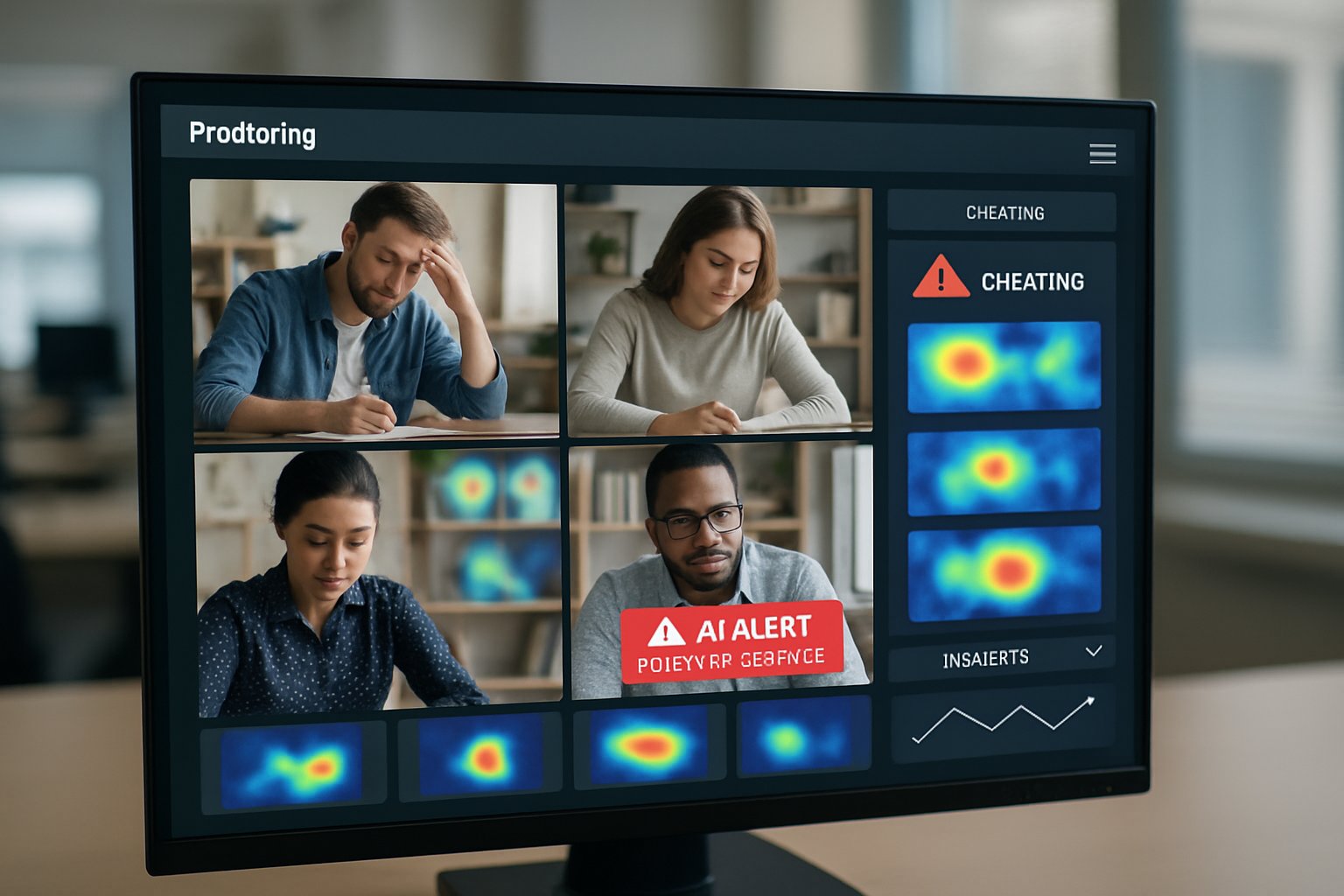
This article examines the emerging landscape and forecasts the next five years. Readers will gain strategic guidance before their next remotely proctored exam rollout.
More than half of surveyed students took at least one monitored online exam last year. Therefore, understanding AI’s role in safeguarding future assessments has never been more urgent. Meanwhile, regulators intensify scrutiny of exaggerated AI claims and biometric data handling. Consequently, technology leaders must align innovation with accountability from day one.
Online Test Monitoring Outlook
Market analysts estimate the global online test monitoring sector will surpass USD 1.4 billion by 2032. Consequently, vendors race to merge AI vision, audio, and behavioral biometrics into unified dashboards.
Universities now seek fewer false flags and faster reviews. Therefore, hybrid human-AI workflows dominate new proposals.
In short, growth and sophistication are rising in tandem. Next, we examine how AI amplifies exam integrity.
AI Elevates Exam Integrity
Computer vision detects face matches, gaze shifts, and environment changes within milliseconds. Additionally, keystroke and mouse patterns confirm continuous identity without extra hardware. Such layered signals have lowered human review minutes per remotely proctored exam session by half, vendors claim.
However, AI alone never decides sanctions in responsible online test monitoring deployments. Consequently, trained proctors verify each flagged clip before faculty intervene.
AI boosts speed and coverage while humans guard due process. Yet technical advances demand equally advanced detection techniques, our next focus.
Multimodal Detection Techniques Advance
Modern platforms fuse webcam, screen, microphone, and interaction streams into one risk score. Moreover, liveness checks deter spoofed faces, while NLP flags suspicious background whispers. Audio algorithms now detect verbal prompts during a remotely proctored exam with growing precision.
Researchers also explore keystroke signatures that separate human typing from large language models. However, early studies show performance drops across devices and demographics.
Therefore, multimodal fusion reduces single-signal errors yet needs ongoing validation. Attention now shifts to privacy and fairness questions.
Balancing Privacy And Fairness
Students voice concerns about home surveillance, data retention, and facial bias. NIST studies reveal higher error rates for some demographic groups in face verification. Consequently, many institutions configure lighter settings for low-stakes quizzes.
GDPR, FTC, and state laws also push for minimal data collection and clear consent. Moreover, accessibility teams request alternative flows for neurodivergent or disabled test-takers.
Balancing security with equity demands transparent policies and flexible technology. Thus, hybrid oversight models are gaining momentum.
Hybrid Oversight Gains Traction
Institutions increasingly combine AI flagging with real-time or post-hoc human review. This layered model cuts costs yet preserves due process. Honorlock, Respondus, and others now market dashboards that prioritize incidents for faculty.
- Human reviewers see time-stamped clips, not hours of footage.
- Automated scores adapt to course risk profiles.
- Online test monitoring insights appear instantly on faculty dashboards.
Consequently, faculty involvement drops while decision quality improves. Next, procurement teams demand hard evidence before purchase.
Procurement Trends And Evidence
Buyers now request confusion-matrix reports, demographic audits, and documented false-positive rates. Furthermore, the FTC warns that unsupported AI accuracy claims invite enforcement. Therefore, vendors share method papers and participate in NIST evaluations.
Universities also compare online test monitoring outcomes with classroom baselines. In one Unizin pilot, flagged events fell 23 % after calibration.
Data-driven procurement thus rewards transparent partners. We now explore the future roadmap guiding those partners.
Roadmap: Next Five Years
Expect richer multimodal fusion, including stylometry for AI-assisted cheating detection. Moreover, risk-based settings will let faculty match proctoring rigor to assessment stakes. Cloud architectures will scale online test monitoring to massive open programs with minimal latency.
Simultaneously, privacy dashboards will grant students granular control over stored data. Consequently, trust should rise across remotely proctored exam experiences.
In essence, technology, policy, and pedagogy will evolve together. The concluding section distills actionable insights for stakeholders.
AI now underpins secure, scalable online test monitoring while hybrid review protects fairness. Multimodal signals, transparent metrics, and adaptive thresholds will define credible, student-centric solutions. Nevertheless, institutions must audit bias, privacy, and learning outcomes each semester. Therefore, selecting a proven partner becomes critical.
Proctor365 delivers AI-powered proctoring, advanced identity verification, and elastic infrastructure that scales from classes to licensure. Trusted by global exam bodies, our solution blends real-time analytics with human oversight for reliable online test monitoring. Visit Proctor365.ai to secure every remotely proctored exam today.
Frequently Asked Questions
- What is online test monitoring and why is it important?
Online test monitoring safeguards exam integrity during digital assessments by combining advanced AI analytics and human oversight. It quickly detects suspicious behavior, prevents fraud, and offers scalable, secure proctoring solutions. - How does AI-driven proctoring enhance exam security?
AI-driven proctoring uses computer vision, behavioral biometrics, and audio analytics to identify irregularities in real time. This technology, paired with human review, minimizes false flags and verifies student identities efficiently. - What methods help balance exam security with student privacy?
Modern proctoring platforms employ multimodal detection, transparent metrics, and selective data retention strategies. Hybrid oversight models maintain exam security while addressing privacy concerns and minimizing biases. - How does Proctor365 provide a secure, scalable proctoring solution?
Proctor365 integrates AI-powered proctoring with advanced identity verification and elastic cloud infrastructure. Its hybrid human-AI review system ensures reliable exam integrity, fraud prevention, and user-friendly, scalable proctoring services.