Inclusive software for online exam: design that delivers

Pressure to adopt inclusive software for online exam delivery has never been higher. Universities feel urgent legal deadlines set by the U.S. DOJ and UK regulators. Meanwhile, 15% of K-12 learners already qualify for accommodations, and many more in higher education remain undisclosed. Consequently, institutions now demand platforms that respect every learner, comply with WCAG 2.2 AA, and avoid intrusive surveillance. Forward-thinking teams also look beyond compliance to Universal Design for Learning principles that lift performance for all. This article maps the new rules, core design patterns, and practical steps for buyers and builders.

Regulatory Pressure Mounts

Regulators now insist that digital assessments match mainstream web accessibility standards. The April 2024 ADA Title II update sets phased deadlines through 2026. Similarly, UK guidance aligns awarding bodies with EN 301 549. Moreover, public funding hinges on conformance evidence. Institutions therefore scrutinize VPATs and third-party audits. Non-compliance risks lawsuits, lost contracts, and reputational damage.

Accessible interface on software for online exam shown on student laptop.
Accessible exam software interface supports a comfortable and equitable experience.

Key takeaway: Legal stakes make accessibility a procurement gate. Consequently, vendors must document progress, not promises.

Universal Design Principles

Universal Design for Learning offers a proactive roadmap. It promotes multiple means of representation, action, and engagement. Therefore, assessments built on UDL reduce the need for individual accommodations. They also enhance validity by testing knowledge, not screen-navigation skills.

  • Multiple response modes: typed, audio, or diagram upload.
  • Flexible timing with pause and resume support.
  • Semantic math markup for screen readers and braille.

Key takeaway: UDL turns compliance into pedagogy. Accordingly, inclusive design benefits every cohort.

Software For Online Exam

Best-in-class software for online exam delivery now embeds accommodations automatically. Interoperability standards such as 1EdTech QTI 3 carry personal needs profiles from the LMS to the test engine. Consequently, approved extra time or high-contrast themes appear without manual setup.

Furthermore, leading platforms like Inspera and Turnitin publish dated VPATs and run screen-reader regression suites. However, buyers must verify math interactions, drag-and-drop alternatives, and mobile responsiveness. Robust keyboard navigation across all items remains non-negotiable.

Key takeaway: Accessible feature depth, not marketing claims, defines modern software for online exam. Therefore, hands-on testing with assistive tech is essential.

Proctoring Pitfalls Addressed

Institutions still rely on remote proctor software, yet privacy and bias concerns grow. Continuous webcam feeds can trigger anxiety and exclude learners lacking private spaces. Therefore, many campuses now offer opt-outs or open-book alternatives. Accessible design also demands captioned identity checks, keyboard-controlled room scans, and low-bandwidth modes.

Moreover, some remote proctor software vendors now expose AI decision logs to disability staff, improving transparency. Nevertheless, policy shifts suggest reducing surveillance where pedagogically possible.

Key takeaway: Maintain integrity, but minimise intrusion. Consequently, balance remote proctor software with authentic assessment models.

Procurement Action Checklist

Teams evaluating software for online exam solutions should adopt a structured process.

  1. Request current VPAT plus third-party audit results.
  2. Confirm PNP/Access-for-All support for automatic accommodations.
  3. Run tests using NVDA, JAWS, and VoiceOver on typical items.
  4. Demand an SLA for critical accessibility fixes.
  5. Review how any linked remote proctor software meets privacy and bias standards.

Key takeaway: Detailed RFP language saves retro-fit costs later. Therefore, embed accessibility metrics from day one.

Securing Inclusive Future Assessments

Market analysts predict steady growth, yet fragmentation persists. Consequently, institutions must future-proof choices. Select vendors committed to WCAG 2.2 AA, ongoing audits, and open standards like QTI 3. Additionally, invest in staff training so faculty author inclusive items from the start.

Emerging AI tools can generate alt-text, captions, and adaptive timing suggestions. However, governance must ensure human oversight to avoid new bias vectors.

Key takeaway: Sustainable inclusivity blends compliant technology with skilled people. Therefore, continuous improvement cycles remain vital.

Conclusion

Inclusive software for online exam delivery now underpins legal compliance, equity, and assessment validity. Institutions should pair UDL principles with rigorous audits, transparent remote proctor software, and standards-based integrations.

Why Proctor365? Our AI-powered platform pairs identity verification, scalable monitoring, and privacy-respectful design inside advanced software for online exam workflows. Trusted by global exam bodies, Proctor365 delivers real-time analytics while meeting WCAG targets. Discover how Proctor365 safeguards integrity today.

Frequently Asked Questions

  1. What makes Proctor365’s online exam software stand out?
    Proctor365 features AI-powered proctoring, scalable monitoring, and inclusive design that meets WCAG standards. Its automatic accommodations and fraud prevention ensure secure, reliable exam delivery.
  2. How does Proctor365 ensure compliant and accessible online exams?
    Proctor365 aligns digital assessments with accessibility guidelines by integrating Universal Design for Learning, conducting third-party audits, and automating features like extra time and high-contrast themes.
  3. What role does AI play in Proctor365’s exam proctoring solutions?
    AI enhances exam integrity by providing real-time analytics, detecting fraud, and supporting transparent identity verification. This approach minimizes bias and strengthens the overall proctoring process.
  4. How can institutions verify exam security and candidate identity using Proctor365?
    Institutions benefit from Proctor365’s identity verification and privacy-respectful remote proctoring, which uses audit logs and accessible, keyboard-friendly features to ensure compliance and prevent fraudulent activities.
Remote Proctor Software: How AI Detects Cheating

Online assessment exploded during the pandemic. However, misconduct risk exploded as well. Institutions now lean on remote proctor software to keep exams fair without physical halls. The technology blends webcams, screen capture, data analytics, and machine learning into a continuous security layer. Yet, myths, legal rulings, and genuine limitations surround these tools. Understanding how the systems watch, decide, and sometimes fail helps leaders choose wisely.

Consequently, this article unpacks the AI pipeline, exposes the accuracy debate, and offers concrete mitigation tips. Readers from universities, certification bodies, and corporate L&D teams will gain a concise roadmap for deploying or auditing solutions. Throughout, we reference recent court decisions, peer-reviewed research, and vendor documentation to balance promise with reality. Choosing reliable software for online exam security now influences accreditation audits.

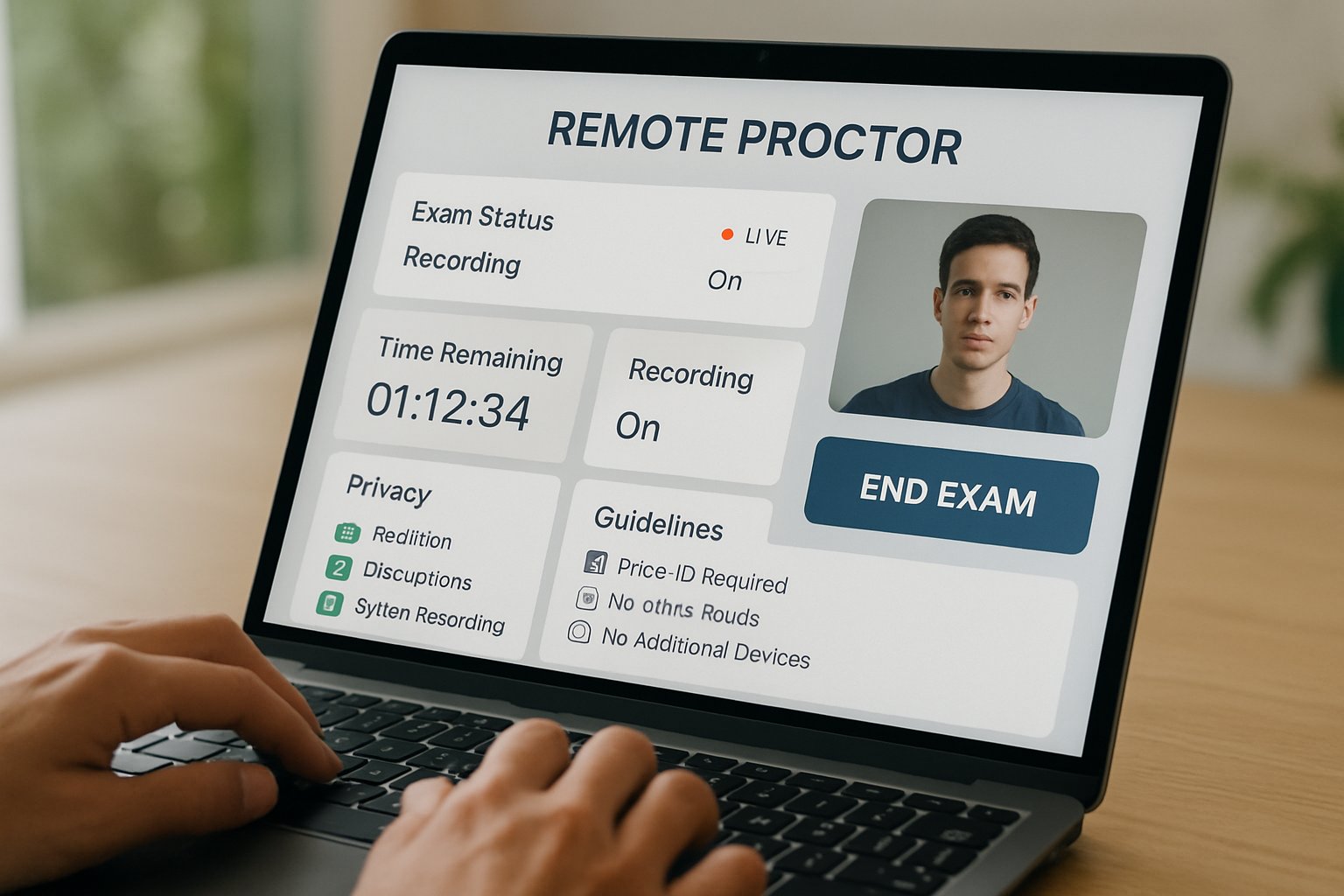
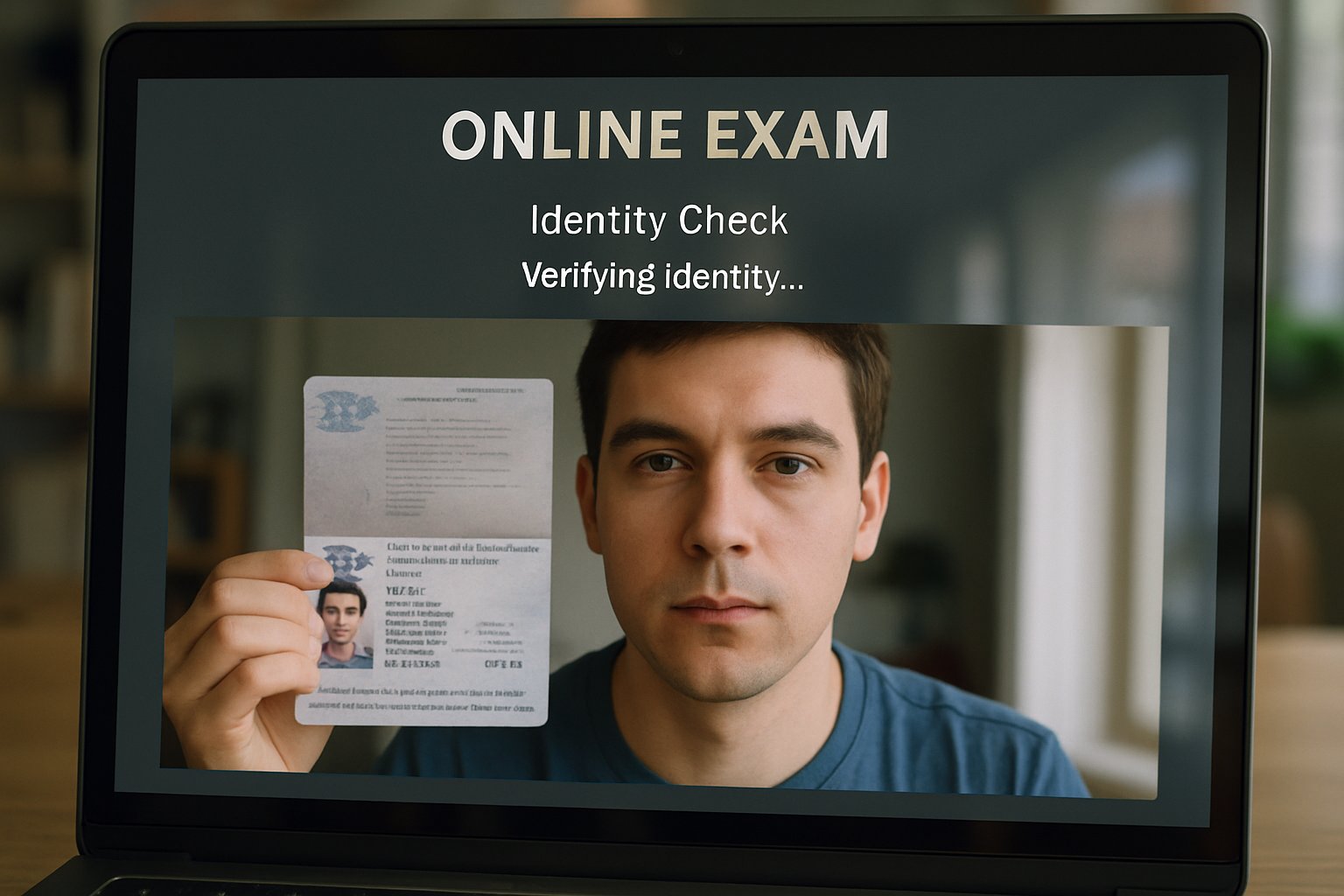
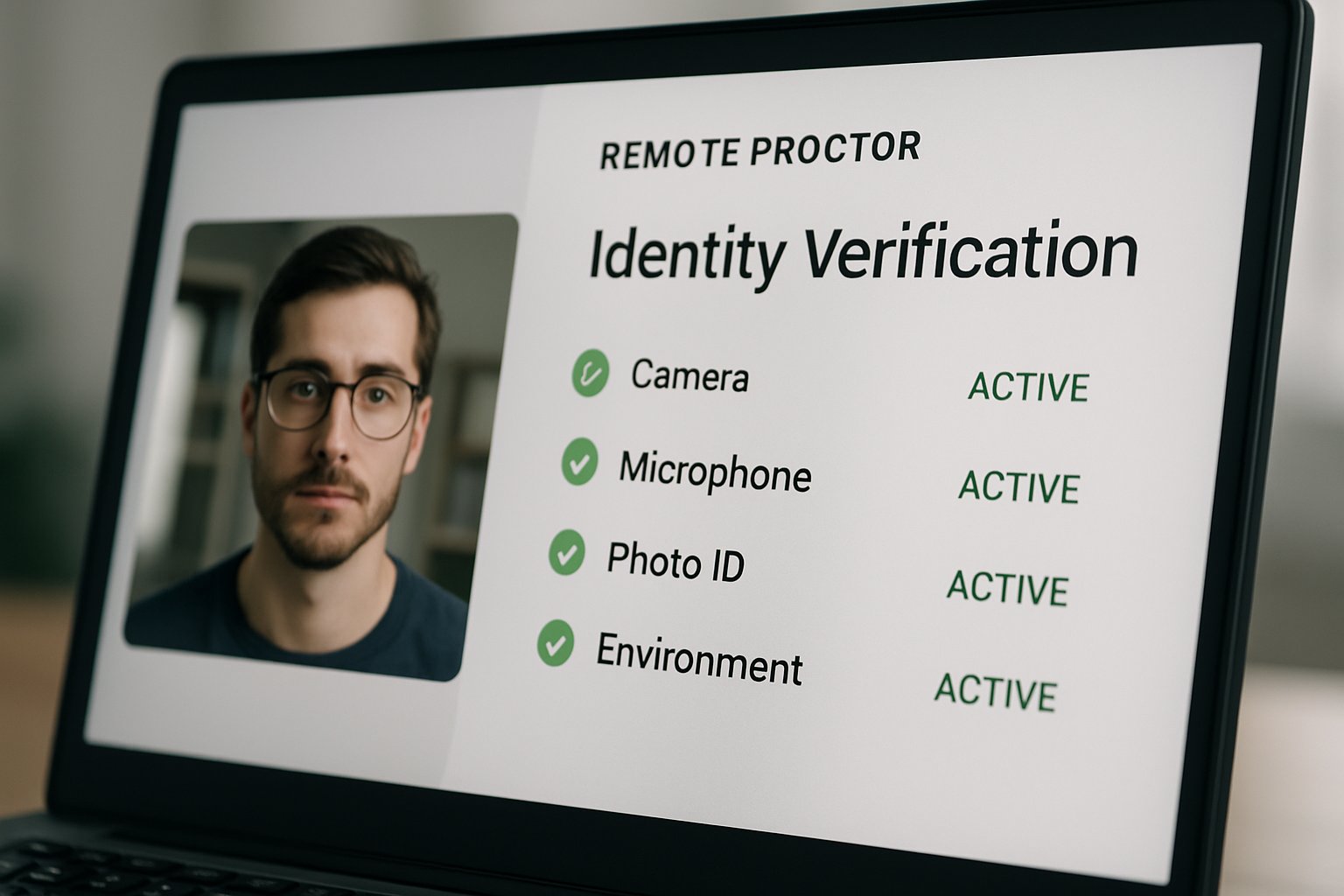
Remote proctor software interface with live identity verification check
Remote proctor software verifies user identity in real-time during the online assessment.

High Exam Integrity Stakes

Breach of assessment integrity erodes credentials and public trust. Moreover, reputational damage can haunt institutions for years. A 2025 review estimated remote learning fraud costs universities millions in resits, investigations, and support. Therefore, scaled surveillance became a necessary shield for mass online testing.

These realities justify careful oversight. Next, we dissect the technology stack.

Remote Proctor Software Stack

Modern remote proctor software integrates five real-time layers. First, identity verification captures an ID photo and live selfie. The system matches templates within milliseconds. Second, environment scans request a short webcam pan to spot notes or helpers. Third, a lockdown browser blocks navigation, copy events, and virtual machines. Fourth, continuous webcam, microphone, and screen feeds stream to computer-vision models. These models detect faces, gaze drift, secondary devices, and voices. Finally, behavioural analytics aggregate every flagged event into a risk timeline for human review. Each layer of software for online exam security feeds unified analytics.

Collectively, layers deliver continuous vigilance. Subsequently, we explore specific cheating flags.

Common Cheating Flag Triggers

Machine-learning models translate raw streams into discrete alerts. Moreover, each alert receives a severity score. Using remote proctor software, these signals appear in a searchable timeline.

  • Face absent or swapped during exam.
  • Prolonged gaze away from screen.
  • Multiple faces or extra voice detected.
  • Phone or paper visible in frame.
  • Browser focus lost or copy attempted.

These flags do not equal guilt. However, accumulated anomalies often prompt manual investigation. Vendors claim adaptive thresholds reduce noise, yet independent audits still log false positives.

Knowing triggers helps educators brief candidates effectively. Consequently, reliability merits close attention.

Accuracy Limits And Bias

Academic studies highlight accuracy gaps across lighting, skin tone, and disability contexts. For instance, Burgess et al. found elevated false-alert rates for darker-skinned students under low light. Meanwhile, Ogletree v. CSU underscored privacy concerns, ruling forced room scans may breach constitutional protections. Vendors respond by stressing human review; nevertheless, bias persists if reviewers trust algorithmic rank scores.

Furthermore, determined cheaters still bypass controls using off-camera phones, hidden earpieces, or virtual machines. That reality proves remote proctor software is a deterrent, not an absolute barrier.

Leaders must balance benefits against documented shortcomings. Next, we outline practical mitigation steps.

Effective Mitigation Best Practices

Strategic policy reduces both cheating and student anxiety. Firstly, redesign high-stakes tests into open-book or project formats where possible. Secondly, publish transparent data-collection notices that meet California’s Student Test Taker Privacy Act. Thirdly, guarantee humans review every automated flag and offer appeals. Also, address infrastructure and audit needs proactively.

  • Provide alternatives for learners lacking cameras or stable bandwidth.
  • Run frequent equipment checks before exam day.
  • Commission independent audits of software for online exam accuracy.

Moreover, combine remote proctor software with diversified assessment design rather than relying solely on surveillance. These moves strengthen legitimacy and reduce appeal rates. Finally, we examine market growth implications.

Fast Growing Market Outlook

Market analysts forecast remote proctoring revenues to top US$2.3 billion by 2031 at a 15% CAGR. Additionally, vendors now bundle LMS integrations and AI upgrades to meet blossoming demand from corporate credential programs.

Simultaneously, legislators push stricter privacy safeguards, and researchers call for open standards. Therefore, future winners will ship transparent, auditable remote proctor software that scales ethically.

Growth appears strong yet conditional on ethics. We conclude with key takeaways and a trusted solution.

Remote proctor software combines identity checks, environment scans, lockdown browsers, and AI analytics to flag misconduct at scale. However, bias, privacy, and technical evasion remain significant challenges. Institutions should pair policy reform, transparent data handling, and human review to maximise fairness while deterring fraud.

Why Proctor365? Proctor365 delivers AI-powered proctoring, advanced identity verification, and scalable monitoring trusted by global exam bodies. Our remote proctor software integrates seamlessly with leading LMS platforms and provides granular, human-verified reporting. Consequently, organisations cut cheating while respecting candidate privacy. Experience improved exam integrity today by visiting Proctor365.ai.

Frequently Asked Questions

  1. What is remote proctor software and how does it maintain exam integrity?
    Remote proctor software employs identity verification, environment scans, and lockdown browsers alongside continuous webcam and screen monitoring. This solution enhances exam integrity and fraud prevention by combining AI proctoring with human review to ensure a secure and fair testing process.
  2. How does Proctor365’s solution address challenges like bias and privacy issues?
    Proctor365’s AI-powered system integrates transparent data handling, human review, and strict privacy safeguards. It utilizes advanced identity verification while ensuring fair examination protocols to minimize bias and maintain compliance with privacy regulations.
  3. What role do human reviews play in remote proctoring systems?
    Human review is crucial for verifying alerts from AI proctoring systems. Proctor365 pairs automated tools with human oversight to minimize false positives, ensuring exam security while safeguarding candidate privacy and promoting unbiased assessments.
  4. What best practices can be implemented to reduce exam misconduct?
    Institutions should redesign assessments into open-book or project formats, provide transparent data policies, conduct equipment checks, and combine AI proctoring with human review. These best practices enhance exam integrity and reduce potential cheating incidents.

Protect Privacy With Remote Proctor Software

Remote learning exploded, and with it, demand for remote proctor software surged worldwide. Many teams rushed to buy software for online exam delivery without vetting privacy impacts. However, privacy regulators, student groups, and universities now question how much data gets collected. This article explains practical steps institutions can take to guard candidate privacy without undermining exam integrity. We draw from new laws, NIST guidance, and real deployments across universities and certification bodies. Furthermore, we examine technical choices, contractual controls, and transparent communication that align with emerging privacy standards. By following the recommendations below, assessment teams can deploy scalable online invigilation while maintaining student trust. Whether you oversee higher-education finals, professional licensure, or corporate upskilling, the guidance remains consistent. Consequently, you will meet compliance requirements and reduce reputational risk. Importantly, adopting privacy-first settings often decreases false cheating flags, saving staff review time.

Privacy Stakes Keep Rising

Market analysts estimate the proctoring sector will top USD 1 billion within three years. Meanwhile, surveys show more than half of students fear intrusive webcams and biometric collection. Additionally, Spain’s AEPD banned facial recognition for exams, and California limited excessive data retention. Therefore, institutions cannot ignore public sentiment or regulatory momentum.

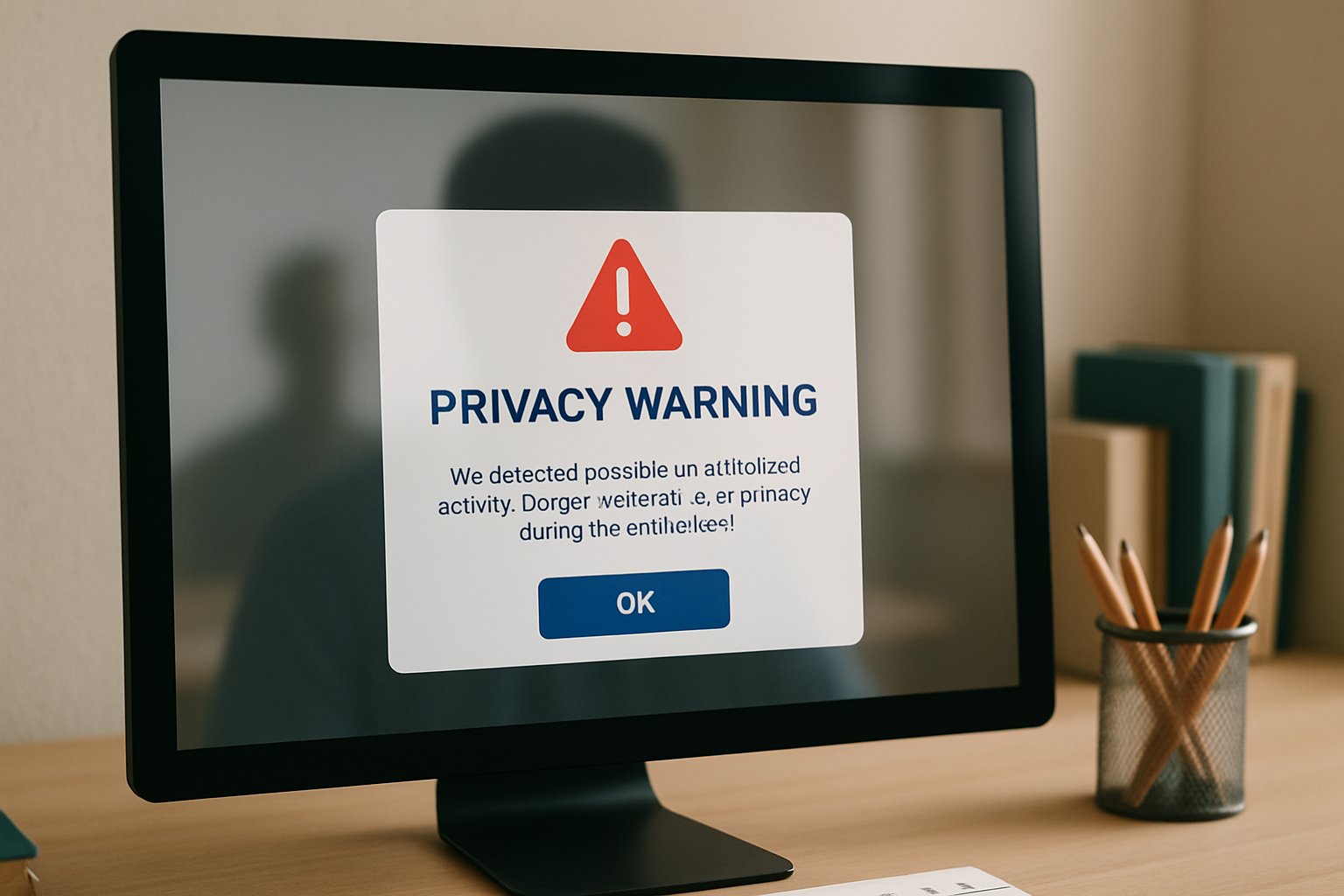
Privacy warning on computer during remote proctor software exam.
Remote proctor software provides visible privacy safeguards during testing.

Privacy concerns now shape adoption decisions and legal exposure. Next, we review the laws driving urgent change.

Evolving Global Legal Mandates

Several jurisdictions now restrict what proctoring vendors may collect. California’s Student Test Taker Privacy Protection Act allows only data strictly necessary for service delivery. The Act also demands deletion after fulfillment and rapid breach notification. Across the Atlantic, Spain’s data authority prohibited any facial-recognition during online assessments. Moreover, NIST guidance encourages alternatives to biometrics and requires measurable accuracy testing.

Consequently, providers of software for online exam proctoring must adapt contract language to these statutes.

Regulators consistently emphasize data minimization, deletion, and transparency. Consequently, contracts must embed these rules, as the next section demonstrates.

Remote Proctor Software Safeguards

Remote proctor software can operate with lighter data footprints when configured carefully. Institutions should disable unnecessary room scans, continuous audio, and full-session downloads. Instead, administrators can request periodic ID snapshots and encrypted screen share logs only. Leading vendors now offer institution-controlled encryption keys, reducing exposure if cloud storage is breached.

  • 500% usage jump during pandemic, yet 50%-78% of campuses still question privacy.
  • One exam saw over one-third of candidates falsely flagged by algorithms.
  • Global market value sits at USD 648M–834M for 2024–2026.

When remote proctor software records only essential evidence, students report higher trust and fewer complaints.

Properly tuned safeguards cut data volume without hurting detection accuracy. We now explore concrete collection principles that deliver this balance.

Principles For Data Collection

First, perform a formal data-protection impact assessment before procurement. Document each personal data field, its purpose, and planned retention window. Second, apply strict data minimization: capture metadata or short clips rather than full video, whenever possible. Third, forbid vendor secondary use and require audit logs for every access. Moreover, always allow human review of AI flags to correct machine bias.

These principles turn abstract legal demands into measurable controls. Technical options, discussed next, reinforce them further.

Privacy First Technical Choices

Edge processing keeps raw video on a candidate’s device, sending only encrypted alerts to reviewers. Obfuscation tools can blur backgrounds or faces after identity checks, protecting home privacy. Furthermore, on-device liveness detection meets NIST accuracy guidelines without creating permanent biometric templates. Several vendors integrate edge analysis into software for online exam platforms focused on privacy.

Key Edge Processing Advantages

  • Reduced bandwidth and storage overhead.
  • Lower risk during cloud breaches.
  • Improved compliance with strict jurisdictions.

Consequently, institutions gain resilience and regulatory confidence.

Technical design choices can materially shrink risk footprints. Next, we translate technology into daily operations.

Operational Privacy Best Practices

Policy must follow technology to achieve results. Below is a five-step operational checklist.

  1. Set retention to 30 days or less; automate deletion.
  2. Publish plain-language notices and FAQs before exams.
  3. Offer in-person or open-book alternatives on request.
  4. Train reviewers to avoid over-flagging and uphold accessibility.
  5. Run annual independent audits covering security and fairness.

Additionally, keep access logs and require supervisors to approve every data retrieval. Selecting remote proctor software with configurable privacy toggles simplifies policy enforcement.

Daily practice cements privacy promises made on paper. Finally, we examine tradeoffs every team must evaluate.

Balancing Privacy Risk Tradeoffs

Reducing data may slightly drop detection sensitivity for sophisticated collusion cases. Nevertheless, research shows obfuscation often lowers false positives for marginalized candidates. Moreover, shorter retention decreases breach fallout while encouraging faster appeal resolutions. Institutions should pilot different configurations and measure both integrity metrics and candidate sentiment. When metrics diverge, engage academic oversight committees to decide acceptable thresholds. Choosing the correct remote proctor software setting often resolves the tension without extra cost.

Balancing privacy and integrity demands continuous measurement and adjustment. With risks outlined, we conclude with actionable next steps.

Conclusion And Next Steps

Candidate trust hinges on three pillars: minimal data, transparent rules, and accountable technology. Institutions adopting remote proctor software with edge processing, short retention, and human review achieve measurable privacy gains. Why Proctor365? Our AI-powered platform delivers live, recorded, or automated monitoring with advanced identity verification and global scalability. Furthermore, Proctor365 remote proctor software encrypts every byte, leaving key control with your institution. Trusted by universities and certification bodies worldwide, we improve exam integrity without sacrificing candidate dignity. Choose software for online exam invigilation that respects privacy and supports fairness. Schedule a demo and protect your next assessment today at Proctor365.ai.

Frequently Asked Questions

  1. How does Proctor365 ensure exam integrity while protecting candidate privacy?
    Proctor365 integrates AI proctoring with strict data minimization, edge processing, and human review, ensuring robust exam integrity while using privacy-first measures and configurable controls to comply with global data regulations.
  2. What measures are recommended to minimize data collection during proctored exams?
    Institutions should enforce short retention periods, disable non-essential features, and capture only essential evidence like periodic snapshots, aligning with best practices to protect privacy and maintain exam integrity.
  3. How does remote proctoring technology balance privacy and fraud prevention?
    Remote proctoring technology employs edge processing to keep sensitive data on-device while recording only necessary evidence, thus minimizing breach risks and effectively using AI for fraud prevention and identity verification.
  4. Why is human review important in online proctoring settings?
    Human review corrects potential AI bias and reduces false positives, ensuring a fair assessment while validating identity verification measures and supporting the balance between privacy and robust fraud prevention.

10 Benefits of Software for Online Exam Adoption

Higher-education leaders face rising demand for flexible, secure assessment at global scale. The answer often lies in software for online exam ecosystems that pair automation with strong governance. Recent market reports forecast double-digit growth and multi-billion revenue by 2030 for these platforms. This article unpacks ten strategic benefits, real data, and practical steps for universities and credential bodies. Grasping these gains helps leaders invest wisely and defend academic integrity against evolving threats. However, strong technology alone never guarantees success. We also examine privacy trade-offs, vendor trends, and remote proctor software best practices. Every point draws from peer-reviewed studies, EDUCAUSE surveys, and recent security investigations. Implement the insights today to strengthen learner trust and operational efficiency tomorrow.

Market Growth Momentum Insights

Market intelligence firms agree on rapid expansion. MarketGrowthReports pegs the 2024 proctoring sector near USD two billion with double-digit CAGR. Cloud deployment and AI features dominate new purchases.

secure software for online exam interface on student's laptop screen
A secure software for online exam creates a reliable testing environment.

Universities sign new contracts almost monthly. CUNY, for example, retendered its proctoring agreement in 2025 to meet stricter requirements. Similar reviews appear across Europe and Asia.

Meanwhile, privacy debates shape procurement timelines. Consumer Reports exposed a source-code leak at Proctortrack, triggering fresh risk assessments worldwide. Consequently, buyers now demand independent security audits before committing funds.

In summary, demand is strong yet scrutiny is rising. Next, we explore how scaling works without ballooning costs.

Scalability And Savings Gains

Traditional paper exams require venues, invigilators, and shipping. Software for online exam systems remove those physical constraints immediately. Moreover, cloud infrastructure lets administrators launch thousands of concurrent sessions with minimal IT overhead.

Distance-learning cost analyses show per-candidate savings of 30-50% after year-one deployment. Institutions redirect those funds toward instructional design and student support. Corporate L&D leaders enjoy similar economies during certification cycles.

  • Reduced facility rental fees.
  • Automated objective grading.
  • Lower paper and shipping costs.

Collectively, these levers make budgets predictable despite enrollment swings. Ultimately, scalability delivers cash and time back to campuses. That value sets the stage for deeper integrity discussions ahead.

Software For Online Exam

This section dives into core platform components. Each module works together to create a seamless candidate journey. Remote proctor software layers on AI detection or live oversight to flag misconduct.

Key building blocks include item banks, timed delivery engines, identity verification workflows, and LMS integrations. Furthermore, audit logs capture every click, forming verifiable evidence during appeals. These features protect credential value across universities, training firms, and licensure boards.

Yet, privacy-first design remains essential. Experts recommend data minimization, clear consent, and accessible alternatives for disabled students. When these guardrails exist, software for online exam ecosystems earn institutional trust.

Effective architecture blends deterrence with transparency. Next, we examine analytics that convert exam data into learning gains.

Analytics Drive Learning Impact

Automated scoring produces instant feedback. Item-level dashboards reveal question difficulty, discrimination indices, and time-on-task patterns. Consequently, faculty spot misconceptions early and adjust lectures inside the same term.

Researchers from MDPI report adaptive testing improves measurement precision while shortening exams up to 30%. Remote proctor software ensures integrity during those adaptive pathways. Therefore, analytics and security reinforce each other.

Software for online exam frameworks also support program-level accreditation reporting. Exported CSVs enable outcome tracking across cohorts and years. Data informs resource allocation for tutoring and curriculum redesign.

Data turns assessments into continuous improvement engines. Next, we highlight flexibility benefits for distributed learners.

Flexibility For Learners Everywhere

Hybrid programs attract working professionals and global students. Online scheduling windows offer day, evening, or weekend sittings without travel. Additionally, remote proctor software adapts to low-bandwidth modes when networks falter.

Accessibility options include screen-reader compatibility, adjustable font sizes, and extended time configurations. Institutions must test these features with real users before launch. Modern exam platforms should support diverse authentication methods, including mobile ID capture.

Such flexibility boosts satisfaction scores and reduces dropout rates. Nevertheless, oversight remains crucial to uphold fairness. Governance considerations come next.

Flexible delivery expands access without compromising standards. However, governance and risk management determine long-term success.

Governance And Risk Balance

Security incidents remind leaders that not every vendor is equal. The Proctortrack leak showed unencrypted keys and outdated libraries inside production code. Therefore, campuses now request HECVAT responses and penetration test summaries before signing.

Privacy advocates also challenge room-scanning and biometric profiling. Some states even restrict certain practices or mandate opt-outs. Modern proctoring platforms must offer transparent flag review workflows to avoid bias claims.

Software for online exam deployments succeed when governance councils set policy, escalation, and data-retention windows. Campus legal teams should review vendor agreements annually. Metrics and student feedback close the loop.

Robust governance reduces legal, ethical, and reputational exposure. Finally, we outline a concise implementation roadmap.

Best Practice Roadmap Forward

Start with pedagogical goals, not technology features. Design formative quizzes, open-book finals, or projects where possible. Reserve high-stakes proctoring for licensure or accreditation demands.

Next, pilot with 200-300 students across bandwidth tiers and accessibility profiles. Gather analytics, incident rates, and student sentiment before scaling. Software for online exam metrics should guide expansion decisions.

Finally, negotiate clear SLAs for uptime, support response, and breach notification. Moreover, require third-party security audits every twelve months. Remote proctor software vendors that refuse audits signal unacceptable risk.

Following this roadmap maximizes ROI and minimizes disruption. We now close with key takeaways and a trusted partner solution.

Conclusion And Next Steps

The ten benefits show why forward-thinking institutions are shifting assessment online. They gain scalability, lower costs, richer analytics, learner flexibility, and stronger governance. However, success requires disciplined implementation and vendor due diligence. That is where Proctor365 excels. Our AI-powered remote proctor software delivers real-time anomaly detection, advanced identity verification, and elastic cloud monitoring. Trusted by global exam bodies, Proctor365 scales seamlessly from small cohorts to nationwide licensure campaigns. Institutions using our software for online exam security report faster rollout and fewer integrity incidents. Ready to elevate assessment quality? Visit Proctor365.ai and schedule a personalized demo today.

Frequently Asked Questions

  1. How does online exam software improve scalability and reduce costs?
    Online exam software eliminates venue and manual invigilation costs while leveraging cloud infrastructure. It supports thousands of concurrent sessions, offering significant savings and streamlined operations for higher education institutions.
  2. How does Proctor365 ensure robust exam integrity?
    Proctor365 uses AI-powered remote proctoring, advanced identity verification, and real-time anomaly detection. This effective combination prevents fraud and maintains a secure, compliant testing environment.
  3. What key features should institutions look for in an online exam platform?
    Institutions should seek platforms with secure identity checks, AI and live proctoring, detailed analytics, adaptive testing, and transparent audit logs to ensure robust governance and fraud prevention.
  4. How do remote proctoring solutions address privacy and accessibility concerns?
    Modern remote proctoring incorporates data minimization practices, clear consent protocols, adaptive interfaces, and secure authentication. These measures balance student privacy with the strong security needed for exam integrity.

Scaling software for online exam platforms to 10,000+ users

High-stakes exams now launch worldwide at the same minute. Consequently, technical teams must guarantee flawless experience for every candidate. The challenge intensifies once simultaneous users exceed five figures. However, modern software for online exam platforms is proving the goal is achievable. Engineering blogs, case studies, and real outages all highlight similar lessons. First, horizontal cloud design beats monolithic servers. Second, real-time media pipelines demand separate tuning. Third, unrelenting load rehearsal remains mandatory. This article distills the most recent evidence, rules of thumb, and practical checklists. Universities, certification bodies, and corporate L&D leaders can therefore plan confidently. Along the way, we spotlight remote proctor software advances that shrink labor cost while protecting integrity.

Global Exam Surge Context

Survey data shows that half of higher-ed institutions now rely on remote proctor software for major tests. Moreover, large universities routinely schedule windows with 10,000 or more concurrent candidates. QuestionPro and Examity engineering teams published postmortems describing memory leaks, network spikes, and permanent lessons learned. Meanwhile, rising privacy debate forces teams to balance surveillance with fairness. In summary, demand keeps growing while tolerance for failure shrinks.

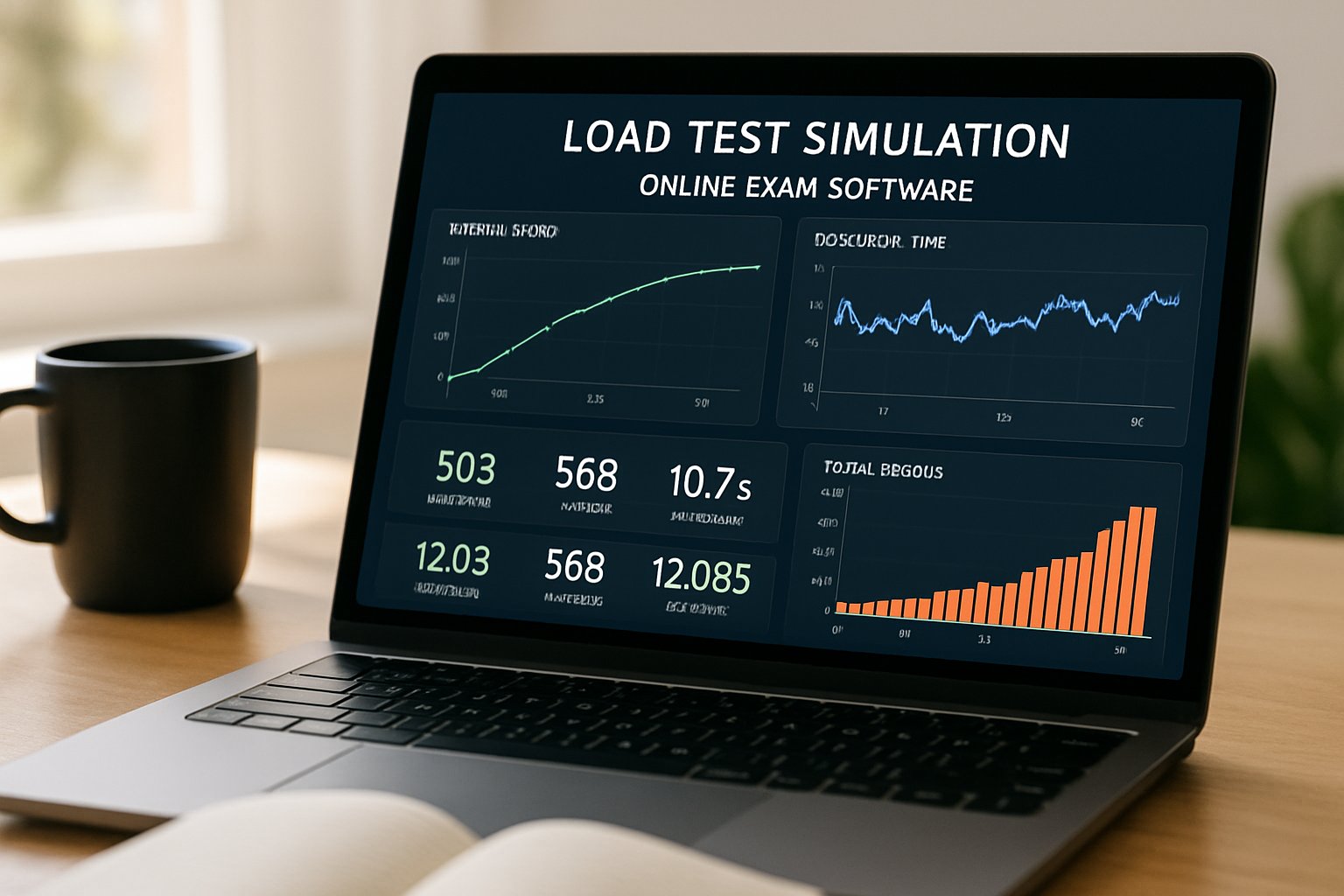
Software for online exam load testing environment with performance graphs.
Load testing ensures software for online exam platforms operates smoothly under pressure.

Consequently, architecture choices made today determine next semester’s headlines.

Software For Online Exam Scale

Successful software for online exam scale follows three unbreakable principles. First, keep application servers stateless and auto-scaled. Second, detach real-time media to SFU clusters positioned near users. Third, route heavy uploads to object storage, not transactional databases. Providers such as Examity moved fully to AWS to unlock quick regional expansion. Furthermore, SFU clustering with LiveKit or Ant Media easily multiplies capacity without code changes. Overall, these patterns create predictable elasticity.

Therefore, teams can focus on pedagogy instead of firefighting infrastructure.

Core Exam Scaling Patterns

Engineers first model expected bandwidth, CPU, and database writes. Then they map each load driver to a loosely coupled service. For real-time video, SFU nodes handle forwarding for about 800 candidates each. Moreover, session data streams into Kafka queues for downstream scoring workers. Redis caches hot exam questions while read replicas satisfy analytics dashboards. Remote proctor software layers AI flagging atop the same streams, which scales cheaply compared with hiring more staff. Without scalable software for online exam infrastructure, even perfect content will fail.

In short, modular design limits blast radius during sudden spikes.

Consequently, even record enrollments remain manageable.

Critical Bandwidth Math Essentials

Media traffic often surprises finance teams more than compute cost. A single 720p webcam stream uses around 3 Mbps. Multiply that by 10,000 and inbound bandwidth jumps to 30 Gbps. Therefore, planners add a safety margin of 50% and distribute ingest across regions. TURN relays also demand attention because many firewalls block peer connections. Remote proctor software vendors publish calculators yet institutions should validate numbers inside their own pilots.

  • Webcam stream: 2–5 Mbps per user
  • 10,000 users: 20–50 Gbps aggregate
  • Safety margin: plan 25–75 Gbps
  • SFU node: ~800 users maximum

These simple figures anchor every capacity model. Moreover, they reveal where costs will explode first.

Testing Steps Before Launch

Architects never trust spreadsheets alone. Instead, they unleash distributed k6 runners that simulate authentication, media handshake, question fetch, and submission flows. Load scripts must mirror real behavior inside the chosen software for online exam stack. Subsequently, chaos tests disable databases or drop a region to confirm graceful degradation. Teams also stage dress rehearsals with low-stakes quizzes to exercise support channels. Importantly, each run measures p95 latency, session-start success, and video frame loss. The results feed dashboards that decide the final go or no-go.

Therefore, surprises occur in rehearsal rather than during graded exams.

Cost And Risk Tradeoffs

Scaling is never free. TURN bandwidth, recording storage, and live human proctors dominate invoices. Conversely, automated AI review in remote proctor software scales almost linearly with compute, not payroll. However, false positives and privacy concerns require clear appeal workflows. When evaluating software for online exam providers, ask for detailed egress and storage cost tables. Financially, over-provisioning reduces risk yet inflates idle spend. Scheduled autoscaling plus capacity reservations strike a balance in most exam calendars.

Institutions should model worst-case cost per candidate. Subsequently, they can negotiate transparent SLAs with vendors.

Vendor Proof Checklist Guide

Before signing, request a dated stress report, regional TURN map, and retention cost quote. Moreover, insist on published incident logs and clear SLO targets. A trustworthy software for online exam vendor backs claims with third-party audits.

These documents separate marketing hype from demonstrable readiness.

Consequently, your reputation stays intact during high-stakes sessions.

Operational Readiness Summary Points

Teams must align monitoring, alerting, and on-call playbooks long before exam day. Moreover, pre-warming autoscalers and regional failover drills close the final gaps. In contrast, skipping dress rehearsals leaves blind spots that surface under pressure.

Consequently, steady operations transform technical risk into competitive advantage.

Scaling assessments to 10,000 candidates demands disciplined architecture, ruthless testing, and constant cost vigilance. The best software for online exam delivery embraces stateless services, clustered SFUs, and clear SLAs. Moreover, teams must pair solid engineering with ethical proctoring and student support.

Why Proctor365? Our AI-powered proctoring, advanced identity verification, and infinitely scalable exam monitoring ensure integrity from day one. Global exam bodies trust Proctor365 because we deliver consistent uptime, instant analytics, and privacy-first design. Experience enterprise-grade confidence by adopting our platform.

Ready to future-proof your next high-stakes session? Visit Proctor365 and discover how we turn remote proctor software challenges into competitive advantage.

Frequently Asked Questions

  1. How does Proctor365 ensure exam security and integrity?
    Proctor365 uses AI-powered proctoring, robust fraud prevention, and advanced identity verification to maintain exam integrity. These features enhance security and offer real-time analytics for a trustworthy remote testing experience.
  2. What architectural strategies help manage high numbers of concurrent exam takers?
    Modern exam platforms use horizontal cloud design, stateless services, and auto-scaled SFU clusters to manage load. These strategies ensure smooth performance even during high-stakes sessions with thousands of users.
  3. Why are load tests and dress rehearsals critical before exam day?
    Load tests and dress rehearsals simulate real exam conditions, validate system performance, and uncover potential issues. This proactive approach ensures the platform scales reliably with minimal downtime or degraded performance.
  4. What cost and risk tradeoffs should institutions consider for online exams?
    Institutions must balance TURN bandwidth, storage expenses, and auto-scaling costs against risk. Transparent SLAs and detailed stress reports help manage over-provisioning, ensuring an optimum blend of cost efficiency and system reliability.

Remote proctor software myths and student concerns explained

Online testing exploded during the pandemic. Consequently, many universities still rely on remote proctor software and related tools. Yet students continue to voice privacy, bias, and stress worries. Moreover, civil-rights cases and mixed research findings add confusion. This article separates myths from evidence, offers data, and supplies practical guidance for institutions and learners.

Remote Proctor Software Myths

Misinformation spreads fast on social media. Therefore, we debunk the most common claims.

Remote proctor software dashboard with visible privacy features and settings.
Modern remote proctor software includes privacy safeguards and user controls.
  • Myth: Companies sell biometric recordings. Fact: Policies deny resale, yet retention periods vary.
  • Myth: AI flags are final. Fact: Most contracts include instructor review and appeal windows.
  • Myth: Tools always break privacy laws. Fact: Courts only struck down specific practices, like forced room scans.
  • Myth: Only surveillance stops cheating. Fact: Research shows design changes deter misconduct, too.

These clarifications show why transparency is essential. Subsequently, institutions should publish clear proctoring FAQs.

Bias And Accuracy Gaps

NIST studies reveal demographic error gaps in facial recognition engines. However, vendor performance differs widely. One sample showed certain groups experienced higher false negatives. Automated flags inside remote proctor software can mirror these patterns. Therefore, human review and accessible appeals remain critical.

Key statistics highlight the stakes:

  1. 21.4% of science undergraduates reported distress during monitored exams.
  2. Students estimated 21.2% remote cheating versus 11.6% in person.
  3. NIST found measurable race and age variances in many algorithms.

Regular audits and diverse training data reduce bias. Consequently, institutions should demand evidence of updates.

Legal And Policy Landscape

Ogletree v. Cleveland State University ruled mandatory room scans unconstitutional. Meanwhile, European regulators scrutinize biometric monitoring rules. Vendors now highlight SOC-2 and ISO attestations to reassure clients. Yet every campus must map policies to local law.

When adopting any software for online exam security, privacy officers should ask:

  • What data elements are collected and encrypted?
  • Who reviews flagged clips, and how quickly?
  • How long will recordings stay on servers?
  • Which accommodations exist for disabilities or faith-based objections?

Clear answers build trust. Moreover, they limit legal exposure.

Student Mental Health Concerns

Anxiety spikes when webcams scrutinize every movement. Additionally, neurodivergent students risk false flags for normal tics. One Dutch student even needed a bright lamp so the algorithm could “find” her face. Such stories amplify opposition to remote proctor software.

Institutions can mitigate stress by:

  • Offering practice sessions that mimic live settings.
  • Providing written appeal instructions before each test.
  • Allowing alternative locations like proctored labs.

These steps humanize technology. Consequently, student satisfaction improves.

Practical Exam Prep Strategies

Learners should prepare systematically. Firstly, read the vendor privacy notice. Secondly, test hardware one day early. Thirdly, document glitches with screenshots. Moreover, those using software for online exam security should secure a stable connection and neutral backdrop.

If flagged, students should:

  • Note the exact timestamp and context.
  • Contact the instructor within 24 hours.
  • Request the review clip under FERPA rights.

Quick action keeps disputes objective. Therefore, outcomes tend to be fairer.

Balanced Assessment Design Alternatives

Cheating deterrence does not rely solely on surveillance. Educators now mix open-book exams, randomized question banks, and oral defenses. Moreover, many platforms embed plagiarism checkers rather than camera feeds. Integrating these designs with limited remote proctor software sessions lowers intrusion while preserving integrity.

When selecting any software for online exam protection, pair it with thoughtful pedagogy. Consequently, overall academic honesty improves.

Key takeaway: Evidence shows proctoring works best alongside strong instructional design. Institutions that balance technology, policy, and empathy earn higher trust. Therefore, continuous review remains essential.

Conclusion

Evidence debunks many fears, yet legitimate risks persist. Bias audits, clear policies, and student support safeguard fairness. Importantly, remote proctor software should complement, not replace, sound assessment strategy.

Why Proctor365? Proctor365 delivers AI-powered proctoring, advanced identity verification, and scalable monitoring trusted by global exam bodies. Consequently, institutions boost integrity without sacrificing user experience. Explore how Proctor365 can elevate your assessment security today.

Frequently Asked Questions

  1. How does Proctor365 ensure exam integrity during online assessments?
    Proctor365 employs advanced AI proctoring, real-time monitoring, and robust identity verification to maintain exam integrity and prevent fraud. The system integrates human review for flagged incidents, ensuring secure online assessments.
  2. What measures does Proctor365 implement to reduce bias and promote fairness?
    Proctor365 regularly performs bias audits and diversifies training data, combining AI proctoring with human reviews to reduce demographic error gaps. These measures ensure fairness and maintain overall exam accuracy.
  3. How does Proctor365 protect student privacy during online examinations?
    Proctor365 prioritizes student privacy by encrypting data, adhering to strict retention policies, and meeting SOC-2 and ISO compliance standards. These practices ensure exam footage is securely managed while privacy is maintained.
  4. What support does Proctor365 offer for exam disputes and technical issues?
    Proctor365 provides clear guidelines for contesting flagged incidents, including rapid instructor review and comprehensive dispute resolution. Its dedicated support team assists with technical issues, ensuring smooth and transparent exam administration.

Future-ready software for online exam ecosystems

Cheating technologies never stand still. Consequently, examination leaders now re-evaluate software for online exam delivery before each academic term. Universities, certifiers and corporate L&D teams all feel the same pressure.

Meanwhile, AI, VR, and blockchain promise fresh answers. However, regulators and professional bodies demand stronger integrity evidence. This article explores emerging trends, drawing from 2024-2026 market data and field pilots. Expect practical insights for choosing remote proctor software and designing future-proof assessments. Therefore, you will understand where to invest and where to tread carefully. Additionally, we unpack AI detection limits, VR simulations, and verifiable digital credentials. Finally, we present actionable roadmap steps. Keep reading to see how tomorrow’s test ecosystem could reshape your assessment strategy. Moreover, market size estimates show double-digit growth despite policy reversals. Industry quotes from Prometric, ACCA, and IMS Global ground our analysis in verified announcements. Understanding both optimism and caution will sharpen your competitive edge.

Secure software for online exam displayed on laptop in home office
User-friendly software for online exams brings testing integrity to every home.

Future Software For Online Exam

Global demand keeps climbing despite uneven projections. Recent reports place the market at USD 780–1,200 million for 2026. Furthermore, analysts expect 10–25% CAGR as institutions embed assessment features into learning platforms.

However, ACCA’s partial retreat from remote invigilation shows growth will not be linear. High-stakes certifiers worry that generative AI outpaces detection capabilities. Therefore, product teams now re-architect software modules for rapid algorithm upgrades. Many universities already supplement remote proctor software with stricter browser lockdown and identity checks.

Most software for online exam vendors now integrate adaptive machine-learning pipelines for threat updates.

Key point: scalability attracts buyers, but integrity drives retention. Next, we examine AI safeguards that support that retention.

AI Integrity Challenges Ahead

AI proctoring blends computer vision, audio analytics, and behavioral models. Consequently, it flags gaze shifts, unauthorized devices, or mismatched identity documents in seconds. Prometric alone monitors millions of exam hours yearly, stressing cloud efficiency.

Nevertheless, research from July 2025 warns about privacy trade-offs and algorithmic bias. Students with darker backgrounds or limited bandwidth experience higher false positive rates. Regulators now urge transparent accuracy reporting and appeals pipelines.

Institutions must therefore blend AI and human review to balance trust and scale. Selecting remote proctor software with published audit data reduces institutional liability.

Takeaway: AI brings speed but also scrutiny. Moving into VR may diversify risk and measure deeper skills.

Immersive VR Assessments Rise

VR allows candidates to practice realistic scenarios instead of ticking radio buttons. For example, Prometric partnered with Mursion to score customer service dialogue and leadership moves. Chief Assessment Officer Nikki Eatchel calls these simulations “a more authentic demonstration of ability”.

  • Assesses communication, teamwork, and situational judgment
  • Reduces answer sharing since scenarios randomize dynamically
  • Collects performance analytics impossible with paper tests
  • Engages candidates, improving completion rates by reported 15%

However, VR headsets and bandwidth constraints limit deployment in some regions. Consequently, many buyers pilot modular 2D simulations before scaling hardware purchases. Immersive tasks complement software for online exam frameworks rather than replace them.

Key point: immersive content measures complex skills. Next section examines credential security for those outcomes.

Blockchain Credentials Gain Trust

Once an assessment ends, verifying results quickly matters. Blockchain-anchored badges solve tamper concerns by embedding cryptographic proofs. IMS Open Badges 3.0 now aligns with W3C Verifiable Credentials for wallet portability.

Moreover, employers can scan a hash and confirm authenticity within seconds. Pilot universities report faster hiring decisions and fewer transcript requests. Integrating remote proctor software logs with blockchain meta-data adds another integrity layer. Yet software for online exam ecosystems must still handle credential revocation events in real time.

Takeaway: verifiable credentials close the assessment loop. But issuing them at scale demands clear adoption plans.

Strategic Adoption Roadmap Steps

Firstly, audit your existing exam workflows and data privacy obligations. Secondly, map desired competencies to delivery modalities, including VR where appropriate. Thirdly, shortlist software for online exam platforms that publish independent security audits. Finally, pilot remote proctor software under real bandwidth conditions before contract signing.

  1. Define success metrics and appeals processes.
  2. Train staff on ethical AI use.
  3. Communicate privacy terms to candidates.

Summary: a structured roadmap mitigates risk. Our conclusion ties these elements together.

Standards Driving Credential Interoperability

Standards remove vendor lock-in and future-proof investments. Therefore, insist on Open Badges 3.0 and W3C conformance during procurement. Additionally, ask vendors for real issuance numbers, not merely pilot promises.

Consequently, your learners can store proofs in self-sovereign wallets and share selectively. This improves compliance with emerging privacy laws.

Key takeaway: open standards sustain long-term value. We now close with final recommendations.

AI, VR, and blockchain now shape assessment strategies across universities, certification bodies and enterprises. Consequently, leaders must balance scalability with privacy, fairness, and authentic skill measurement. Institutions that embrace open standards, immersive tasks, and audited AI gain a decisive advantage. Regular roadmap reviews keep technology aligned with policy shifts like the ACCA decision.

Proctor365 delivers software for online exam integrity you can trust. Our AI-powered proctoring detects anomalies in real time while advanced identity verification stops impersonation. Furthermore, scalable cloud monitoring supports thousands of candidates concurrently. Global exam bodies already rely on Proctor365 for secure, seamless testing. Visit Proctor365.ai to protect your next assessment today.

Frequently Asked Questions

  1. How does AI proctoring enhance exam integrity?
    AI proctoring uses computer vision, audio analytics, and behavioral models to flag suspicious activity. Proctor365’s solution provides real-time detection and identity verification, ensuring effective fraud prevention.
  2. What role does VR play in modern assessments?
    VR assessments offer immersive, realistic simulations to evaluate soft skills such as teamwork and situational judgment. They enhance candidate engagement and provide dynamic exam experiences aligned with future testing trends.
  3. How does blockchain improve credential security?
    Blockchain technology anchors digital credentials with cryptographic proofs. This tamper-proof approach enables instant verification and real-time credential updates, ensuring secure and reliable exam result validation.
  4. Why is a structured adoption roadmap important for remote proctoring?
    A structured roadmap guides the audit of existing workflows, integration of AI proctoring and identity verification, and ensures software scalability. It helps institutions meet regulatory compliance while enhancing exam integrity

Reliable Internet for Online Exam Proctoring

Online exam proctoring only works when every pixel reaches the cloud without delay. Candidates, instructors, and IT teams therefore need crystal-clear guidance on network speed. Moreover, bandwidth planning directly affects exam integrity, candidate stress, and institutional reputation. This article translates vendor specifications into practical numbers and workflows you can deploy before the next proctored online test session.

Online Exam Proctoring Speeds

Vendors now publish stricter minima than five years ago. Pearson OnVUE states 6 Mbps down and 3 Mbps up, while Examity prefers 10 Mbps symmetrical. Consequently, a single benchmark no longer fits all scenarios. Institutions should map each proctored online test workflow to its specific network tier.

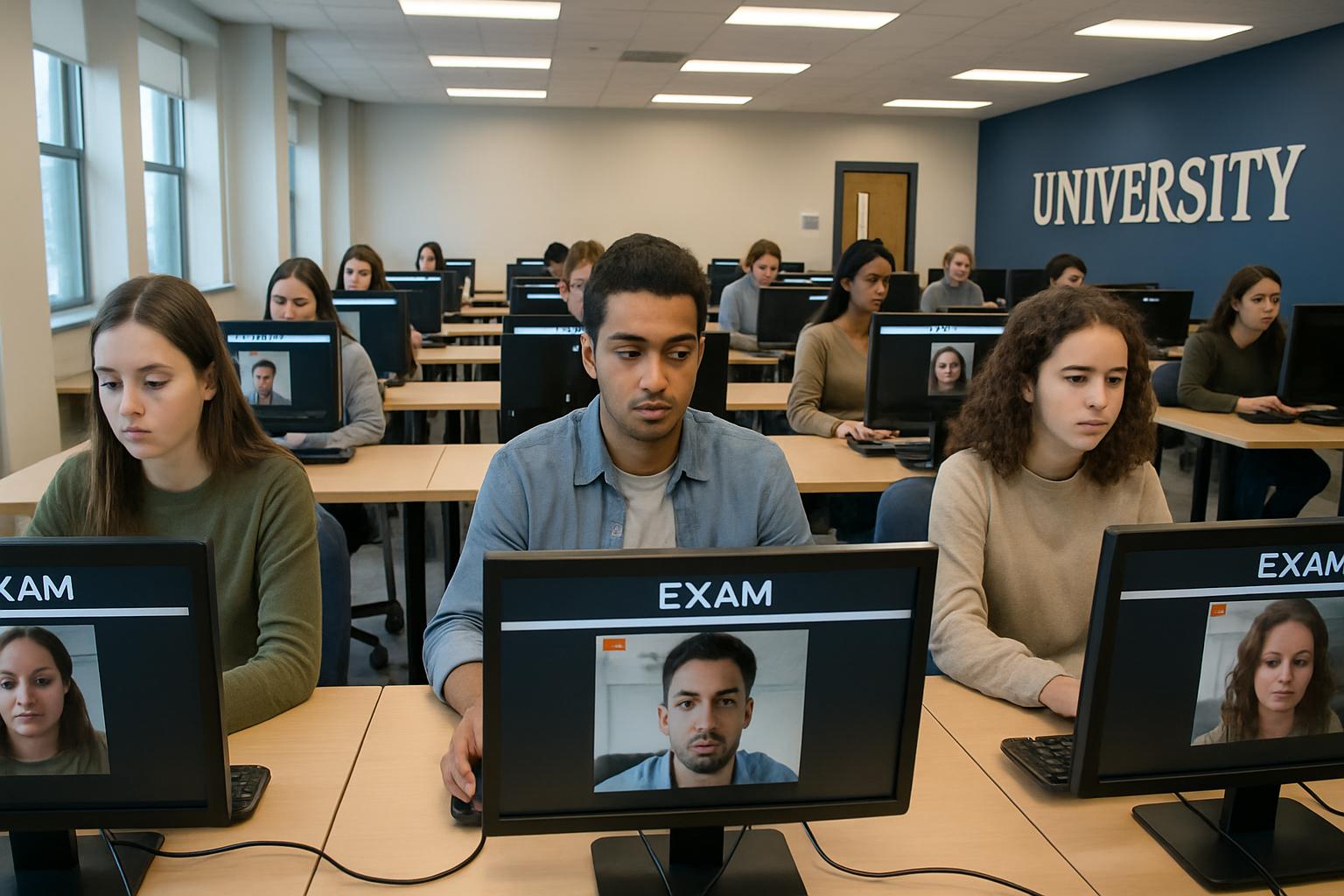
University lab with students using online exam proctoring systems on desktop computers.
A reliable university lab setup facilitates effective online exam proctoring.

Across the industry, two tiers dominate. Automated record-and-review products normally function at 3 Mbps down and 1-3 Mbps up. Live human-proctored sessions, especially high-stakes certifications, demand 6-10 Mbps down and 2-5 Mbps up with latency below 50 ms. Those numbers form the backbone of the remaining recommendations.

Why Network Speed Matters

Upload capacity drives video clarity because the candidate pushes video frames to the server. A congested uplink produces dropped frames and false flags. Furthermore, low latency reduces reconnect times after momentary blips and decreases buffer underruns during screen sharing.

WebRTC statistics show a 720p webcam stream averages 1-3 Mbps each way. Therefore, running a second camera or full-screen share easily doubles the requirement. Summarizing, robust upload and stable ping safeguard both candidate experience and audit quality. In short, speed equals confidence.

Baseline Bandwidth Target Levels

Single User Practical Minimums

For one candidate on an automated workflow, target 3 Mbps down and 1-3 Mbps up. Additionally, insist on wired Ethernet whenever possible. Wi-Fi remains acceptable only when signal strength is excellent and household traffic stays silent during the proctored online test window.

High Stakes Exam Bandwidth

High-stakes or live sessions require more headroom. Aim for 6-10 Mbps down and 2-5 Mbps up. Moreover, test latency; anything above 100 ms increases timeout risk. Finally, schedule the exam when roommates are not streaming 4K content.

  • Automated webcam only: 3 / 1 Mbps minimum.
  • Automated plus screen share: 5 / 2 Mbps recommended.
  • Live proctor with desktop feed: 6-10 / 2-5 Mbps strongly advised.

These targets mirror Pearson, ProctorU, and SmarterProctoring guidance. Consequently, following them minimizes last-minute surprises.

Mitigating Online Connectivity Risks

Even perfect bandwidth cannot fix careless setups. Therefore, implement a mandatory system check 24-72 hours before every proctored online test. The check confirms camera, microphone, browser, and network speeds on the exact device that will be used.

Next, instruct candidates to close cloud backups, game launchers, and video calls. Meanwhile, institutions should publish a hotline number for real-time troubleshooting. When issues still surface, quick escalation prevents abandoned sittings. Summarizing, preparation plus support equals resilience.

Institutional Action Plan Checklist

Universities and corporate L&D teams can embed the following workflow:

  1. Publish vendor-aligned speed tables and latency caps.
  2. Require automated pre-exam checks and collect screenshots as proof.
  3. Offer wired workstations on campus for students lacking broadband.
  4. Maintain an incident log and provide resit options after verified outages.
  5. Audit proctoring vendors for encryption, retention, and compliance.

These steps create transparency, fairness, and reliability. Consequently, stakeholder trust increases with every successful session.

Equity concerns remain. Pew data shows roughly 20% of U.S. adults still lack home broadband. Therefore, always plan alternative sittings or loaner hotspots. By doing so, programs uphold access without lowering security.

In conclusion, matching the right bandwidth tier to each exam type, enforcing system checks, and documenting clear fallback plans will keep online exam proctoring sessions smooth and defensible.

Conclusion

Reliable bandwidth, low latency, and disciplined pre-exam checks form the trio that secures every online exam proctoring session. Follow the 3 / 1 Mbps rule for automated workflows and the 6-10 / 2-5 Mbps rule for live, high-stakes sittings. Moreover, publish clear requirements, provide wired alternatives, and support candidates facing connectivity gaps.

Why Proctor365? Our AI-powered proctoring platform combines advanced identity verification, scalable monitoring, and global trust to deliver uncompromised online exam proctoring. Institutions worldwide maintain integrity while candidates test with confidence. Experience the difference today at Proctor365.

Frequently Asked Questions

  1. Why is network speed critical for online exam proctoring?
    A fast network ensures high video clarity and low latency, which minimizes dropped frames and delays. This stability is crucial for maintaining exam integrity and providing a seamless candidate experience.
  2. What are the bandwidth requirements for automated and live proctored sessions?
    Automated proctoring typically requires around 3 Mbps down and 1–3 Mbps up, while live sessions demand 6–10 Mbps down and 2–5 Mbps up with low latency to ensure accurate video streaming and exam integrity.
  3. How can institutions mitigate online connectivity risks during exams?
    Institutions can reduce connectivity risks by conducting mandatory pre-exam system checks, enforcing wired connections, and offering real-time technical support, which together secure the proctored exam environment.
  4. What makes Proctor365’s AI proctoring unique for online exams?
    Proctor365’s AI proctoring integrates advanced identity verification, fraud prevention, and scalable monitoring, providing a robust, secure exam environment that upholds integrity and boosts candidate confidence.

Ethical AI: Governing Online Exam Proctoring Effectively

Students now sit proctored online test sessions from bedrooms, boardrooms, and remote classrooms worldwide.

Consequently, institutions rely on online exam proctoring to defend integrity without physical test centers.

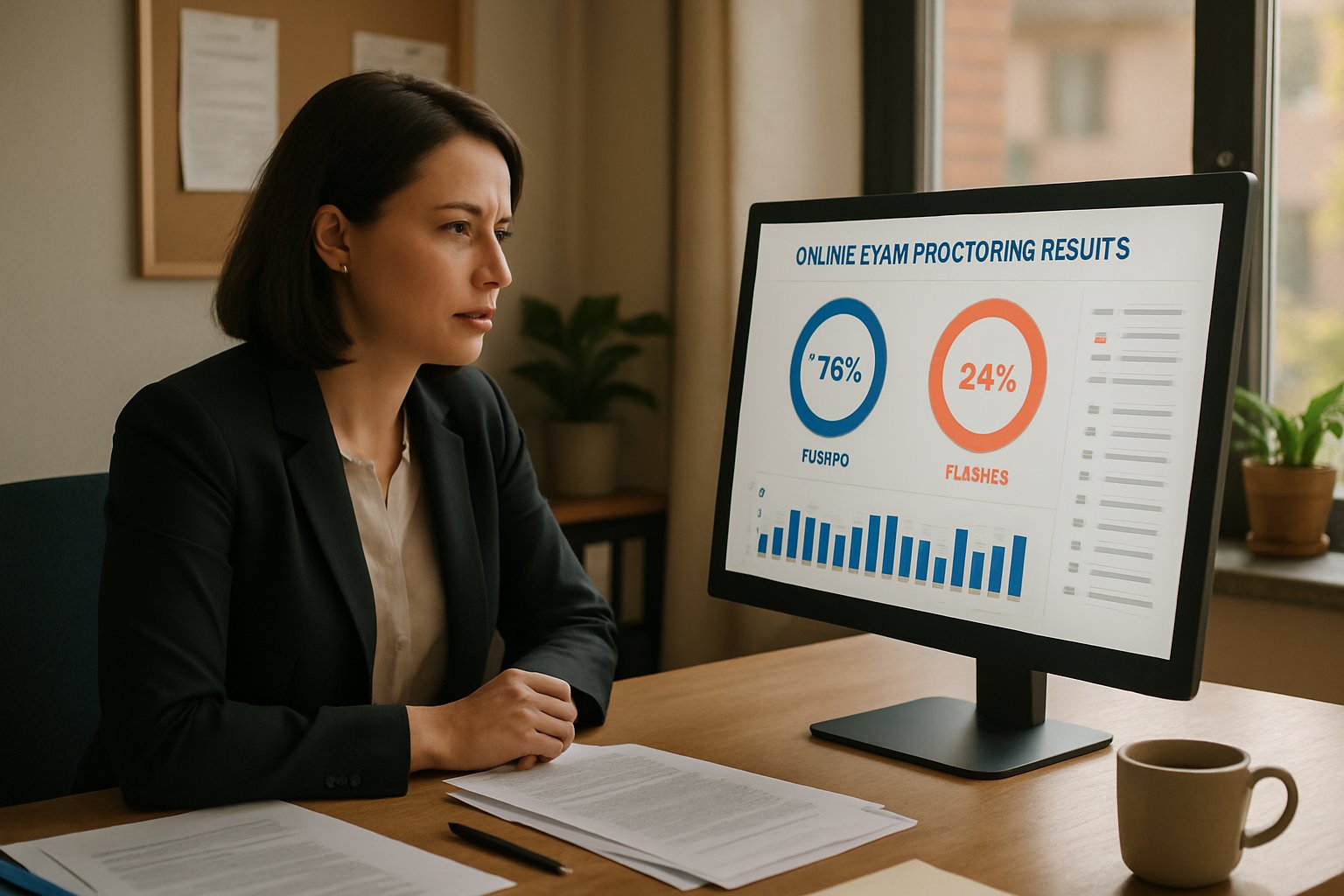
HR manager reviews online exam proctoring data in office environment
Corporate HR utilizes online exam proctoring analytics for training assessments.

However, fast adoption has raised pointed ethical questions about bias, privacy, and regulatory oversight.

This article unpacks the market forces, policy changes, and technical safeguards shaping ethical AI supervision.

Moreover, it offers practical steps for universities, corporations, and certification boards evaluating modern solutions.

Read on for a concise, expert guide grounded in current research and real-world deployments.

Meanwhile, regulators worldwide tighten rules that directly affect procurement contracts.

Therefore, understanding both opportunities and obligations has never been more crucial.

This guide equips decision-makers with data, case studies, and actionable checklists for upcoming evaluations.

Ultimately, informed choices protect learners, reputations, and qualification value.

Global Market Growth Drivers

Global demand for secure remote assessment keeps climbing.

Market reports place proctored online test revenues between $1 billion and $9 billion, depending on scope.

Furthermore, over 40% of commercial platforms now embed AI features that reduce staffing costs at scale.

Adoption remains highest in North America, yet APAC growth rates already outpace other regions.

In short, strong convenience, scalability, and cost savings fuel sustained investment.

Yet numbers alone reveal nothing about fairness or trust.

Next, we examine responsible online exam proctoring principles guiding ethical adoption.

Responsible Online Exam Proctoring

Ethical AI demands transparency across every algorithmic stage.

Consequently, vendors increasingly publish model descriptions, data-flows, and human-review protocols.

Many tools use face detection instead of face recognition to cut privacy exposure.

Additionally, behaviour analytics flags unusual patterns, yet final judgment should remain with a trained reviewer.

Human-in-the-loop designs protect candidates from automated false accusations.

Taken together, these practices build initial trust among diverse test takers.

Nevertheless, critics highlight persistent bias and accessibility gaps begging deeper scrutiny.

The following section explores those pressures in detail.

Mounting Ethical Use Pressures

Research finds higher false-flag rates for darker skin tones and some disabilities.

Moreover, student groups describe anxiety from intrusive webcam views during a proctored online test at home.

Such issues erode confidence in online exam proctoring across campuses and certification centers.

Privacy advocates, including EPIC, argue that opaque data retention violates meaningful consent.

Meanwhile, Stanford’s multi-year pilot recommends alternative assessments when technology disadvantages candidates.

Clearly, unchecked automation risks inequitable outcomes and reputational harm.

Ethical pressure now influences purchasing decisions as much as cost.

Regulators have also stepped in, shaping the next conversation.

Regulatory Landscape Rapid Shifts

The EU AI Act labels many educational AI tools high-risk, triggering strict oversight obligations.

Therefore, providers must document accuracy, embed human supervision, and enable detailed logging.

Institutions deploying online exam proctoring within Europe must meet those high-risk requirements or face penalties.

In contrast, the United States relies on overlapping state privacy laws and FERPA protections.

However, advocacy complaints still drive enforcement and public scrutiny.

Beyond legislation, ISO/IEC 42001 offers an auditable framework for responsible AI management.

Some vendors already advertise certification, though independent verification remains essential.

Regulation now defines baseline expectations and procurement checklists.

Organizations ignoring compliance face legal and reputational exposure.

Next, we present concrete mitigation steps for immediate implementation.

Implementing Practical Mitigations

Effective safeguards begin with transparent data practices for online exam proctoring deployments.

Collect only essential signals, prefer edge processing, and delete recordings quickly.

  • Independent audits covering demographic accuracy.
  • Human review before sanctions.
  • Accessible alternatives for disabled candidates.
  • Clear consent and opt-out paths.

Furthermore, service-level agreements should cap acceptable false-flag rates and mandate breach notifications.

Procurement teams must embed these clauses early, not after issues emerge.

These safeguards ensure every proctored online test follows clear, fair, and auditable rules.

Solid mitigations transform ethical principles into enforceable contracts.

They also reassure leadership and learners alike.

Choosing the right vendor is the next critical step.

Choosing Trusted Vendors Wisely

Vendor selection should prioritize verifiable evidence over glossy brochures.

Request detailed online exam proctoring audit results, dataset demographics, and human-review statistics.

Additionally, interview reference institutions about sanction outcomes and support responsiveness.

Compare marketing claims against published EU AI Act alignment statements and ISO certificates.

When possible, pilot the platform with a small, diverse cohort before large rollouts.

Objective evidence shields organizations from avoidable backlash.

With a vetted partner secured, attention turns to future innovation.

Future Outlook Insights Ahead

Multi-modal sensors, explainable models, and privacy-preserving techniques will soon redefine AI oversight.

Consequently, stakeholders should expect continuous updates to standards and campus policies.

Nevertheless, human judgment will remain central while algorithms mature.

Institutions that embed ethical guardrails today can adopt innovations confidently tomorrow.

The path forward blends technical progress with principled governance.

Our conclusion distills key lessons and next steps.

Conclusion and Next Steps

Ethical AI transforms online exam proctoring from a surveillance risk into a trusted learning safeguard.

Market growth, regulatory pressure, and student activism now converge, demanding transparency, fairness, and human oversight.

Stakeholders should apply rigorous audits, clear consent workflows, and strong accessibility accommodations.

Those steps protect learners while strengthening credential value.

Why Proctor365? Our AI-powered proctoring blends advanced identity verification with scalable, cloud-native monitoring.

Moreover, global exam bodies trust Proctor365 to uphold integrity without compromising privacy or user experience.

Experience secure, compliant, and efficient assessments by visiting Proctor365 today.

Frequently Asked Questions

  1. What ethical challenges are associated with online exam proctoring?
    Online exam proctoring raises ethical challenges such as privacy concerns, bias in AI algorithms, and potential over-surveillance. These issues require transparent data practices and human oversight to ensure fairness and maintain exam integrity.
  2. How does Proctor365 ensure exam integrity and prevent fraud?
    Proctor365 leverages AI proctoring combined with robust identity verification and fraud prevention measures. Our system uses cloud-native monitoring and human-in-the-loop review to ensure secure, compliant, and fair assessments.
  3. What steps should institutions take when selecting a proctoring vendor?
    Institutions should review vendor audit results, verify compliance with regulations, and assess human-review protocols. Requesting detailed demographic data and pilot testing samples can help ensure ethical, secure, and efficient exam proctoring.
  4. How do evolving regulations impact online exam proctoring services?
    Evolving regulations, like the EU AI Act and state privacy laws, require vendors to maintain transparency, human oversight, and accurate logging. Compliance with these rules ensures services are ethical, secure, and aligned with industry standards.

Automated Identity Verification in Online Exam Proctoring

Remote learning surged, and online exam proctoring became essential within months. Institutions loved the scale but soon faced identity fraud and AI-driven cheating. Automated verification now stands at the center of every proctored online test workflow. This article unpacks current methods, market shifts, benefits, and risks. Because the threat landscape evolves weekly, leaders must grasp how each technology layer works. We use 2024-2026 data, vendor claims, and legal cases to guide decisions. Moreover, we highlight practical procurement tips that protect test integrity and student rights. Finally, we show why adaptive, certified liveness checks matter more than ever. Market forecasts predict double-digit growth for identity-centric proctoring, yet major exam bodies retreat. For example, ACCA will scrap most remote sittings in March 2026 after widespread AI abuse. Understanding that paradox is critical for every assessment leader today.

Identity Checks Rapidly Evolve

Most platforms begin with document capture and OCR. The candidate photographs a government ID. Algorithms extract text, verify holograms, and flag tampering cues. Then one-to-one face matching compares the ID photo with a live webcam selfie. This first gate remains vital for online exam proctoring because it deters quick impersonation attempts. However, forged documents and credential sharing still slip through single snapshots.

Online exam proctoring identity check process onscreen with visible human face.
Identity verification is an essential part of secure online exam proctoring.
  • MRFR valued the market at USD 2.1 billion during 2024.
  • More than 40% of platforms adopted facial recognition by 2024.
  • Independent PAD labs recorded zero spoofs across 1,500 attacks for some vendors.

Document plus face checks scale easily. Yet better liveness is required; the next section explains recent PAD gains.

Liveness Detection Gets Tougher

Deepfakes and silicone masks forced vendors to harden anti-spoofing. Level-2 ISO 30107-3 certifications from iBeta and FIME dominated 2024-2025 headlines. 1Kosmos, Identy.io, and others achieved perfect scores during controlled evaluations. Passive liveness now analyzes subtle texture and lighting cues while users proceed naturally. Active prompts, such as head turns, remain available for poor camera conditions. Both modes now guard a proctored online test against replay video attacks. Consequently, institutions strengthen online exam proctoring by requiring Level-2 proof in contracts.

Modern PAD blocks most casual spoofs. However, continuous monitoring remains essential, as the following section shows.

Continuous Authentication Gains Traction

Single checkpoints fail when imposters tag-team mid-session. Therefore, platforms record gaze, keystroke rhythm, and mouse cadence throughout the sitting. Machine-learning models compare these signals to baseline enrollment profiles. Alerts trigger when patterns deviate sharply, prompting human review. Early research reports encouraging accuracy, yet false positives affect neurodivergent students. During a proctored online test, head-pose drift can wrongly flag restless examinees. When combined with online exam proctoring analytics, behavior data delivers real-time identity assurance.

Continuous signals keep imposters out. Yet privacy and bias debates intensify, as discussed next.

Privacy Bias Concerns Escalate

Face recognition algorithms still show demographic gaps, according to NIST FRVT studies. Students wearing hijabs or with darker skin report higher false rejection rates. Room-scan lawsuits, like Ogletree v. CSU, highlight privacy boundaries courts may enforce. Senators continue to question opaque algorithms and expansive data retention policies. A misflag during a proctored online test can disrupt careers and invite legal claims. Therefore, any online exam proctoring rollout must publish clear appeals and deletion procedures.

Transparency eases student anxiety. Procurement teams can codify safeguards, as the next guide explains.

Strategic Procurement Playbook Guide

Begin with a detailed matrix covering threats, disability access, and legal mandates. Demand independent PAD and FRVT letters, plus demographic disaggregated bench results. Moreover, insist on data-retention caps, audit clauses, and human review service-level agreements.

  • Ask for anonymized false-positive statistics each semester.
  • Require BIPA compliance for biometric storage in US regions.
  • Test with low-bandwidth devices before campus-wide rollout.

Such diligence ensures online exam proctoring aligns with institutional ethics and risk appetite. It also protects every proctored online test from needless litigation.

Strong contracts reduce surprises. Finally, we must anticipate emerging threats.

Future Threats And Defenses

Cheaters increasingly orchestrate deepfake video relays and real-time language model coaching. Multi-camera setups, browser locks, and multimodal fusion now counter these sophisticated plots. However, platform privileges create new attack surfaces, so vendors must harden code security. Experts predict an arms race, yet layered analytics will slow fraud momentum. Continual innovation keeps online exam proctoring viable even as tactics evolve.

Threats grow, yet layered AI fights back. The conclusion summarises and shows Proctor365’s edge.

Conclusion And Next Steps

Automated identity verification now blends document scans, liveness PAD, behavioral analytics, and secure browsers. Together these layers deliver scalable integrity for every credentialing program. Yet leaders must balance fairness, privacy, and constant technical upgrades.

Why Proctor365? Our AI-powered platform unites advanced identity verification, certified liveness, and continuous analytics. Consequently, we scale monitoring from a single class to global certification networks without friction. Trusted by universities and professional boards, our solution elevates online exam proctoring reliability. Visit Proctor365.ai to safeguard every proctored online test today.

Frequently Asked Questions

  1. How does Proctor365 ensure exam integrity during remote tests?
    Proctor365 employs AI-powered identity verification, certified liveness detection, and continuous behavioral analytics to prevent fraud and impersonation, ensuring secure and reliable online exam proctoring.
  2. What measures does Proctor365 use to prevent cheating?
    Our platform integrates advanced document capture, one-to-one face matching, and robust liveness PAD to counter deepfakes and impersonation, effectively reducing fraud in proctored online tests.
  3. How is identity verification handled in online exam proctoring?
    Proctor365 verifies identity using government ID scans, OCR, and real-time face matching, combining these with continuous monitoring to maintain rigorous exam integrity.
  4. How does Proctor365 address privacy concerns during proctored tests?
    We prioritize transparency and fairness by implementing clear data usage policies, secure biometric storage, and robust appeals procedures, ensuring privacy while maintaining exam security.