Your top student asks a familiar question minutes before a remote final: “Can I leave for the restroom?” Despite widespread online test monitoring, the answer still depends on who controls the exam. Institutions, vendors, and disability offices each shape bathroom break rules.
This article unpacks those policies for universities, ed-tech partners, and corporate L&D teams. We map the latest vendor guidance, legal obligations, and student welfare considerations. You will leave ready to craft consistent, defensible rules before your next remotely proctored exam.
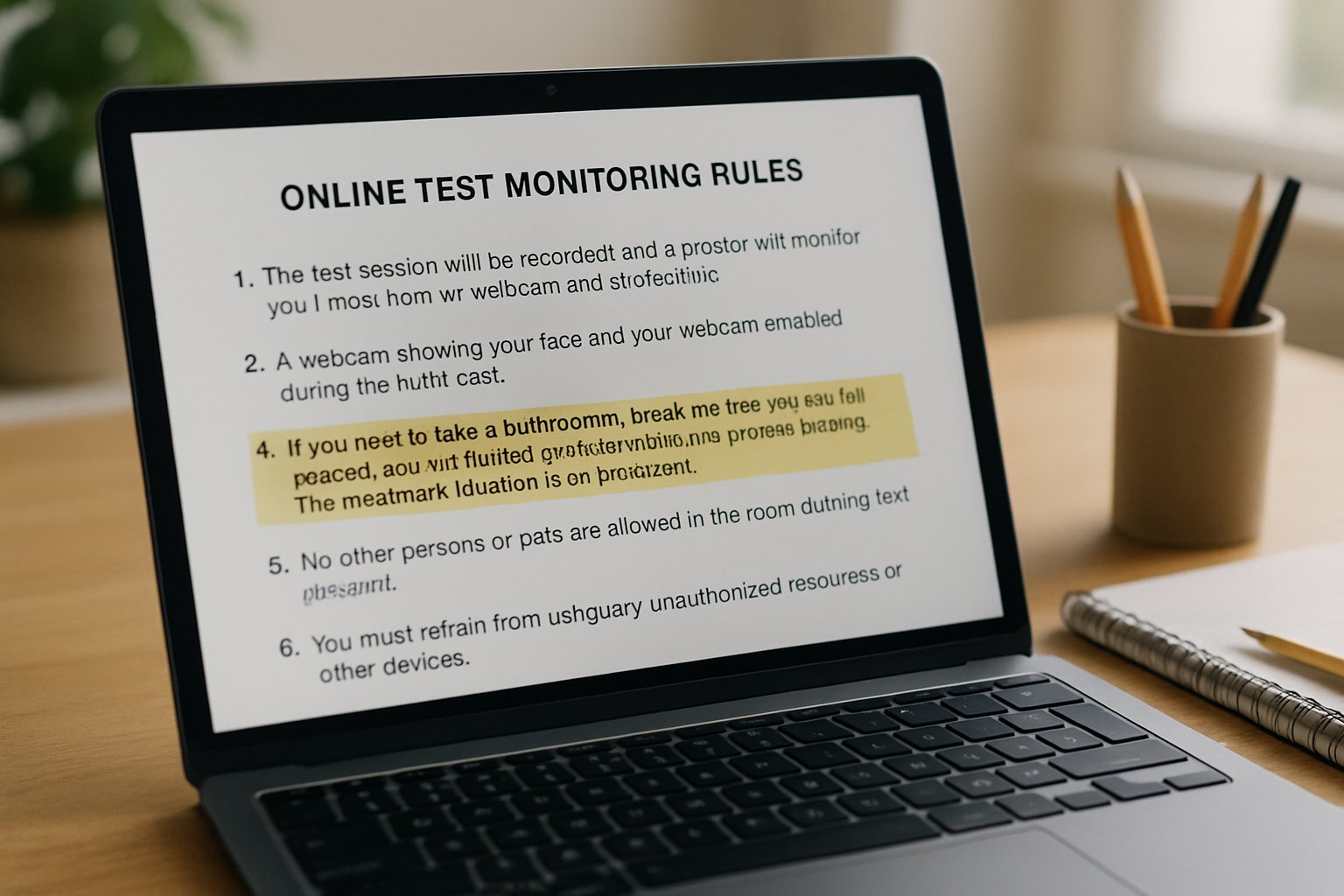
Remote bathroom guidance now appears in vendor FAQs, disability policies, and tech press headlines. Consequently, administrators must synthesize scattered information into one consistent rule set. This guide distills that material, referencing Pearson VUE, ProctorU, and LSAC policies. It also provides actionable checklists your team can deploy before the next testing window. Read on to protect exam integrity without sacrificing student health or legal compliance. Prepared leaders prevent panic.
Online Test Monitoring Rules
First, understand the hierarchy governing bathroom breaks. Most exams rely on online test monitoring settings defined by the exam owner.
Consequently, a university might forbid any camera departure, while a certification board allows timed breaks. The vendor platform only enforces what the administrator selects.
In short, policies differ because power sits with the test owner. Next, examine how major vendors translate those choices into rules.
Why Policies Often Vary
However, several forces shape break permissions. Academic integrity teams fear unsupervised minutes during a remotely proctored exam. Meanwhile, disability advocates highlight medical needs requiring flexible scheduling.
Therefore, institutions tread a line between online test monitoring security, accessibility, and reputation. Market research shows remote proctoring remains a multimillion-dollar fixture in higher education. Careful policy review helps prevent public controversy.
Policies vary because each stakeholder values risk differently. Now, see how platforms codify these preferences.
Common Vendor Break Rules
Vendor documents reveal stark contrasts. Pearson VUE OnVUE forbids any exit; leaving can automatically terminate the session. ProctorU defers to the exam owner, yet still records movement logs.
Proctorio encourages allowing bathroom breaks, provided re-authentication occurs on return. Consequently, two exams on the same platform may apply different break logic.
During a remotely proctored exam, leaving the camera view can trigger an auto-termination.
- No-break mode: timer continues; session ends if camera empty.
- Timed break mode: clock keeps running; re-scan required.
- Accommodation break mode: extra time added; documentation filed.
These patterns help online test monitoring administrators predict candidate behavior. Next, weigh accessibility implications.
Accessibility And Fairness Needs
Equity demands break flexibility for some candidates. A remotely proctored exam must respect documented medical or disability needs under ADA guidelines. Moreover, many institutions grant extra time or scheduled pauses after reviewing accommodation letters.
However, last-minute requests often fail because settings are locked 48 hours before launch. Therefore, proactive communication protects both student welfare and exam integrity.
Fair policies blend compassion with verification. The next subsection outlines a clear request workflow.
Accommodation Request Steps Guide
- Submit documentation to disability office at least two weeks ahead.
- Confirm approval in writing.
- Notify the proctoring vendor through the exam owner.
- Test settings get updated; verify confirmation.
Following these steps minimizes confusion on exam day, consequently reducing incident reports. Effective online test monitoring must coexist with these accommodations without introducing bias.
Creating Clear Exam Instructions
Transparent messaging prevents surprise bathroom requests mid-session. Include break rules in the syllabus, the test invitation, and the launch chat.
Moreover, embed a quick reference inside the assessment platform banner. Students can glance up and confirm whether a restroom trip ends the attempt.
Consistent online test monitoring directions cut down live proctor interventions. Next, prepare your staff and learners.
Remind candidates that a remotely proctored exam often keeps the timer running during any departure.
Practical Exam Prep Checklist
Administrators need a repeatable routine before every assessment. Consequently, many teams run a dry-run session to validate webcams, ID scans, and break settings.
Use the following quick checklist:
- Publish break rule summary 72 hours prior.
- Verify online test monitoring configuration matches policy.
- Confirm proctors understand re-authentication flow.
- Post support contacts for technical issues.
A disciplined checklist prevents last-minute chaos. Finally, consider where policy trends appear headed.
Future Policy Outlook Trends
Remote assessment and online test monitoring are evolving alongside privacy regulations and AI analytics. Moreover, some campuses now pilot open-book formats that lower surveillance demands. Yet high-stakes certifications still lean on rigorous controls.
Industry experts expect hybrid human-plus-AI models to dominate. Therefore, flexible bathroom policies will likely stay configurable per exam.
Staying current requires periodic policy reviews with stakeholders. Let us end with actionable takeaways.
Bathroom break rules hinge on the exam owner, the vendor, and accommodation law. Know the hierarchy, document decisions, and clarify them early. Apply accessibility principles, maintain security logs, and test configurations well before launch.
Why Proctor365? Our AI-powered platform delivers reliable online test monitoring with advanced identity verification, scalable exam supervision, and global trust. Consequently, universities, certification boards, and corporations secure assessments without silencing candidate needs. Explore how Proctor365 fortifies exam integrity today. Visit Proctor365 to safeguard your next assessment.
Frequently Asked Questions
- What are the common vendor guidelines regarding bathroom breaks in remotely proctored exams?
Vendor policies vary; some completely disallow breaks while others permit timed or accommodation breaks. Exam owners set these rules with re-authentication to maintain exam integrity. - How does online test monitoring enhance exam security?
Online test monitoring employs real-time AI proctoring, fraud prevention, and identity verification to safeguard exam integrity and ensure consistent, secure enforcement during remotely proctored assessments. - How does Proctor365 ensure fair accommodation for exam break requests?
Proctor365 integrates flexible settings for documented medical needs while maintaining strict online test monitoring, using AI proctoring and fraud prevention to comply with ADA guidelines and secure exam sessions effectively. - What steps should institutions take to prepare for remotely proctored exams?
Institutions should publish clear break rules, conduct dry runs to verify hardware and settings, update policies well in advance, and train proctor staff to ensure a seamless and secure remotely proctored exam environment.