Introduction
Universities now rely on proctoring software for online exam integrity as enrollment shifts digital. However, sole automation raises fairness, privacy, and cost concerns. Consequently, hybrid models mixing AI vigilance and human judgment dominate current adoption. This article explores best practices, regulatory triggers, and strategic tips for decision makers. Furthermore, we highlight how proctoring software for online exam ecosystems can scale without sacrificing equity. Readers will leave with actionable checklists and data backed by global policy moves. Exam bodies, ed-tech platforms, and L&D teams all face similar scaling pressure. Meanwhile, student advocates demand transparency and accommodation. The hybrid answer appears simple yet requires disciplined execution. This guide compresses recent research, policy guidance, and market data into practical takeaways.
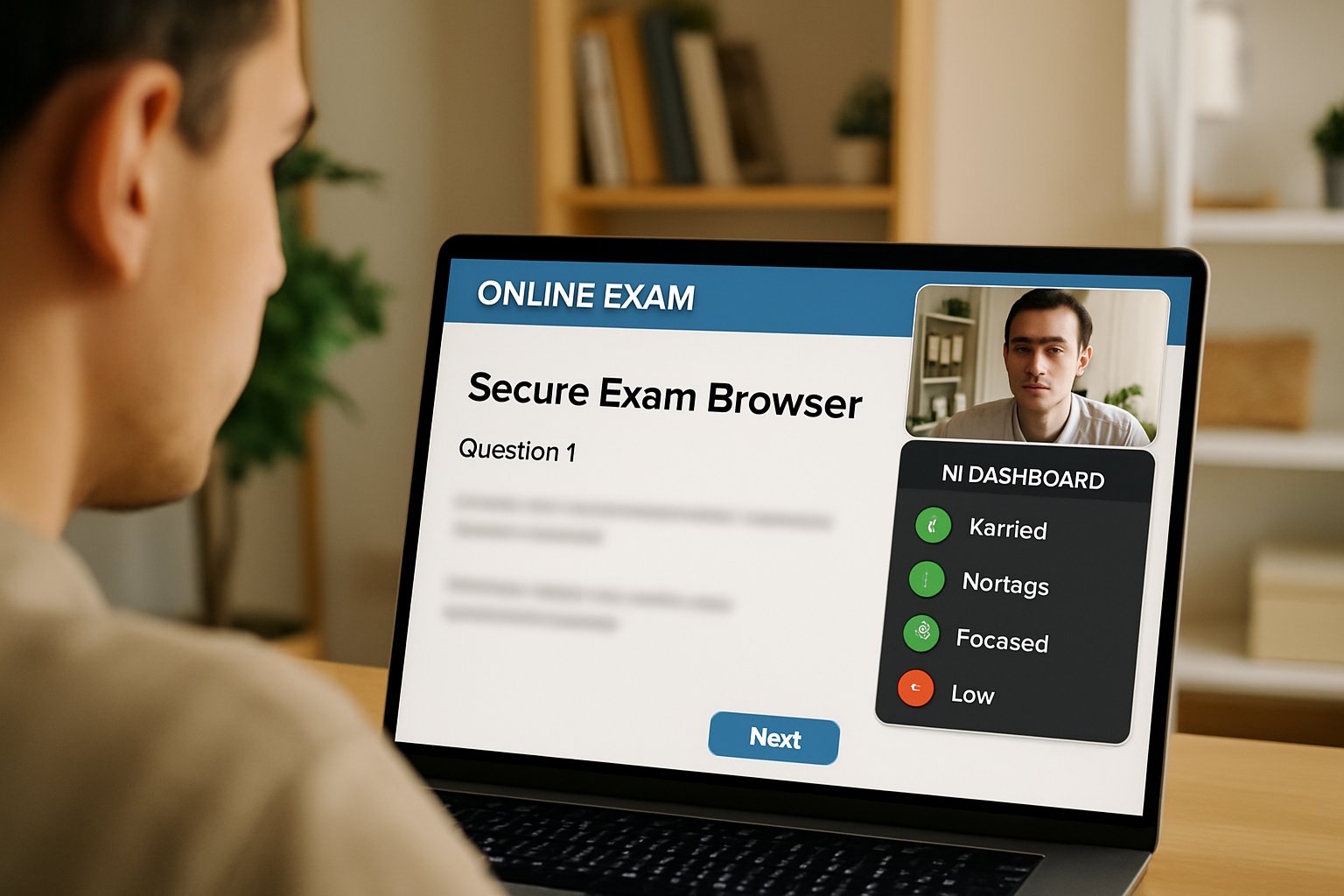
Hybrid Proctoring Model Defined
Hybrid proctoring pairs algorithmic surveillance and real-time or post-exam human review. AI engines flag suspicious actions like gaze drift, second screens, or background voices. Meanwhile, trained proctors validate each alert, decide on interventions, and document rationale for appeals. Consequently, the workflow cuts staffing hours while preserving nuanced judgment. Institutions deploying proctoring software for online exam sessions often start with recorded review, then add live pop-in support.
Key takeaway: Hybrid proctoring merges scale and empathy.
Next, we examine the laws shaping that choice.
Current Regulatory Landscape Trends
Regulators increasingly demand human oversight within any ai proctor exam workflow. For instance, Spain’s AEPD fined a university for mandatory facial recognition without alternatives. Similarly, Ofqual warns that algorithms alone cannot invigilate high-stakes qualifications. Meanwhile, the U.S. DOE toolkit flags proctoring as a high-risk civil-rights use case. Therefore, proctoring software for online exam programs must incorporate audits, transparent policies, and appeal mechanisms.
Regulators speak with one voice: keep humans involved and document impacts.
The next section explores why institutions agree.
Key Benefits At Scale
Hybrid models deliver three headline gains.
- Scalability: AI reviews thousands; humans review 3-5% flagged clips.
- Fairness: human context halves false positives reported by a 2022 study.
- Cost: Market reports show hybrid reduces proctor payroll by up to 60%.
Moreover, ai proctor exam analytics create searchable audit trails supporting accreditation and student appeals. Students also appreciate faster dispute resolution when people, not algorithms, make final decisions. Clearly, benefits extend beyond budgets.
Benefits compound when policy, process, and technology align.
Yet, every advantage carries linked risks, discussed next.
Operational Risks And Mitigations
Privacy remains the loudest concern. Spain’s sanction proves biometric misuse can trigger million-euro fines. Additionally, a Frontiers study noted higher error rates for darker skin tones. To counter, institutions embed bias audits and diverse test datasets in each ai proctor exam rollout. Moreover, contracts must cap data retention and guarantee breach notifications within 72 hours. Finally, avoid sole automated decisions when using proctoring software for online exam sanctioning.
Mitigation demands governance plus technical safeguards.
With risks addressed, leaders can focus on execution specifics.
Implementation Best Practice Checklist
Successful deployments follow a disciplined sequence.
- Map exam stakes and choose modality accordingly.
- Run DPIA and AIA before vendor selection.
- Demand model cards and subgroup accuracy metrics.
- Pilot with diverse participants and unstable bandwidth.
- Train proctors in bias, accessibility, and de-escalation.
- Publish appeal timelines and decision logs.
Furthermore, integrate ai proctor exam metrics into annual quality reviews. Institutions using proctoring software for online exam scenarios should schedule quarterly fairness audits.
Process discipline turns policy into everyday practice.
Now, let’s examine market momentum supporting investment.
Market Outlook And Metrics
Analysts predict double-digit growth through 2030. Reports place the 2024 market between USD 780M and 2.1B. Consequently, vendors consolidate; Meazure acquired Scantron’s licensure business, expanding hybrid capacity. Universities choose proctoring software for online exam scale because staffing budgets remain flat. Therefore, solutions matching AI efficiency with human oversight attract procurement teams worldwide.
Market signals affirm hybrid’s staying power.
We conclude with actionable steps and a trusted partner.
Conclusion
Hybrid proctoring succeeds because it balances scale, fairness, and compliance. Institutions that audit bias, train reviewers, and publish metrics build community trust. Regulators will keep pressuring programs to maintain human control over algorithms. Therefore, leaders should embed the best practices outlined here.
Proctor365 delivers proctoring software for online exam needs with AI-powered monitoring, advanced identity checks, and on-demand human reviewers. Our scalable platform supports universities, certifiers, and corporate teams in 70+ countries. Trusted exam bodies value our transparent reports and rapid appeal workflows. Visit Proctor365 now to protect integrity, cut costs, and give every candidate a fair test.
Frequently Asked Questions
- What is hybrid proctoring and how does it work in online exams?
Hybrid proctoring combines AI-powered monitoring with real-time human oversight to review flagged behaviors, ensuring exam integrity through scalability, fairness, and compliance with transparent and reliable technologies. - How does proctoring software like Proctor365 help prevent fraud and ensure exam fairness?
Proctor365 integrates advanced AI proctoring with on-demand human review, reducing false positives and maintaining strict identity verification and fraud prevention while upholding equitable exam conditions. - What are the key benefits of using a hybrid proctoring model for online exams?
The hybrid model offers scalability by leveraging AI to monitor large groups while human proctors verify alerts, resulting in cost-effective solutions that enhance fairness and secure exam environments. - How does Proctor365 address privacy and bias risks in online proctoring?
Proctor365 mitigates risks through bias audits, diverse data sets, and strict data retention policies, ensuring robust privacy protection and fairness by combining AI surveillance with meticulous human oversight.