Online testing is booming, yet privacy rules tighten daily. Institutions now ask a tough question: can a GDPR and FERPA compliant lockdown browser truly exist? Students demand fairness, regulators demand safeguards, and cheating still threatens outcomes. Consequently, universities, ed-tech firms, and certification bodies must balance integrity, usability, and strict law.
However, the answer is nuanced, not binary. Recent rulings from the Spanish AEPD and reminders from the U.S. Department of Education show that webcam monitoring and biometric scanning raise heavy risks. Meanwhile, vendors respond with EU hosting, stronger contracts, and less intrusive features.
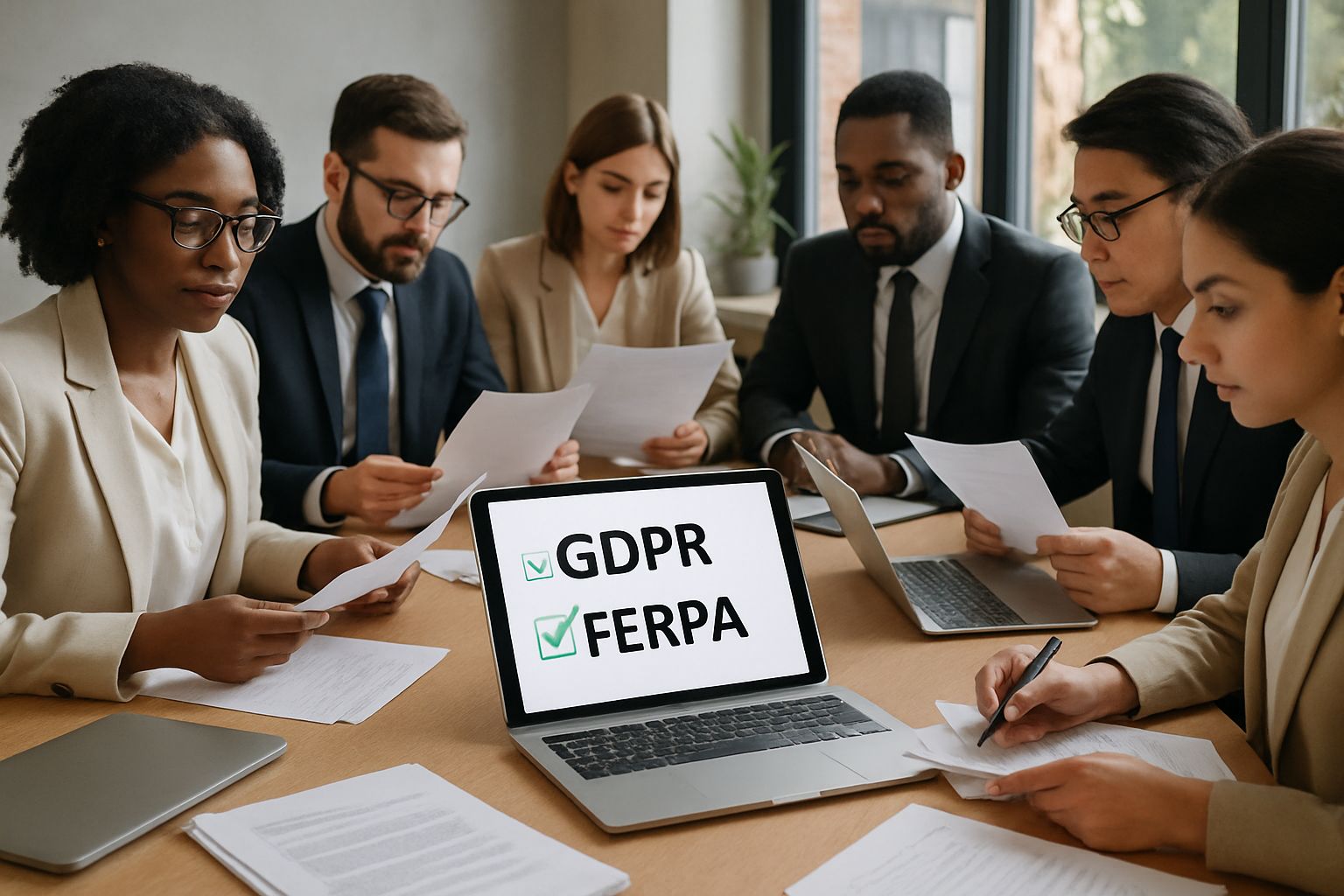
This guide unpacks the practical steps, from legal foundations to technical design, that transform any lockdown setup into a defensible privacy posture. We ground each recommendation in real enforcement examples and contract language. By the end, you will know exactly which questions to ask, which clauses to negotiate, and how to prove compliance in audits.
GDPR and FERPA compliant lockdown-browser
At first glance, a lockdown browser seems simple. It blocks tabs, disables copy-paste, and locks screen sharing. Yet, beneath that surface sits a complex data pipeline filled with live video, keystrokes, and system calls. Each item may link to an identifiable student, so both GDPR and FERPA apply immediately.
Therefore, calling a tool a GDPR and FERPA compliant lockdown browser requires more than marketing words. It demands evidence of data minimization, lawful basis, and airtight contracts that place the institution firmly in control.
Moreover, compliance is never static. Regulators continue to challenge continuous facial recognition, long retention periods, and overseas transfers lacking safeguards. Institutions must, consequently, adopt adaptive governance frameworks that evolve with rulings.
In short, compliance depends on technology, contracts, and governance working together. Next, we examine the laws driving those requirements.
Key Legal Pillars Explained
GDPR treats biometric data as a special category. Consequently, any face-matching module triggers a Data Protection Impact Assessment and strict safeguards. Consent alone rarely suffices because students usually lack real choice.
Hence, many universities now favor GDPR compliant exam software that avoids continuous biometrics and keeps retention short. The lawful basis usually shifts to legitimate interest supported by strong proportionality analysis.
In contrast, FERPA focuses on educational records. The law allows disclosure to vendors acting as “school officials” only when written agreements restrict use. Therefore, institutions must set access controls and deletion schedules in every agreement with FERPA compliant proctoring software.
Both regimes share core principles: transparency, data minimization, and enforceable student rights. However, the enforcement paths differ. GDPR fines vendors and controllers, while FERPA threatens federal funding.
The legal pillars create non-negotiable boundaries for design and contracts. With those boundaries set, we move to technical architecture.
Essential Technical Design Choices
First, institutions aiming for a GDPR and FERPA compliant lockdown browser must decide whether the exam needs live video at all. Many high-stakes tests succeed with a lockdown browser alone, coupled with randomized questions. Removing webcams slashes privacy risk and simplifies lockdown browser privacy compliance.
If webcams remain necessary, limit capture strictly to the exam window. Moreover, stream footage to encrypted exam data storage within the same region. This approach meets both GDPR transfer rules and institutional security policies.
Next, disable continuous facial recognition unless national law expressly authorizes it. Instead, one-time photo ID checks reduce biometric scope while still deterring impersonation.
Furthermore, use AI scene analysis only for obvious anomalies. Excessive AI flagging creates unnecessary records and undermines webcam monitoring privacy compliance objectives.
Every feature should face a data minimization online exams test: is each collected element essential, proportionate, and time-bound?
Vendors marketing GDPR compliant exam software often offer modular toggles. Institutions should activate only the modules supporting their risk assessment.
Thoughtful design choices slash risk before lawyers even draft clauses. Consequently, attention now shifts to those clauses.
Critical Contractual Safeguards Requirements
Contracts make or break compliance. Start with a robust Data Processing Agreement that clearly names the institution as Controller and the vendor as Processor. The DPA must list all subprocessors, retention periods, and breach notification timelines.
Additionally, specify that exam recordings remain encrypted exam data storage managed by the institution. Vendors may retain only minimal logs for troubleshooting and must delete them after defined days.
Include appendices covering FERPA clauses. They should mirror Department of Education guidance, restricting vendor use to exam delivery and review only. Such wording turns ordinary software into FERPA compliant proctoring software.
Only then can the institution confidently market the service as a GDPR and FERPA compliant lockdown browser to stakeholders.
For cross-border transfers, vendors should certify under the EU-U.S. Data Privacy Framework or offer EU-only data residency. Both routes strengthen lockdown browser privacy compliance positions during audits.
A tight contract channels technology into lawful boundaries. Next, we spotlight common missteps that still derail projects.
Common High-Risk Red Flags
Continuous facial recognition without alternatives tops the regulator watchlist. The Spanish AEPD has already issued fines for this practice.
Long retention of raw video is another warning sign. Consequently, always align retention with academic appeal periods, not semesters.
Third, vague language allowing vendors to train AI on student videos undermines data protection for online exams. Delete such clauses immediately.
Fourth, unsecured backups spoil encrypted exam data storage guarantees. Ensure encryption at rest and in transit across primary and backup services.
Fifth, missing opt-out provisions breach both GDPR and FERPA, especially for students with disabilities.
Spotting red flags early prevents expensive retrofits. With pitfalls clear, institutions can apply a structured checklist.
Practical Compliance Evaluation Checklist
The following quick-fire list helps teams validate any claimed GDPR and FERPA compliant lockdown browser within one meeting.
- Confirm a documented DPIA covers data minimization online exams criteria.
- Review the DPA for explicit FERPA language and vendor Processor status.
- Verify encrypted exam data storage with regionally bound servers.
- Check webcam monitoring privacy compliance by sampling access logs.
- Ensure students receive plain-language notices and non-biometric alternatives.
Moreover, benchmark the solution against peer institutions using GDPR compliant exam software. Shared metrics accelerate negotiation.
Each checklist item supports data protection for online exams demanded by auditors.
Completing this checklist arms decision makers with evidence for both auditors and anxious students. Finally, we consider market dynamics.
Market Pressure And Trends
The global online proctoring market nears USD 2 billion and continues growing. However, regulatory pressure forces vendors to adapt quickly.
Respondus, Proctorio, and others now pitch EU hosting and data minimization online exams features to win European deals.
Meanwhile, student surveys reveal anxiety regarding webcam monitoring privacy compliance. Institutions offering alternative assessment formats report higher satisfaction scores.
Consequently, buyers now favor any GDPR and FERPA compliant lockdown browser that demonstrates third-party audits and transparent pricing.
North American campuses increasingly shortlist FERPA compliant proctoring software with SOC-2 attestations.
Market forces and regulation now push in the same direction: less intrusive, contractually controlled proctoring. Therefore, choosing the right partner becomes strategic.
Conclusion
Achieving a GDPR and FERPA compliant lockdown browser is possible, yet it requires disciplined design, firm contracts, and constant review. Institutions must minimize data, encrypt every byte, and publish clear student notices. When those pillars align, online exams stay fair, secure, and defensible.
Why Proctor365? Our AI-powered platform delivers real-time anomaly detection, advanced identity verification, and scalable monitoring trusted by global exam bodies. Consequently, we provide the fastest route to a GDPR and FERPA compliant lockdown browser strategy without costly re-engineering. Protect your reputation and future-proof your assessments by visiting Proctor365 today.
Frequently Asked Questions
- How can institutions ensure a GDPR and FERPA compliant lockdown browser?
Institutions should enforce data minimization, secure encryption, and robust DPAs. Proctor365 offers AI proctoring and adaptive monitoring, aligning with GDPR and FERPA requirements for exam integrity and privacy. - What key technical design choices support compliant online exams?
Essential choices include opting for minimal webcam use, one-time ID checks, and encrypted data storage. Proctor365 implements AI scene analysis and secure monitoring to meet data protection and compliance needs. - How does Proctor365 enhance exam integrity while protecting privacy?
Proctor365 uses advanced AI proctoring and identity verification, ensuring real-time anomaly detection and strict data security. This aligns with GDPR and FERPA standards, safeguarding exam integrity and student privacy. - What contractual safeguards are critical for reliable proctoring solutions?
Key safeguards include a detailed Data Processing Agreement, explicit FERPA clauses, and defined retention schedules. Proctor365’s contracts enforce strict controls and transparency to protect institutions during audits and assessments.