Credential trust drives hiring, compliance, and upskilling in modern enterprises. However, deepfake risks and AI cheating threaten that trust at unprecedented scale.
A robust certification maker must therefore orchestrate proctoring, standards, and governance to preserve authenticity. Furthermore, identity verification and secure online assessments now sit at the core of credible credential programs.
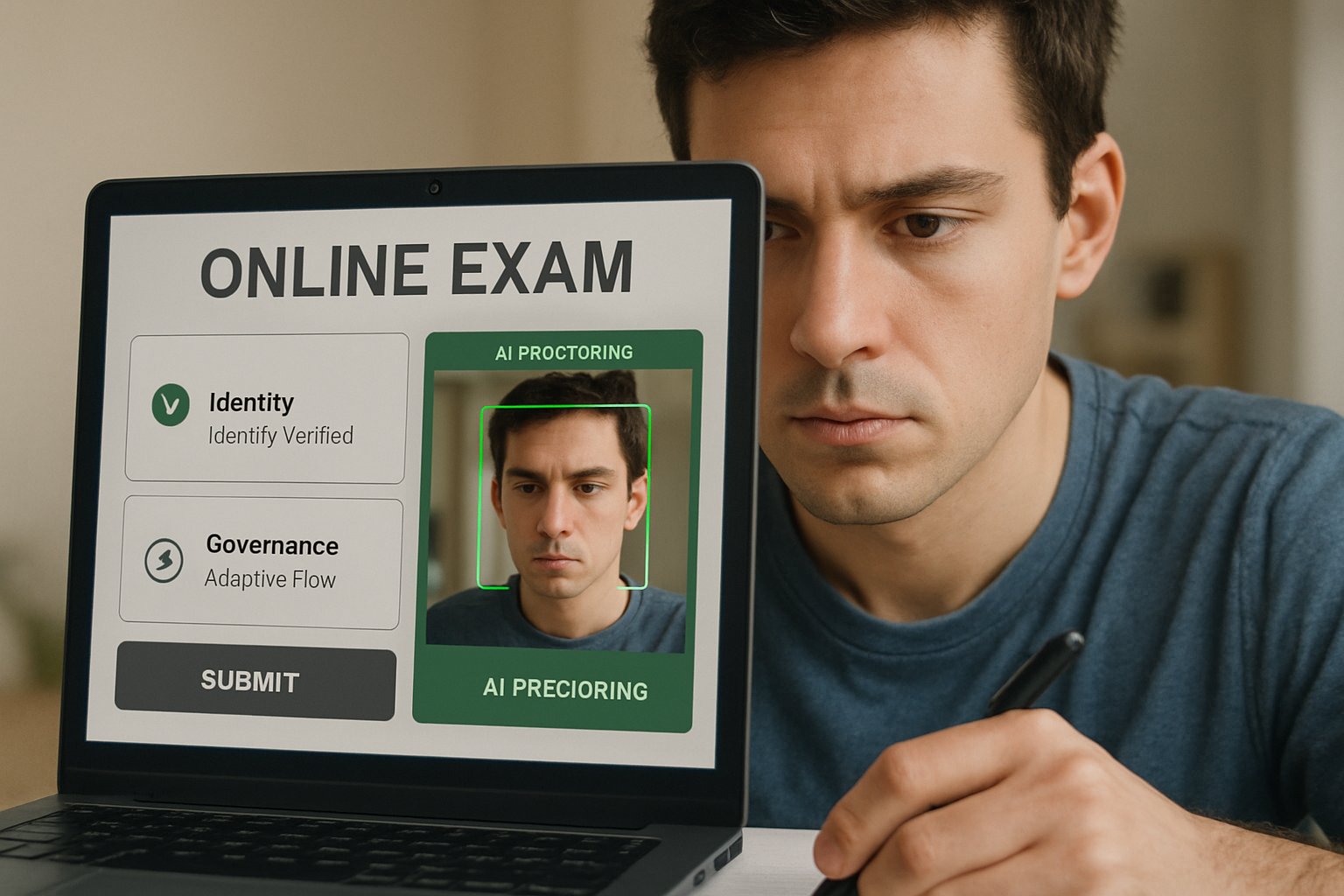
This article guides leaders through AI proctoring, verifiable credentials, and AdaptOps governance for resilient certification strategies. Consequently, you will learn proven steps to align people, processes, and platforms for scalable credential success. Moreover, key market data reveals double-digit growth in remote proctoring as enterprises shift learning online. Nevertheless, privacy concerns and fairness expectations demand careful design, transparent policies, and measurable outcomes. Adoptify.ai’s AdaptOps framework offers an end-to-end playbook for governing each lifecycle phase. Subsequently, this discussion will highlight how AdaptOps supports issuance, revocation, and ROI dashboards.
Major Credential Integrity Drivers
Market analysts project remote proctoring to exceed USD 2.3 billion by 2031, reflecting urgent integrity needs. In contrast, generative AI accelerates impersonation threats that can invalidate entire certification inventories overnight. Therefore, boards demand stronger controls that assure employers every digital certificate belongs to a verified skill holder.
Identity verification, AI proctoring, and cryptographic wallets have emerged as the preferred control triad. Meanwhile, online assessments expand talent reach yet amplify substitution risk if controls lag. Recent literature surveys record a surge in research on detection limits, bias, and psychometric implications. Furthermore, universities pilot lighter surveillance models, pairing oral checks with browser lockdowns to protect exam value.
These drivers confirm that integrity is non-negotiable for any certification maker scaling programs globally. Consequently, leaders must pair market insight with disciplined operational governance, which the next section explores.
AI Proctoring Core Essentials
AI proctoring solutions monitor behavior, device activity, and environmental cues during high-stakes exams. Moreover, modern engines flag suspicious events in real time, reducing human review burden. Nevertheless, false positives can erode trust if reviewers blindly accept algorithmic output.
Hybrid models combine AI detection with trained human auditors who examine flagged footage and context. A mature certification maker embeds this hybrid workflow into documented policy and transparent appeal processes. Additionally, accessibility accommodations must bypass invasive requirements without lowering integrity thresholds.
Extensive datasets train anomaly detectors, yet adversaries continually invent spoofing tactics that evade gaze tracking. Consequently, vendors invest in multimodal signals such as keystroke cadence, background noise, and network fingerprints. Nevertheless, ethical review boards caution that overcollection can violate proportionality and participant consent principles. In contrast, policy tuned to risk level enables lighter supervision for low-stakes quizzes, reserving full monitoring for licensure.
Effective proctoring balances automation speed with human judgment to sustain fairness. Therefore, organizations need structured governance, which AdaptOps conveniently supplies.
Governance With AdaptOps Alignment
AdaptOps provides templates that codify policies covering data retention, privacy notices, and subgroup fairness testing. Consequently, program owners gain a repeatable cadence for pilots, scale decisions, and continuous improvement reviews. The framework integrates identity verification vendors, proctoring tools, and credential issuers under one governance umbrella.
Moreover, ROI dashboards track false positive rates, appeal outcomes, and certification usage across business units. AdaptOps playbooks include stakeholder maps that clarify who approves exceptions and who owns audit evidence. Meanwhile, weekly stand-ups review metrics, ensuring rapid feedback loops between technologists, instructors, and legal counsel. Moreover, learner representatives contribute to fairness boards, creating shared ownership of integrity outcomes.
Subsequently, the certification maker receives actionable data to adjust proctoring thresholds and training content swiftly. AdaptOps converts governance from reactive compliance to proactive optimization. In contrast, ad-hoc programs struggle to learn quickly, leading to escalating integrity gaps.
Standards For Tamper Proofing
Cryptographic standards remove guesswork from credential authenticity. W3C Verifiable Credentials v2.0 enables selective disclosure and machine verification across ecosystems. Additionally, wallets such as Google Wallet and Microsoft Entra Verified ID support these specifications natively.
Enterprises issuing certificates after online assessments can now attach signed proofs that employers verify instantly. Moreover, revocation lists and audit logs prevent expired or withdrawn certificates from lingering in circulation. Digital wallets also support granular consent, allowing holders to reveal only necessary claims to recruiters. Therefore, graduates preserve privacy while still proving achievement to multiple employers within minutes. Subsequently, hiring platforms can call verification APIs instead of storing fragile PDF attachments.
A forward-looking certification maker must embed these standards at issuance, not as a retrofitted plugin. Standards therefore future-proof credentials and reduce manual verification costs. Consequently, attention shifts toward measurement, discussed next.
Metrics That Matter Most
Executives approve budgets when metrics align with business outcomes. Typical dashboards track detection coverage, review time, false positive rate, and verified credential issuance speed.
Decision makers should baseline current performance before deploying new tooling, otherwise improvements remain anecdotal. Consequently, many programs run A/B pilots, comparing separate cohorts under different monitoring levels. Results often show diminishing returns once detection coverage surpasses an optimal threshold, highlighting the value of data-driven tuning. Additionally, cost models should account for reviewer labor, appeals management, and infrastructure overhead.
- False positive flags under 2% across demographic subgroups.
- Average identity verification time below 90 seconds per candidate.
- Credential issuance latency under five minutes post-exam completion.
- Appeal resolution closed within two business days on average.
Moreover, certified professionals can advance their marketing prowess through the AI Marketing™ certification, which showcases applied analytics skills. The certification maker gains reputational lift when such role-based offerings deliver measurable business impact.
Meaningful metrics motivate continuous refinement of policies and tools. Therefore, implementation strategy becomes the final leverage point.
Critical Implementation Best Practices
Implementation begins with a readiness assessment that maps risks, controls, and stakeholder appetite. Next, choose identity verification vendors that support decentralized identifiers and privacy-preserving attestations. Then, redesign online assessments to reduce substitution while maintaining accessibility for remote learners.
Pilot the combined flow with a small cohort, capturing fairness metrics and candidate feedback. Subsequently, the certification maker iterates thresholds, question pools, and accommodation pathways before enterprise rollout. Moreover, publish transparent policy summaries so candidates understand how monitoring data informs decisions.
Successful pilots document lesson-learned logs and corrective actions for future cohorts. Consequently, these logs feed into knowledge bases that reduce onboarding time for new proctors. Advanced programs integrate dashboards with collaboration tools, sending real-time alerts to responsible owners. Meanwhile, communication templates accelerate candidate outreach when issues arise, promoting transparency.
Following these practices reduces legal exposure and fosters learner trust. Consequently, your program positions itself for long-term relevance.
Future Ready Credential Programs
Emerging regulations will likely restrict invasive proctoring while mandating bias audits. Nevertheless, organizations prepared with AdaptOps governance can adjust settings quickly and document compliance evidence. A flexible certification maker integrating wallets, analytics, and policy engines will outpace slower competitors.
Meanwhile, immersive simulations will supplement online assessments, demanding richer integrity checks beyond webcams. Enhanced identity checks through voice biometrics and liveness proof will support these immersive scenarios. Open standards continue evolving, with draft extensions adding revocation status lists and trust registries. Moreover, cloud platforms are releasing low-code connectors that simplify wallet issuance for corporate learning teams. Consequently, early adopters enjoy strategic advantage as the ecosystem matures.
These trends reward programs that treat authenticity as a continuous product feature. Therefore, strategic leaders must act now, not later.
AI proctoring, verifiable credentials, and AdaptOps governance together protect modern credentials against evolving threats. Consequently, a disciplined certification maker can guarantee authenticity at scale while respecting privacy and fairness. Moreover, precise identity verification and thoughtful assessment design elevate learner experience and employer confidence. Meanwhile, continuous metrics guide iterative improvement and demonstrate tangible ROI to stakeholders. Consequently, early preparation positions your program to pivot as regulations and market expectations shift. Moreover, transparent reporting fosters stakeholder trust, ensuring continued investment in capability upgrades. Therefore, partner with a forward-thinking certification maker and augment your team’s skills immediately. Start by reviewing AdaptOps resources or earning the linked AI Marketing™ certification today. Your credential program’s future credibility depends on choices made now.
Frequently Asked Questions
- What impact do AI cheating and deepfakes have on credential trust?
AI cheating and deepfakes threaten the legitimacy of certifications by enabling impersonation, which forces certification makers to implement stricter identity verification and advanced proctoring methods to safeguard authenticity. - How does AI proctoring enhance exam integrity?
AI proctoring uses real-time monitoring of behavior, devices, and environmental cues to flag suspicious events. This hybrid approach combines algorithmic detection with human review, ensuring timely and fair evaluation. - What role does AdaptOps governance play in maintaining credential integrity?
AdaptOps offers standardized templates and dashboards to manage policies, monitor metrics, and facilitate stakeholder collaboration, enabling certification makers to continuously optimize proctoring, identity verification, and overall governance. - How do cryptographic standards help create tamper-proof credentials?
Cryptographic standards such as W3C Verifiable Credentials enable selective disclosure and instant machine verification, ensuring that digital certificates are securely issued, verifiable, and resistant to fraudulent alterations. - What key metrics should be monitored for effective proctoring?
Important metrics include false positive rates, average identity verification times, credential issuance speed, and timely appeal resolutions, all of which help in optimizing processes and ensuring reliable exam assessment. - How can certification makers balance integrity with candidate privacy?
They can achieve balance by using privacy-preserving identity verification, transparent policy summaries, and controlled data collection practices, ensuring robust security measures without compromising candidate confidentiality.