Remote test proctoring has moved from niche pilot to enterprise backbone for digital assessment. Universities now run millions of high-stakes exams without physical halls. However, escalating privacy debates and vendor consolidation demand careful strategy.
Stakeholders seek platforms that balance scale, trust, and student experience. Consequently, virtual exam supervision and online proctoring software promise 24/7 flexibility and data-rich audit trails. Yet the market’s rapid shift leaves leaders sifting through competing remote proctoring software for universities with limited guidance. This article unpacks trends, technology, risks, and procurement playbooks to help institutions deploy remote test proctoring responsibly.
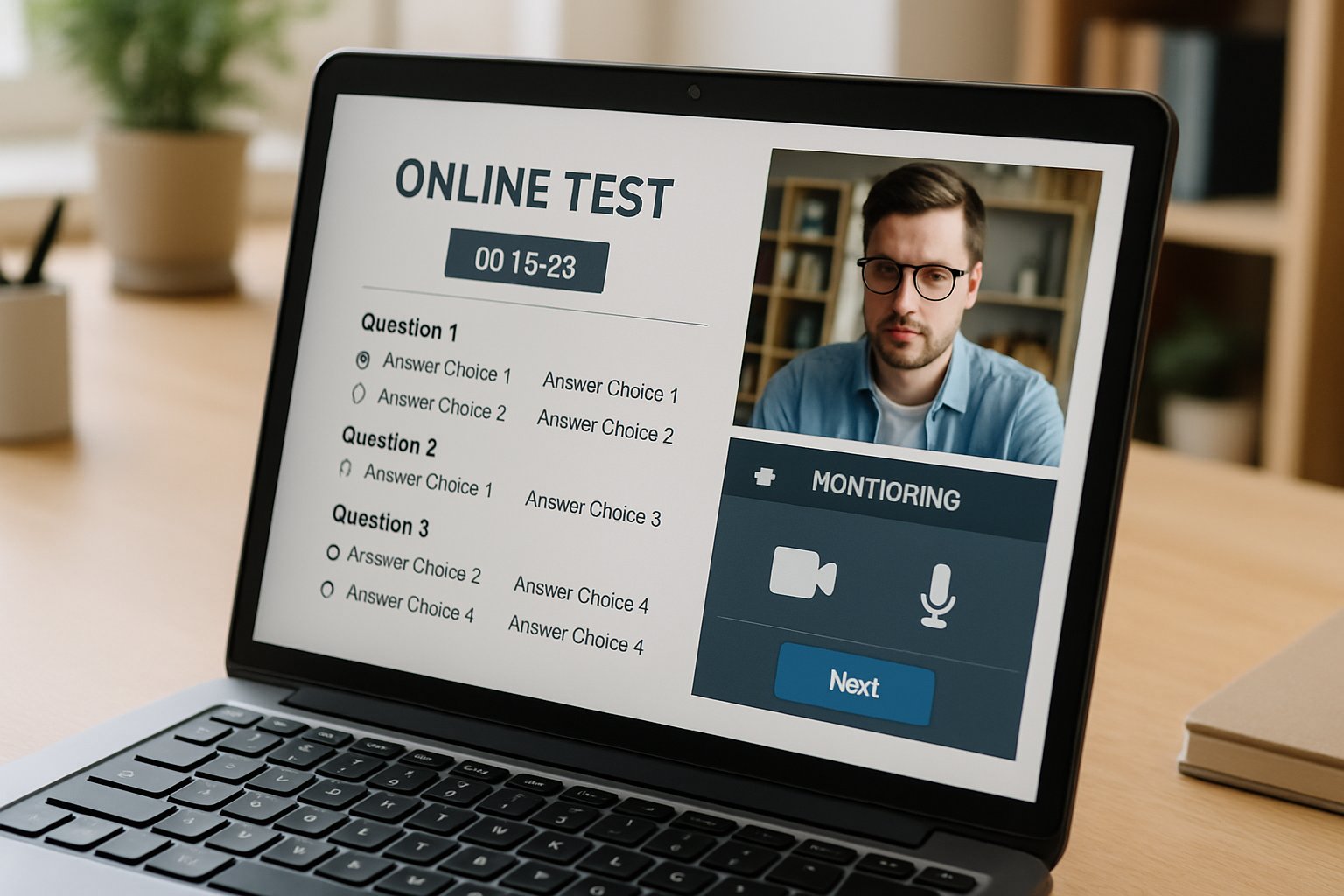
Market analysts project double-digit growth beyond 2030, with estimates reaching USD 2.38 billion next year. Moreover, 63 percent of North American campuses already mention proctoring tools on their websites. Therefore, decision-makers must separate marketing hype from proven, student-centered design.
Remote Test Proctoring Trends
The market continues double-digit expansion, driven by hybrid learning and credential demand. MarketResearchFuture pegs 2024 revenue at USD 2.10 billion, rising to USD 2.38 billion in 2025. Meanwhile, vendor consolidation accelerates as Meazure Learning absorbs Examity and migrates customers onto ProctorU. Large public universities, including Ohio State and UC Davis, have switched suppliers after rigorous RFPs.
Procurement cooperatives, like California’s STAC, now streamline online proctoring tools for universities across hundreds of campuses. However, privacy legislation such as California SB-1172 forces platforms to publish transparent data-governance clauses. Institutions increasingly demand human-in-the-loop review to curb false flags and protect equity. Consequently, remote test proctoring vendors tout both AI speed and live auditor backup.
Adoption grows, yet oversight strengthens. Hybrid AI-human models now dominate enterprise deals. Next, we explore the core technology powering this growth.
Core Technology Stack Overview
Modern platforms blend camera, audio, and screen telemetry with machine learning heuristics. Additionally, identity validation combines document capture and facial matching within seconds. Browser lockdown for exams prevents tab switching, virtual machines, and copy-paste exploits. Online exam proctoring tools integrate deeply with LMS systems using secure LTI connectors.
- Live streaming with trained human proctors
- Automated flagging of anomalies for later review
- Recorded sessions stored under SOC-certified encryption
- Multi-camera support for larger workspaces
Colleges prefer online proctoring software that delivers in-dashboard analytics for instructors. Moreover, cheating prevention software now includes keystroke dynamics and background process detection. Proctoring software for higher education must also surface accommodation overrides inside accessibility workflows. Leading remote test proctoring suites now offer API triggers for adaptive assessments.
Technology blends automation with secure integrations. Lockdowns, analytics, and identity proof anchor integrity. Understanding features matters, yet outcomes matter more; benefits appear next.
Key Institutional Benefit Highlights
Institutions first cite scalability. One Respondus claim mentions tens of millions of annual exams, impossible in physical centers. Similarly, remote proctoring software for universities allows asynchronous scheduling, aiding part-time learners. Furthermore, virtual exam supervision produces searchable video evidence to support integrity hearings.
Faculty value analytics dashboards showing flag density by question. Additionally, online proctoring tools for universities often bundle 24/7 chat support, easing help-desk loads. Students appreciate flexible locations when online exam proctoring tools reduce travel costs. Consequently, proctoring software for higher education can boost retention in distance programs.
Benefits revolve around reach and flexibility. Evidence trails also streamline honor processes. Yet every upside has a counterpart, as the next section explains.
Persistent Risks And Criticisms
Privacy advocates warn about biometric overreach and indefinite data retention. EPIC complaints highlight opaque algorithms inside cheating prevention software. Moreover, facial recognition misfires can disproportionately flag students of color. False positives escalate stress, with studies showing mixed score impacts.
Technical failures during high-stakes exams can erode trust within minutes. Additionally, browser lockdown for exams sometimes conflicts with assistive technologies, harming accessibility. Market consolidation also heightens vendor-lock risks when migration plans falter. Therefore, remote test proctoring must stay transparent, auditable, and inclusive.
Risks span privacy, bias, and reliability. Stakeholders need safeguards before large-scale deployments. The following playbook outlines practical safeguards for enterprise buyers.
Enterprise Procurement Playbook Steps
Successful RFPs include students, faculty, legal, and disability services from inception. Ohio State’s process demonstrates cross-functional pilots before contract signatures. Moreover, institutions request service-level agreements covering uptime, support, and false-flag rates. Data governance clauses should cap retention and forbid sale of recordings.
- Audit AI logic and bias testing reports
- Verify SOC or ISO security certificates
- Review accommodation workflows with DSS leaders
- Mandate accessible browser lockdown for exams
- Run controlled load tests with virtual exam supervision in live courses
Online proctoring software vendors cooperating on these points usually win long contracts. Consequently, remote proctoring software for universities gains campus-wide adoption with fewer escalations.
A structured playbook mitigates most operational shocks. Transparent contracts protect both students and institutions. With safeguards in place, leaders can look toward future developments.
Forward Looking Outlook Notes
Expect AI to detect contextual anomalies, not just rule violations. Additionally, privacy dashboards will grant students visibility and control over recordings. Open-standard APIs may let online exam proctoring tools interoperate across LMS and assessment apps. Meanwhile, competition persists despite consolidation, as startups refine niche cheating prevention software.
Market forecasts predict sustained growth driven by global certification uptake. Consequently, proctoring software for higher education must maintain agile roadmaps and community partnerships.
Innovation will prioritize privacy and fairness. Regulatory alignment will shape platform success. The conclusion summarizes why strategic choices now matter.
Conclusion
Remote test proctoring now sits at the intersection of scale, privacy, and pedagogical change. Institutions that align technology, policy, and student support secure flexible assessment without sacrificing trust. Clear procurement steps ensure benefits outweigh risks.
Why Proctor365? Our AI-powered remote test proctoring platform pairs advanced identity verification with scalable, human-reviewed monitoring. Trusted by global exam bodies, Proctor365 delivers secure browser lockdown for exams and real-time analytics. Consequently, institutions deploy online proctoring tools for universities faster and cut investigation time. Explore how Proctor365 boosts exam integrity today at Proctor365.ai.
Frequently Asked Questions
- What are the key benefits of remote test proctoring for universities?
Remote test proctoring enables institutions to scale assessments, offer flexible scheduling, and generate data-rich audit trails. Proctor365 leverages AI proctoring and fraud prevention to enhance exam integrity and security. - How does hybrid AI-human monitoring improve exam integrity?
Hybrid AI-human monitoring blends rapid automated anomaly detection with live proctor support to resolve false flags. Proctor365 integrates machine learning with human review, ensuring reliable oversight and secure exam environments. - What role does identity verification play in securing online exams?
Identity verification is critical for preventing fraud and ensuring genuine test-taker participation. Proctor365 employs document capture, facial matching, and secure browser lockdown to strengthen exam security. - What should institutions consider during the procurement of remote proctoring solutions?
Institutions should prioritize platforms that provide scalability, privacy compliance, and robust fraud prevention. Proctor365 meets these needs with AI-powered monitoring, human oversight, and secure integrations.