Institutions shifted assessment online faster than any earlier period.
Many teams now want durable, secure online test monitoring directly inside their campus LMS.
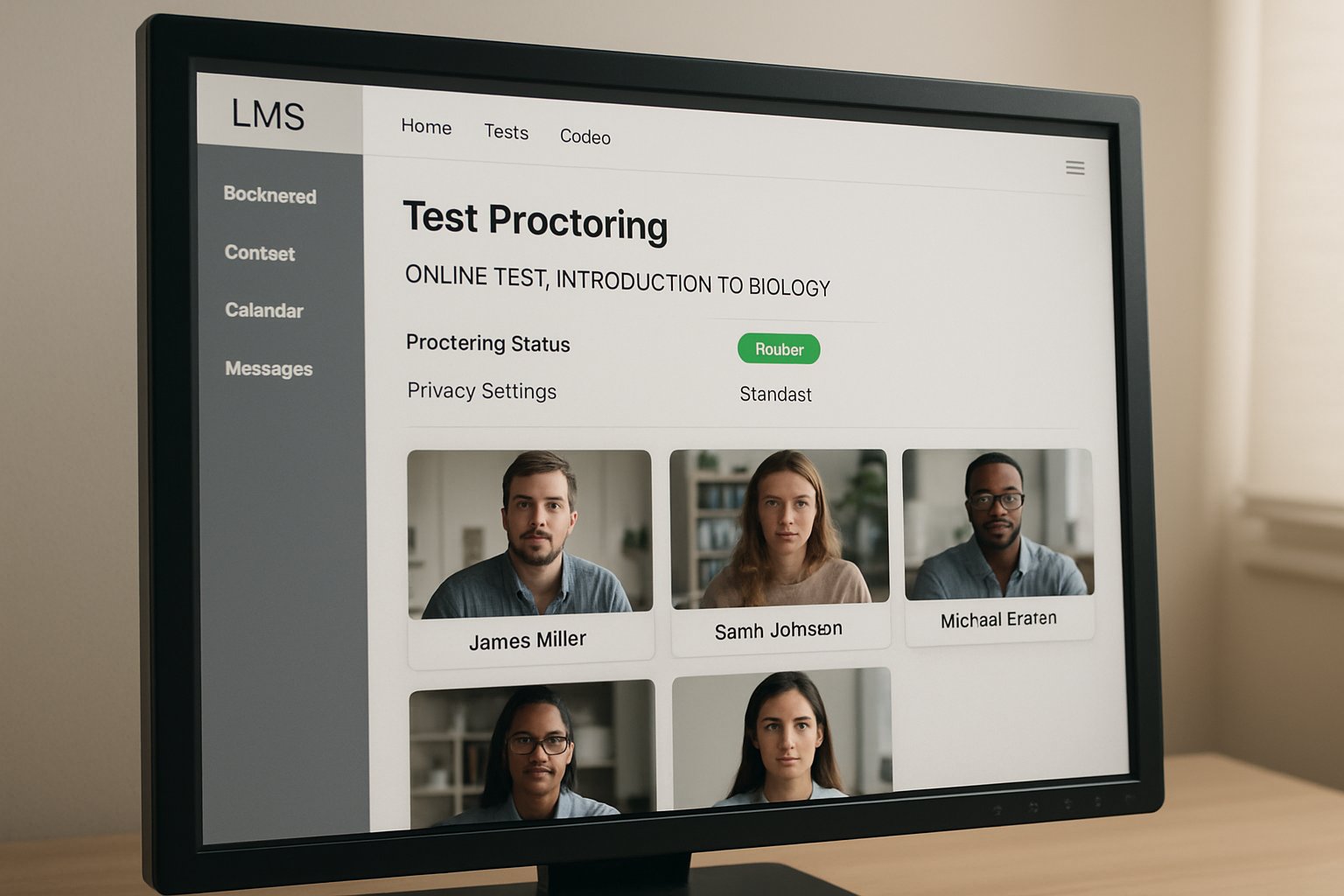
However, integration success depends on clear standards and disciplined rollout.
Consequently, this guide maps every critical decision, from technical specs to privacy rules.
Readers include universities, ed-tech leaders, and certification providers planning the next remotely proctored exam cycle.
Each paragraph will outline practical steps, supported by industry standards like LTI 1.3.
Moreover, we spotlight market trends, adoption data, and student sentiment to inform balanced decisions.
Finally, you will leave with a concise checklist ready for immediate pilot deployment.
Forecasts place the global proctoring market above USD two billion by 2024, with rapid growth ahead.
Yet, privacy litigation and accessibility gaps still shape procurement timelines.
Online Test Monitoring Benefits
Institutions adopt the practice to safeguard academic integrity at scale without overcrowded testing centers.
With LTI, launch and grade passback happen inside the familiar LMS flow, reducing user confusion.
- Scales to cohorts exceeding 10,000 candidates without extra rooms.
- Provides timestamped video, screen, and audio evidence for hearings.
- Supports hybrid models, blending campus labs and remotely proctored exam sessions.
- Delivers consistent online test monitoring across every course instance.
These benefits boost instructor confidence and streamline support.
Next, we explore the standards powering this experience.
Standards Enable Smooth Integration
The IMS/1EdTech Proctoring Services profile extends LTI 1.3 for exam control messages.
Therefore, modern LMSs such as Canvas, Blackboard, and Brightspace connect with certified proctoring vendors quickly.
A single sign-on launch passes identity and role data, ensuring accurate roster alignment.
This handshake triggers online test monitoring without extra passwords.
Additionally, Assignment and Grade Services return scores automatically, saving faculty countless clicks.
Standards remove brittle custom code.
The following section compares available paths.
Integration Paths Explained Clearly
Teams usually pick between LTI deployment or direct API stitching.
LTI remains fastest for any mainstream LMS because configuration needs no engineering sprints.
In contrast, custom REST webhooks fit proprietary training portals where LTI is unavailable.
However, custom work increases security review and ongoing maintenance costs.
Each approach still supports a securely remotely proctored exam when policies are aligned.
Choose LTI for speed and support.
This choice influences the checklist ahead.
Technical Checklist Summary Guide
Successful rollouts follow a disciplined seven-step playbook.
Firstly, verify vendor LTI and Proctoring spec certificates.
Secondly, register tool credentials, then deep link exams within course shells.
Thirdly, exercise sandbox tests that trigger start, flag, and finish events.
- Confirm data residency and encryption settings.
- Map accommodations to proctoring time multipliers.
- Establish 24/7 support escalation contacts.
- Document retention windows for recorded sessions.
Moreover, always pilot one remotely proctored exam before scaling campus-wide.
This pilot identifies network quirks and accessibility blockers early.
During the pilot, monitor logs to prove online test monitoring accuracy and responsiveness.
A checklist protects both candidates and staff.
Next, we tackle policy obligations.
Policy And Compliance Essentials
Legal exposure rises when biometric data crosses state or national borders.
Therefore, sign a detailed data processing addendum covering consent, retention, and deletion.
Illinois BIPA lawsuits against Respondus remind leaders to obtain explicit, written consent from affected students.
Meanwhile, accessibility offices expect WCAG-aligned workflows and clear accommodation toggles.
A privacy impact assessment should reference every online test monitoring feature captured in the platform.
Consequently, auditors gain line-of-sight into evidence chains during disputes.
Strong policy reduces headline risk.
The next section balances benefits and criticism.
Pros Risks Balanced View
Automated AI supervision scales far beyond human invigilators for large cohorts.
Moreover, detailed session logs deter casual cheating and support academic hearings.
Nevertheless, false positives and student stress can erode trust if reviews are slow.
Inside Higher Ed reported a sting where a service fooled AI checks during a remotely proctored exam.
Therefore, pair algorithms with transparent human review to keep credibility intact.
Balanced communication positions online test monitoring as a safeguard, not a surveillance scheme.
Every solution carries trade-offs.
Your governance model must address each one.
Finally, we close with actionable next steps.
Conclusion And Next Steps
Integrating standards-based online test monitoring into your LMS need not feel daunting. Follow the technical checklist, anchor policy in law, and communicate benefits clearly. Together, these steps build a trusted assessment environment.
Why Proctor365? Our AI-powered platform delivers live, automated, and record-review options, backed by advanced identity verification. We provide scalable exam monitoring that global universities and certification bodies already trust.
Consequently, support teams gain actionable dashboards while candidates face minimal friction. Moreover, integrations align with LTI 1.3 and the Proctoring Services profile out of the box. Choose confidence; choose Proctor365 today.
Visit Proctor365 to schedule a demo and enhance integrity before your next remotely proctored exam.
Frequently Asked Questions
- What are the benefits of integrating online test monitoring into a campus LMS?
Integrating online test monitoring reduces user confusion and scaling issues by capturing detailed video, screen, and audio evidence. This supports academic integrity and fraud prevention for secure, scalable exam processes. - How does LTI integration enhance exam proctoring?
LTI integration streamlines exam proctoring with single sign-on, automated grade passback, and accurate roster alignment. It enables seamless identity verification and supports well-known LMS platforms for a smooth exam launch. - How does Proctor365 ensure exam integrity with advanced AI proctoring?
Proctor365 utilizes AI proctoring and fraud prevention techniques to record detailed session logs, including video and audio. This real-time monitoring with robust identity verification safeguards exam integrity and minimizes cheating. - What technical steps are recommended for a secure online testing environment?
Follow a disciplined checklist that includes vendor certification, sandbox testing, data encryption, and comprehensive privacy policies. These steps ensure robust identity verification and seamless integration using LTI standards.